
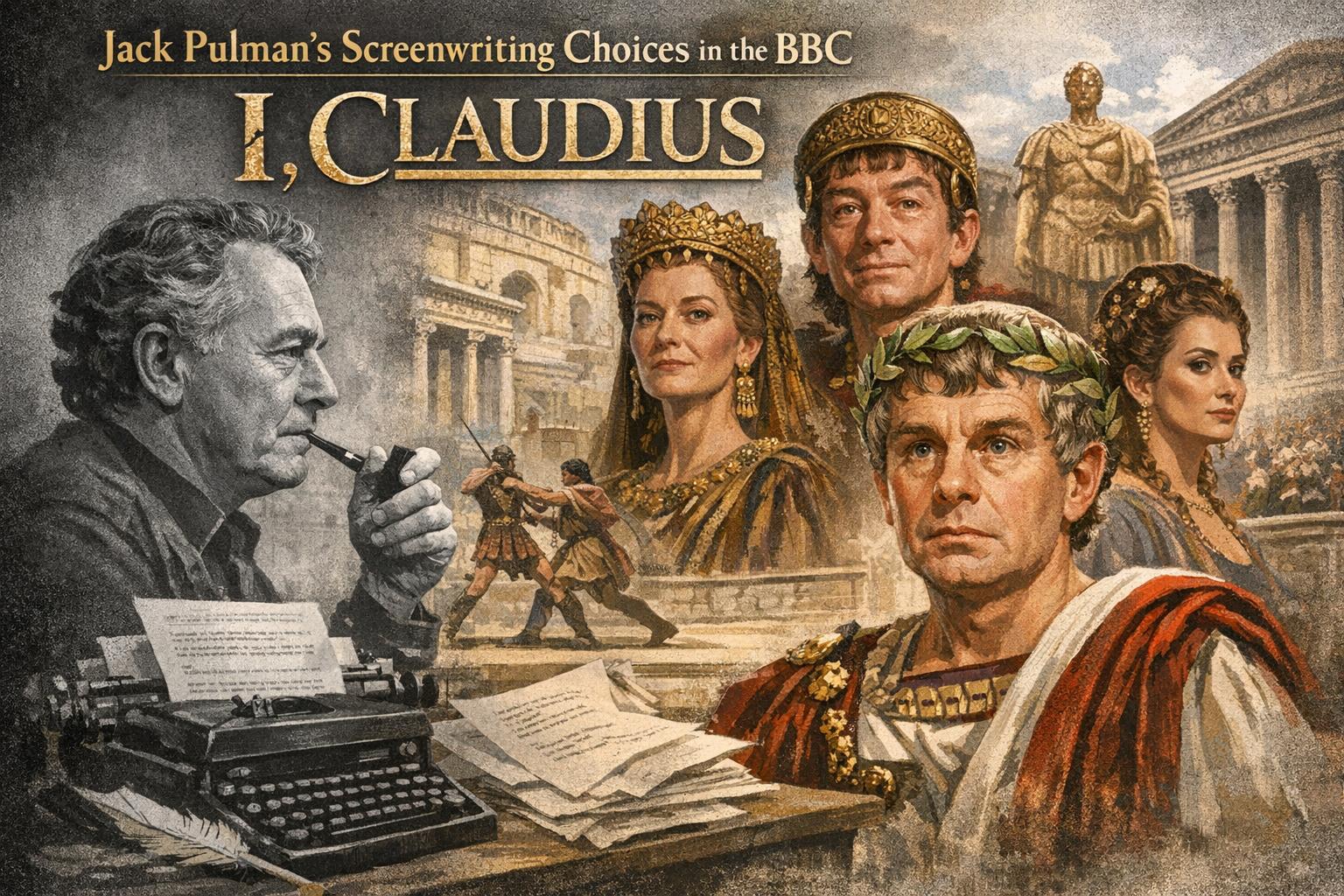
Introduction to Jack Pulman’s Adaptation of “I, Claudius”
In the mid-1970s, screenwriter Jack Pulman undertook the complex task of adapting Robert Graves’ historical novels I, Claudius and Claudius the God into a serialized television drama. The resulting production, first broadcast by the BBC in 1976, became widely regarded as one of the most accomplished literary adaptations produced for television. Pulman’s contribution was central to this achievement. His scripts translated a dense, layered narrative—rich with political maneuvering, dynastic conflict, and psychological nuance—into a format suited to episodic broadcast without sacrificing intellectual depth.
Graves’ novels are written as a fictional autobiography of the Roman emperor Claudius, presented as a secret history of the Julio-Claudian dynasty. The books combine documented historical events with imaginative reconstruction, satire, and introspection. Pulman had to determine how best to preserve the distinctive voice of the novels while shaping them into a visual drama driven by dialogue and performance. His solution was not literal transcription but reinterpretation. He restructured events, sharpened character arcs, and allowed performance and camera technique to shoulder part of the narrative weight originally carried by prose.
The adaptation appeared at a moment when British television drama emphasized performance and writing over spectacle. Budgetary limitations and studio-bound production conditions required creativity rather than scale. Pulman’s scripts demonstrate how narrative economy, disciplined structure, and sustained attention to character can transform historical material into compelling drama. The series stands as an example of how literary complexity can be rendered accessible through careful selection and thematic focus.
Condensing Complex Narratives
One of Pulman’s central challenges was the scope of Graves’ narrative. The novels span decades of imperial rule, beginning with the later years of Augustus and ending with Claudius’ own reign. They encompass numerous political conspiracies, familial betrayals, military campaigns, and changes in succession. Translating such breadth into a limited number of television episodes required extensive condensation and reorganization.
Pulman approached this task with deliberate selectivity. Rather than attempt to reproduce every event described in the novels or documented by ancient historians, he isolated those developments that directly shaped the imperial succession and the moral climate of the ruling household. The scripts concentrate on the transfer of power from Augustus to Tiberius, from Tiberius to Caligula, and finally to Claudius. Peripheral campaigns or administrative reforms are referenced briefly or omitted altogether. By narrowing the narrative to the internal dynamics of the imperial family, Pulman created a strong through-line anchored in personal rivalry and ambition.
This condensation required structural clarity. Episodes were constructed around decisive turning points: a political betrayal, a suspicious death, a revelation of hidden intent. Instead of presenting a chronicle of Rome, Pulman framed the story as a chain of cause and consequence. Each shift in power appears not as isolated history but as the culmination of earlier choices. This method maintained coherence and reinforced the sense that events unfold according to intelligible motivations rather than random fate.
A further element of condensation involved simplifying intricate genealogies. The Julio-Claudian family tree is extensive and potentially confusing. Pulman’s scripts emphasize a manageable core of figures—Augustus, Livia, Tiberius, Germanicus, Caligula, Messalina, and Claudius himself—allowing viewers to follow relationships without constant exposition. Secondary figures contribute to the atmosphere of suspicion and ambition, but rarely distract from the main succession narrative. In doing so, Pulman balanced fidelity to source material with the practical demands of serialized television.
Character Development
The adaptation’s lasting reputation is largely due to its emphasis on character depth. Graves’ novels devote considerable space to interior reflection, as Claudius narrates events with hindsight and commentary. Pulman translated this introspection into dramatic exchange. The series foregrounds psychological motive, presenting historical figures not as distant icons but as individuals shaped by insecurity, loyalty, fear, or calculation.
The portrayal of Livia exemplifies this approach. In both novel and series, she emerges as a central architect of succession politics. Pulman’s scripts reinforce her strategic intelligence and composure through scenes that depict controlled conversations rather than overt action. Her influence is conveyed not through spectacle but through implication—suggestions, calculated remarks, and carefully timed silences. By focusing on intention and subtext, Pulman ensures that her authority arises from intellect rather than theatrical exaggeration.
Claudius himself is shaped through contrast. Historically remembered as physically impaired and socially awkward, he appears underestimated by those around him. Pulman retains this perspective while revealing an analytical mind capable of discerning the hypocrisies of court life. Claudius is often positioned as observer rather than participant, listening quietly while others reveal themselves. This structural device mirrors the narrative voice of the novels and situates the audience alongside him. His apparent marginality becomes a means of dramatic access, allowing viewers to witness political machination from a vantage point of apparent safety.
Tiberius and Caligula also receive careful attention. Tiberius is depicted as reluctant heir, burdened by obligation and distrustful of the political structures he inherits. Caligula’s transformation from promising youth to erratic ruler is developed gradually rather than abruptly. While the historical accuracy of certain details can be debated, Pulman’s scripts aim for psychological coherence. Decisions, even violent ones, arise from patterns of behavior established over earlier episodes.
Through these sustained character studies, the adaptation invites consideration of how power reshapes identity. Authority is shown not only as reward but as constraint. Rulers must calculate loyalties constantly, manage public image, and anticipate betrayal. Pulman’s focus on these pressures helps unify disparate historical episodes under a consistent thematic framework.
Dialogue and Language
The dialogue crafted for the series occupies a distinctive middle ground between historical suggestion and modern intelligibility. Pulman avoided archaic constructions that might alienate contemporary audiences, but he also resisted colloquial phrasing that would undermine the Roman setting. The resulting language has a measured, formal quality, suited to a culture structured by hierarchy and ritual.
In constructing dialogue, Pulman recognized that much of Roman political life revolved around rhetoric. Speeches, private consultations, and Senate debates were central venues of influence. Accordingly, many key scenes depend on articulate exchange rather than physical movement. Characters reveal themselves through argument, irony, or veiled threat. Language becomes an instrument of strategy. A phrase may conceal accusation, and a compliment may signal impending danger.
Pulman also made selective use of exposition embedded within conversation. Because the series deals with real historical events, context was often necessary. Rather than insert detached explanations, he integrated background information into disputes or warnings. For example, reminders of prior alliances or grievances emerge naturally when characters justify their positions. This technique minimizes narrative interruption while preserving clarity.
Claudius’ reflections sometimes approach monologue, echoing the autobiographical format of Graves’ novels. These passages provide continuity and reinforce the idea that the story is being recounted retrospectively. However, Pulman uses them sparingly, allowing dramatic interaction rather than narration to dominate. The balance between reflective commentary and active exchange sustains momentum across episodes.
Cinematic Techniques
Although the series is often remembered for its studio-based production, Pulman’s scripts were developed with visual storytelling in mind. The physical constraints of 1970s television encouraged concentration on framing, lighting, and performance rather than large-scale spectacle. Costumes and set design evoke imperial Rome, but the emphasis remains on intimacy.
Camera placement frequently reinforces power relations. Characters of authority are positioned centrally, while those at risk stand partially obscured or framed by architectural elements that suggest confinement. Close-ups highlight hesitation or calculation, compensating for the absence of expansive battle sequences. Pulman’s scripts, attentive to these possibilities, often stage confrontations as face-to-face encounters in enclosed spaces, intensifying scrutiny.
Temporal shifts are also handled visually. Flashbacks or recollective passages are integrated carefully to clarify motive without fragmenting the storyline. Rather than frequent chronological jumps, Pulman maintains linear progression, allowing the accumulation of consequences to carry thematic weight. When retrospective explanation is necessary, it tends to occur through Claudius’ perspective, keeping the audience anchored.
The limited depiction of warfare illustrates Pulman’s priorities. Military campaigns are acknowledged but not elaborated in detail. Instead of large battle scenes, the scripts explore how news of victory or defeat alters political equilibrium. This decision reinforces the idea that imperial stability depends as much on perception and reputation as on force. In this way, cinematic economy aligns with thematic coherence.
Engaging the Audience
Sustaining audience engagement across a historical drama with numerous speaking roles required disciplined pacing. Pulman structured episodes around escalating tension, often concluding with decisive developments that altered the succession landscape. Rather than rely on sensationalism, he cultivated anticipation through uncertainty. A suspicious illness, a sudden accusation, or the announcement of succession created narrative momentum.
The framing device of Claudius recounting his life contributes to engagement by suggesting inevitability alongside unpredictability. Viewers know that Claudius will survive events that destroy others, yet they cannot foresee precisely how he will navigate each crisis. This tension between known outcome and uncertain process encourages sustained attention.
Pulman also trusted the audience’s capacity for intellectual involvement. Political alliances are not oversimplified. Motivations may remain ambiguous, requiring viewers to interpret tone and implication. By refraining from overt explanation at every turn, the scripts invite active observation. This approach aligns with the tradition of serious historical drama that treats its material as complex rather than didactic.
Another dimension of engagement lies in thematic continuity. Questions about legitimacy, moral compromise, and the corrupting potential of authority recur throughout the series. Individual episodes vary in focus, yet these concerns provide cohesion. The audience is encouraged to consider not only what occurs but also why patterns repeat across generations.
Historical Interpretation and Adaptational Choices
Pulman’s adaptation inevitably reflects interpretive choices. Graves’ novels draw upon ancient historians such as Tacitus and Suetonius, whose accounts combine history and rumor. By adopting certain character traits—particularly the calculated ruthlessness attributed to Livia—the series participates in a specific historiographical tradition. Pulman did not attempt to mediate scholarly disputes within the drama; rather, he selected a consistent interpretive stance and developed it fully.
At the same time, he avoided presenting events as simple morality tales. Characters are not defined exclusively by virtue or vice. Even figures engaged in manipulation articulate rational justifications. This complexity prevents the narrative from becoming reductive. Historical uncertainty is transformed into dramatic ambiguity, allowing multiple perspectives to coexist within the same scene.
The adaptation also reflects the conventions of 1970s British television drama, which favored dialogue-driven realism and theatrical performance. Pulman adjusted the pacing of the novels to suit episodic broadcast, dividing the larger arc into self-contained segments while preserving cumulative development. His scripts demonstrate how adaptation involves negotiation between source material, medium, and audience expectation.
Conclusion
Jack Pulman’s adaptation of I, Claudius represents a considered transformation of literary history into televisual drama. Through selective condensation, structured narrative progression, and sustained emphasis on character psychology, he rendered an expansive chronicle into an intelligible and compelling series. His dialogue balances formal restraint with accessibility, while visual strategies compensate for limited scale by intensifying interpersonal conflict.
The series illustrates how adaptation is neither replication nor simplification, but reinterpretation shaped by medium and context. Pulman identified the thematic core of Graves’ novels—succession, power, and observation from the margins—and organized the drama around these elements. In doing so, he produced a work that continues to be studied as a benchmark of historical television drama.