
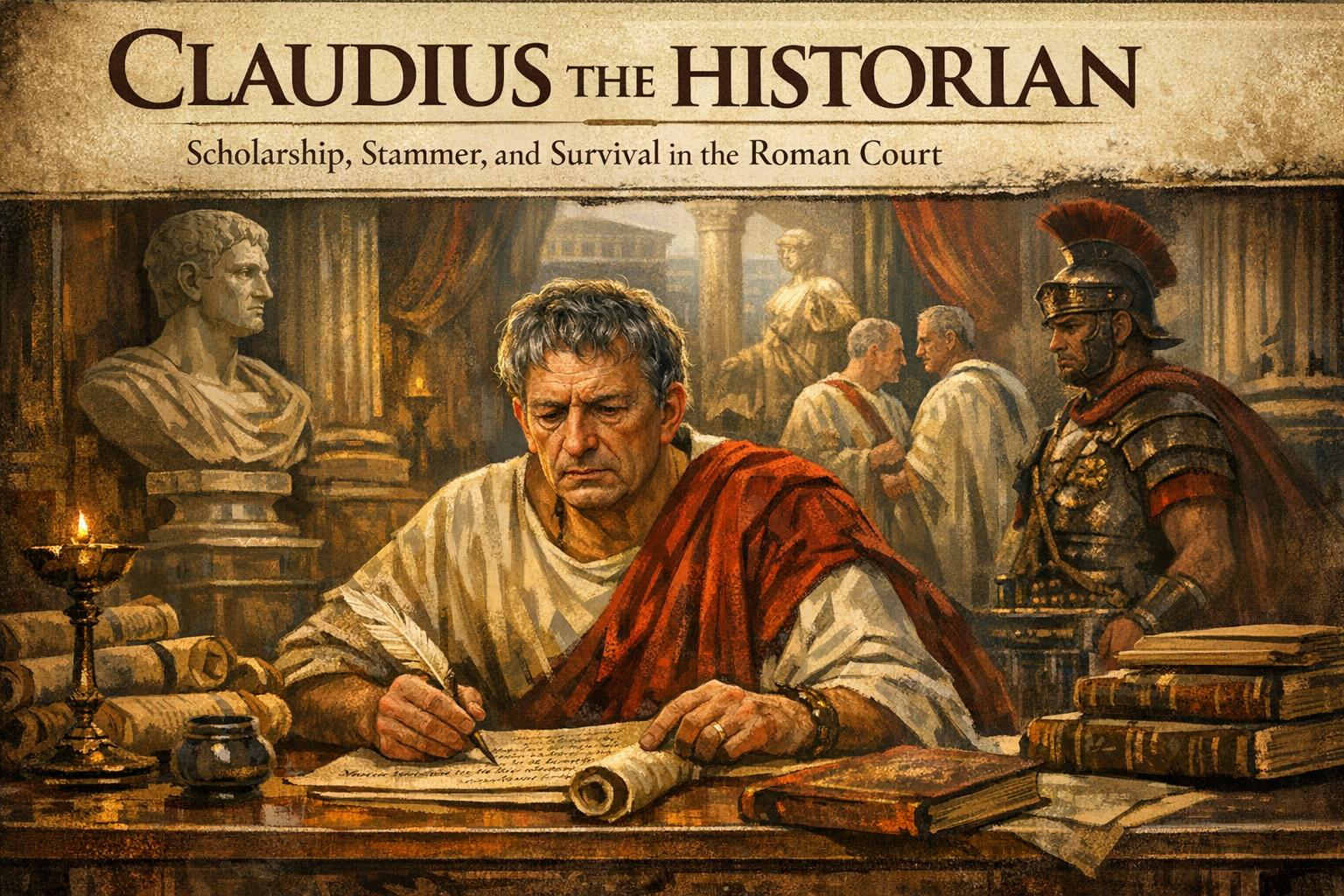
Introduction to Claudius: A Surprising Historian
Tiberius Claudius Caesar Augustus Germanicus, known to history as Claudius, ruled as Roman emperor from 41 to 54 CE. For centuries he was portrayed as an unlikely sovereign: physically impaired, hesitant in speech, and overshadowed by more charismatic members of the Julio-Claudian dynasty. Yet modern reassessment reveals a more complex figure. Claudius was not merely a passive beneficiary of circumstance but a capable administrator and a dedicated scholar. His intellectual interests, particularly in history and language, set him apart from many Roman aristocrats of his era.
Claudius’s rise was shaped by contingency. The assassination of his nephew Caligula in 41 CE created a sudden power vacuum. Members of the Praetorian Guard proclaimed Claudius emperor, reportedly discovering him hiding within the imperial palace. What appeared at first to be a desperate elevation soon evolved into a stable reign lasting thirteen years. His government expanded the empire, restructured administration, and extended Roman citizenship to provincial elites. Behind his public acts stood a man deeply engaged with the past, convinced that knowledge of history strengthened political judgment.
Family Background and Early Marginalization
Born in 10 BCE in Lugdunum (modern Lyon), Claudius was the son of Nero Claudius Drusus and Antonia Minor, and the grandson of Mark Antony and Octavia. Through these connections he belonged to the innermost circle of the imperial household. His grandmother Livia and his uncle Tiberius wielded immense influence during his childhood. Despite this privileged lineage, Claudius did not enjoy the prestige automatically afforded to other aristocratic youths. Chronic health problems, including a stammer, tremors, and possible motor impairments, made him appear vulnerable in a society that valued military bearing and rhetorical fluency.
Ancient sources describe him as awkward and physically ungainly. While these accounts may exaggerate, they suggest that his family considered him unsuitable for high office. Unlike other young nobles, Claudius did not initially pursue a traditional political career marked by military command and public oratory. Instead, he was steered toward scholarly pursuits. Ironically, this redirection protected him during the purges and executions that characterized the reigns of Tiberius and Caligula. His perceived ineffectiveness rendered him non-threatening, allowing him to survive where many of his relatives did not.
Claudius’s Intellectual Formation
Claudius received a rigorous education that reflected elite Roman standards. Tutors instructed him in Latin and Greek literature, rhetoric, and philosophy. Although public speaking posed difficulties, written scholarship did not. Claudius developed a sustained engagement with historical inquiry. He examined early Roman traditions, the development of republican institutions, and the histories of neighboring peoples. This intellectual formation was unusual for a future emperor; while Roman aristocrats often cultivated literary interests, few immersed themselves in prolonged research.
He also studied linguistics. Claudius proposed reforms to the Latin alphabet and advocated the revival or introduction of certain letters to better represent spoken sounds. Though these reforms did not survive long after his reign, they demonstrate his analytical approach to language and communication. His attention to linguistic detail paralleled his broader concern with clarity in administration.
The Stammer and Public Perception
Claudius’s speech impediment significantly influenced how contemporaries judged him. In Roman political culture, persuasive oratory was central to authority. The Senate functioned as a deliberative body in which speakers commanded influence through confident delivery and stylistic skill. A hesitant voice could appear incompatible with leadership.
This perception fostered a narrative of weakness. To many aristocrats, Claudius seemed unsuited to command troops or address large assemblies. However, his impediment affected style rather than intellect. Surviving evidence suggests he was thoughtful and methodical in conversation, especially among trusted advisers. Moreover, his reliance on written communication may have encouraged an administrative style grounded in documentation and procedure.
In a paradoxical way, the stigma attached to his stammer allowed him to evade lethal suspicion during unstable political transitions. Under both Tiberius and Caligula, ambitious relatives faced exile or execution. Claudius, viewed as marginal, attracted less scrutiny. His survival owed partly to this misjudgment. When guards rallied around him after Caligula’s assassination, he was the only adult male of the dynasty readily available to assume power.
The Accidental Emperor and the Role of the Praetorian Guard
The political crisis of 41 CE unfolded rapidly. Following Caligula’s murder by members of the Praetorian Guard, uncertainty gripped Rome. Some senators contemplated restoring the republic, while others feared chaos. According to tradition, soldiers found Claudius within the palace and acclaimed him emperor. Whether he actively sought power remains debated, but he decisively accepted the position once offered.
The support of the Praetorian Guard proved decisive. Claudius secured their loyalty through financial rewards and recognition of their role in his accession. This reliance marked a significant development in imperial governance: the military, especially the guard stationed in Rome, demonstrated its capacity to determine succession. Claudius understood the implications and worked to maintain stable relations with both the army and the Senate.
Though lacking extensive prior magistracies, he quickly asserted authority. He confirmed legal structures, punished conspirators selectively, and emphasized continuity with earlier emperors. His initial vulnerability prompted him to cultivate multiple constituencies, balancing military backing with senatorial cooperation.
Administrative Reforms and Governance
Claudius’s reign displayed consistent administrative engagement. He presided over judicial hearings personally, sometimes spending long hours listening to petitions. His decisions reveal attention to provincial affairs and commercial regulation. He reorganized parts of the bureaucracy, increasingly employing imperial freedmen as secretaries and financial officials. This practice reduced dependence on senatorial elites and created a more specialized administrative apparatus.
He also pursued infrastructural development. Projects included harbor construction at Ostia to improve Rome’s grain supply and the building of aqueducts that expanded urban resources. These initiatives required logistical planning and financial oversight. Their completion attests to sustained administrative focus rather than ceremonial rule.
In legal matters, Claudius extended Roman citizenship to certain provincial communities and individuals. He integrated elites from Gaul into the Senate, arguing that Rome’s strength derived from incorporating diverse peoples. A speech preserved in part on a bronze tablet from Lyon records his rationale, demonstrating his familiarity with early Roman precedents. His historical knowledge supported arguments for inclusive governance.
Expansion of the Empire
While not renowned as a battlefield commander, Claudius oversaw notable territorial expansion. The most significant campaign was the conquest of Britain beginning in 43 CE. Initially led by the general Aulus Plautius, the campaign eventually involved Claudius himself, who traveled to Britain to participate in the formal submission of local rulers. The annexation expanded Roman influence and enhanced imperial prestige.
Additional territories in North Africa and the Near East were reorganized or incorporated. These expansions were administrative as well as military undertakings, requiring stable governance structures. Claudius’s approach reflected a combination of pragmatism and continuity with earlier imperial policies.
The Historian’s Works
Claudius authored several scholarly works, though none survives in complete form. References by later authors provide insight into their scope. He composed a multi-volume history of the Etruscans and another on the Carthaginians. Both topics addressed peoples central to early Roman identity. By studying former rivals, Claudius sought to contextualize Rome’s development within a broader Mediterranean framework.
His interest in the Etruscans was particularly significant. Roman religious ceremonies and political symbols retained traces of Etruscan origin. Claudius appears to have consulted archival and antiquarian sources to reconstruct their institutions and language. Likewise, his Carthaginian history likely examined the Punic Wars and the cultural dynamics of North Africa. These works suggest scholarly independence rather than simple celebration of Roman triumph.
He also wrote an autobiography and possibly a defense of Cicero against critics. Through these texts, Claudius engaged in intellectual debates about Rome’s republican past and its literary heritage. Although later historians such as Tacitus and Suetonius sometimes portrayed him as manipulated by advisers, the existence of substantial scholarly output indicates an emperor capable of sustained research and composition.
Historical Method and Intellectual Character
Claudius approached history as an analytical discipline. Surviving fragments and references imply reliance on archival documents and earlier annalists. His attention to detail in administrative matters likely paralleled his scholarly habits. By grounding political arguments in historical precedent, he reinforced legitimacy. For example, when advocating for Gallic senators, he cited precedents of foreign integration dating to early Rome.
This method demonstrates the practical application of intellectual inquiry. Claudius did not treat history as ornament but as a resource for governance. His reign illustrates how historical knowledge informed policy decisions, particularly in law and citizenship.
Challenges Within the Imperial Household
Despite administrative achievements, Claudius’s domestic life created political instability. His marriages, notably to Messalina and later Agrippina the Younger, became focal points of court intrigue. Ancient sources accuse Messalina of conspiring against him, leading to her execution. Agrippina successfully advanced her son Nero as heir. These episodes reveal the persistent volatility of dynastic politics.
It is difficult to determine how fully Claudius controlled events within his household. Nonetheless, he maintained overall governmental continuity. The presence of influential freedmen and family members did not eclipse his direct involvement in policy, as evidenced by surviving edicts and speeches.
Death and Posthumous Reputation
Claudius died in 54 CE, possibly from natural causes, though rumors of poisoning circulated in antiquity. Nero succeeded him with senatorial and military approval. After his death, Claudius was deified by the Senate, a customary honor for emperors considered legitimate. Yet literary portrayals shaped by senatorial critics often emphasized his physical limitations and susceptibility to manipulation.
Modern historiography offers a more balanced assessment. Archaeological evidence, inscriptions, and administrative records suggest a ruler attentive to structural reform and provincial integration. His scholarly identity challenges assumptions that effective Roman emperors were solely warriors or charismatic speakers.
Conclusion
Claudius’s life illustrates the interplay between perception and capability. Marginalized in youth because of physical impairments, he redirected his energies toward scholarship. When circumstances elevated him to power, he applied intellectual discipline to governance. His reforms in administration, citizenship, and infrastructure indicate sustained engagement rather than accidental stewardship.
Although his historical writings are lost, their themes reveal a ruler attentive to cultural complexity and institutional evolution. Claudius stands as an example of leadership shaped not by rhetorical brilliance or military legend but by persistence, study, and procedural order. His reign underscores the diversity of paths to authority within the Roman imperial system and demonstrates how intellectual inquiry could inform practical rule.