
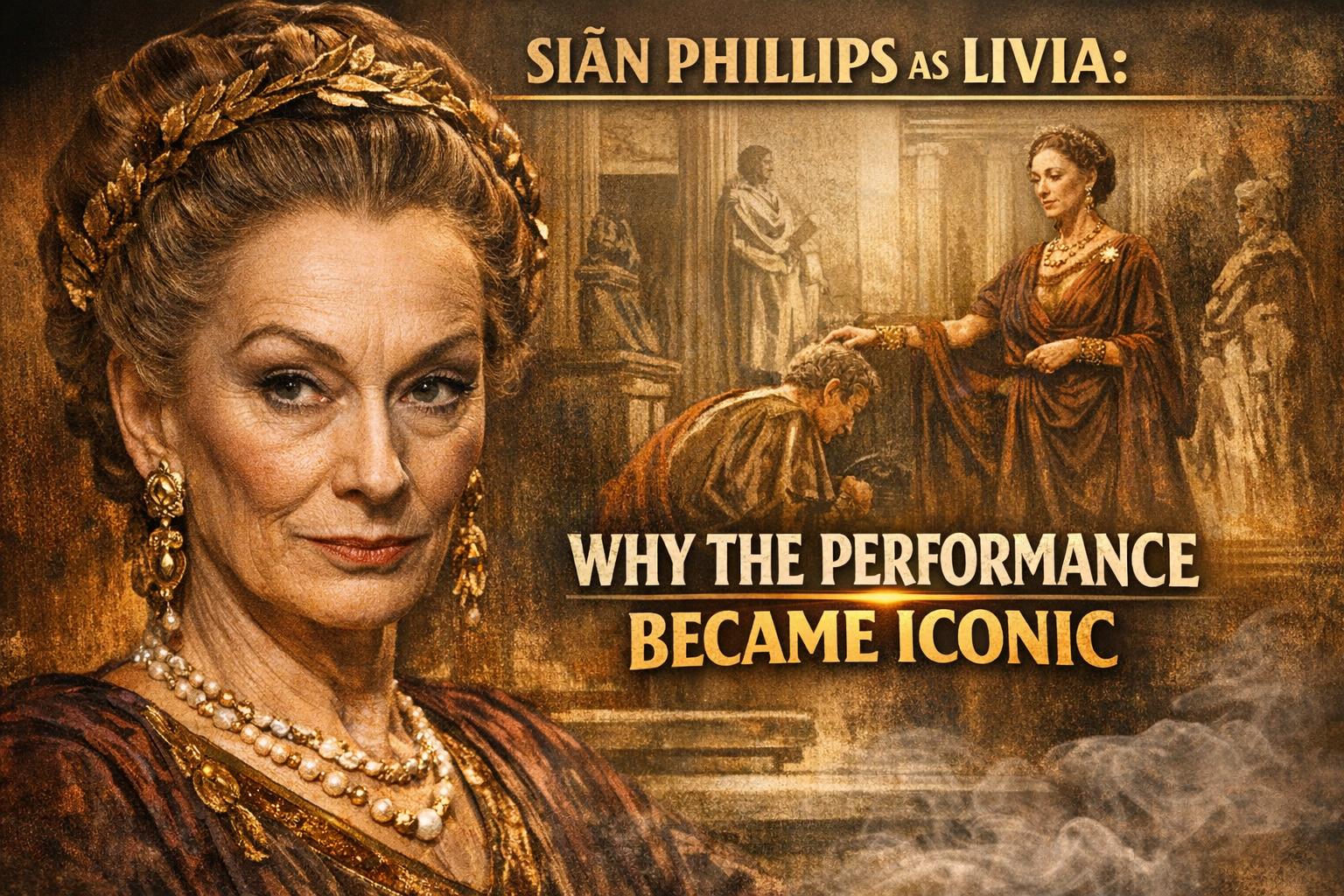
The 1976 BBC adaptation of I, Claudius, based on the novels by Robert Graves, remains one of the most respected historical dramas in television history. Central to its enduring reputation is the portrayal of Livia Drusilla by Siân Phillips. As the wife of Augustus and the matriarch of the Julio-Claudian dynasty, Livia stands at the center of the political and familial struggles that define the series. Her presence shapes the narrative structure, influences the destinies of Rome’s rulers, and provides a sustained examination of power exercised through indirect, domestic, and psychological means. Through Phillips’ interpretation, Livia becomes not merely a historical figure but a study in authority, ambition, and strategic patience.
The Role of Livia in “I, Claudius”
Within the framework of I, Claudius, Livia functions as both participant and architect of imperial history. The story, narrated retrospectively by the Emperor Claudius, frames her as the dominant force in Rome’s early imperial period. Although the series explores several reigns—Augustus, Tiberius, Caligula, and Claudius—Livia’s influence is especially prominent in its early episodes. Her political calculations and quiet interventions establish the dynastic line that shapes subsequent events.
The character’s portrayal relies on a careful balance between historical plausibility and dramatic interpretation. Ancient sources such as Tacitus and Suetonius present Livia as an ambiguous figure, sometimes crediting her with virtue and loyalty, at other times accusing her of orchestrating assassinations to secure her son Tiberius’ succession. Robert Graves’ novels adopt a perspective that leans toward intrigue, and the television adaptation follows this interpretation. As a result, Livia emerges as a strategist whose actions operate behind formal structures of authority while rarely occupying the throne herself.
Her methods are often indirect. Rather than commanding armies or delivering public speeches, she exerts influence through conversation, persuasion, and manipulation of personal relationships. The domestic sphere becomes a political arena. Marriages, adoptions, and illnesses are treated not simply as personal matters but as tools of governance. In dramatizing these mechanisms, the series positions Livia as a figure who understands that durable power resides in shaping succession rather than claiming overt control.
Siân Phillips: Crafting a Memorable Character
Siân Phillips’ performance anchors the character with clarity and restraint. From her first appearance, she projects composure and deliberation. Rather than relying on exaggerated gestures, Phillips employs measured speech and deliberate pacing. Her vocal control plays a significant role in defining Livia’s authority. Sentences are delivered with precise emphasis, allowing understatement to carry as much weight as overt confrontation.
The costume design and production constraints of 1970s British television required performances to carry much of the dramatic intensity. The series was largely studio-bound, with limited sets and minimal special effects. Under these conditions, actors were responsible for generating the sense of scale and gravity appropriate to imperial Rome. Phillips meets this challenge by creating a figure whose stillness suggests control. Even when surrounded by political turmoil, her posture and expression remain composed, reinforcing the impression that she anticipates outcomes before others perceive them.
Her interpretation avoids caricature. While Livia is often associated with calculated ruthlessness, Phillips does not present her as overtly malevolent. Instead, she emphasizes rationality. Decisions that result in exile or death are framed as logical measures to secure stability. This approach complicates the audience’s response. Rather than interpreting Livia solely as a villain, viewers are invited to consider the structural realities of succession in a volatile empire.
Highlights of Phillips’ Performance
Throughout the series, several moments exemplify the precision of Phillips’ portrayal. In scenes opposite Brian Blessed’s Augustus, Phillips conveys both partnership and competition. Livia is attentive to Augustus’ vulnerabilities—his health concerns, his anxiety about succession—and Phillips subtly registers awareness through facial expression and timing. The dynamic between the two characters suggests a marriage defined as much by political calculation as by personal attachment.
Equally notable are her interactions with her son Tiberius. Here, the performance reveals another dimension. Livia’s ambition for Tiberius is accompanied by a form of maternal intensity that borders on possessiveness. Yet Phillips presents this not as sentimentality but as conviction. Livia’s insistence on her son’s destiny is expressed through controlled insistence rather than overt affection. The tension between Tiberius’ reluctance and Livia’s determination becomes a recurring theme, illustrating how parental authority intersects with imperial governance.
In later episodes, as Livia ages, Phillips adjusts her performance to reflect shifting power dynamics. The certainty that characterized earlier scenes gives way to moments of isolation. Subtle changes in tone and physical bearing communicate the reality that influence can diminish as new rulers assert independence. These transitions are handled without melodrama, reinforcing the sense that Livia’s authority is rooted in discipline rather than spectacle.
The Dual Nature of Power and Domestic Identity
A defining feature of Livia’s character is the coexistence of public strategy and private identity. Within the world of the series, she is simultaneously matriarch, adviser, wife, and political operator. Phillips integrates these roles without fragmenting the character. In domestic settings, Livia supervises household matters with efficiency, yet conversations often pivot seamlessly toward questions of imperial policy. The boundaries between family life and statecraft dissolve.
This duality is central to the thematic structure of I, Claudius. The series suggests that the Roman Empire is sustained through personal alliances as much as institutional authority. Livia embodies this principle. Her influence derives not from formal office but from proximity to decision-makers and her capacity to anticipate threats. By presenting maternal devotion and strategic calculation as intertwined rather than contradictory, Phillips supports the narrative claim that domestic roles can mask political control.
Impact on Future Performances
The portrayal of Livia by Siân Phillips has had sustained influence on subsequent historical dramas. The character established a template for depictions of women operating within male-dominated political institutions. Rather than portraying female authority as exceptional or anomalous, I, Claudius normalized the idea that influence might be exercised through counsel, alliance, and long-term planning.
Later series set in ancient Rome or other historical contexts often feature similarly complex female figures. While these characters differ in tone and context, the precedent of Livia’s intellectual dominance is evident. The emphasis on dialogue-driven intrigue, psychological tension, and layered motivation became a recognizable feature of prestige historical television. Phillips’ performance demonstrated that a character’s power could be conveyed through verbal precision and composure rather than spectacle.
Moreover, the series contributed to the development of ensemble drama in which individual performances define the tone of the whole production. Livia’s presence in early episodes establishes expectations regarding narrative complexity. Political developments are interpreted through her perspective, shaping how viewers assess subsequent rulers. This structural role has been mirrored in later series where a central strategist frames the unfolding of events.
Accolades and Recognition
Although Siân Phillips did not receive major international awards specifically for her portrayal of Livia, the performance garnered substantial critical acclaim. Reviewers frequently highlighted her contribution as a defining element of the series’ success. The visibility of I, Claudius in academic discussions of television drama has reinforced the status of her interpretation as a reference point for studies of character construction and historical adaptation.
The endurance of the series in broadcast repeats and home media releases has continued to introduce new audiences to her work. In retrospectives examining influential television performances, Livia is often cited alongside other notable dramatic roles of the twentieth century. The absence of formal awards has not diminished the recognition of the performance within critical discourse and popular memory.
Influence on the Genre
I, Claudius occupies a significant position in the evolution of the historical television genre. Produced on a modest budget, it relied primarily on dialogue, writing, and performance rather than large-scale visual representation. Livia’s character exemplifies this approach. Complex political developments are articulated through conversation and interpersonal negotiation. This narrative strategy allowed the series to explore structural questions about empire, legitimacy, and succession without extensive external spectacle.
The success of the production demonstrated that audiences would engage with intellectually demanding material presented through sustained dialogue and character-driven storytelling. As a result, later historical dramas adopted similar strategies, combining research-based detail with morally ambiguous characterization. Livia’s prominence confirmed the viability of narratives centered on strategic insight rather than physical action.
The character also contributed to a broader reconsideration of historical women in media. Rather than occupying peripheral or purely supportive roles, women in historical series increasingly appear as architects of political change. In this respect, the example set by Siân Phillips’ Livia extends beyond Roman drama to other periods and settings. The framework established by I, Claudius—a concentration on succession crises, private negotiation, and psychological realism—remains visible in contemporary productions.
Historical Context and Dramatic Interpretation
The historical Livia Drusilla remains a subject of scholarly debate. Ancient texts provide contradictory accounts, and modern historians differ in their assessments of her influence. The television series adopts a perspective aligned with the more suspicious ancient sources, portraying her as directly responsible for several deaths within the imperial household. While this interpretation cannot be confirmed, it serves a clear dramatic function. By attributing agency to Livia, the narrative achieves coherence in its explanation of succession outcomes.
Phillips’ performance supports this interpretive approach by maintaining composure even in moments that imply severe consequences. The absence of overt confession or visible remorse heightens ambiguity. Viewers are left to infer culpability from context and implication rather than explicit admission. This restraint enhances the realism of the portrayal, suggesting how power might operate through plausible deniability and indirect action.
The series thereby encourages reflection on how historical narratives are constructed. Claudius, as narrator, offers his own interpretation of events. Livia’s depiction is filtered through his memory and perspective. Phillips embodies this complexity by allowing space between spoken words and implied intention. The result is a character who appears authoritative yet remains partly mediated by another’s account.
Cultural Legacy
Decades after its original broadcast, I, Claudius continues to be referenced in discussions of high-quality television drama. Academic courses on media studies and classics frequently cite the series as an example of adaptation that balances fidelity to source material with dramaturgical invention. Livia’s character often forms a focal point in these discussions, serving as an illustration of how performance can shape historical interpretation.
Siân Phillips’ portrayal contributed significantly to the durability of the series. The clarity of her characterization ensures that Livia remains recognizable even to viewers encountering the production in a different cultural context. The combination of disciplined acting, structured dialogue, and thematic coherence has preserved the relevance of her performance over time.
Conclusion
The role of Livia in I, Claudius exemplifies the capacity of television drama to explore political complexity through character-driven narrative. Siân Phillips’ interpretation provides the structural foundation of the early episodes and establishes patterns that reverberate throughout the series. By portraying Livia as composed, strategic, and analytically minded, Phillips elevates the character beyond archetype and embeds her within a broader examination of imperial governance.
Through measured delivery and consistent psychological clarity, Phillips crafted a portrayal that remains influential in discussions of historical drama. The character’s impact extends beyond the confines of the series, shaping subsequent representations of women in positions of indirect power. In the context of television history, Livia stands as a demonstration of how performance, writing, and thematic ambition can converge to produce a work of lasting significance.