
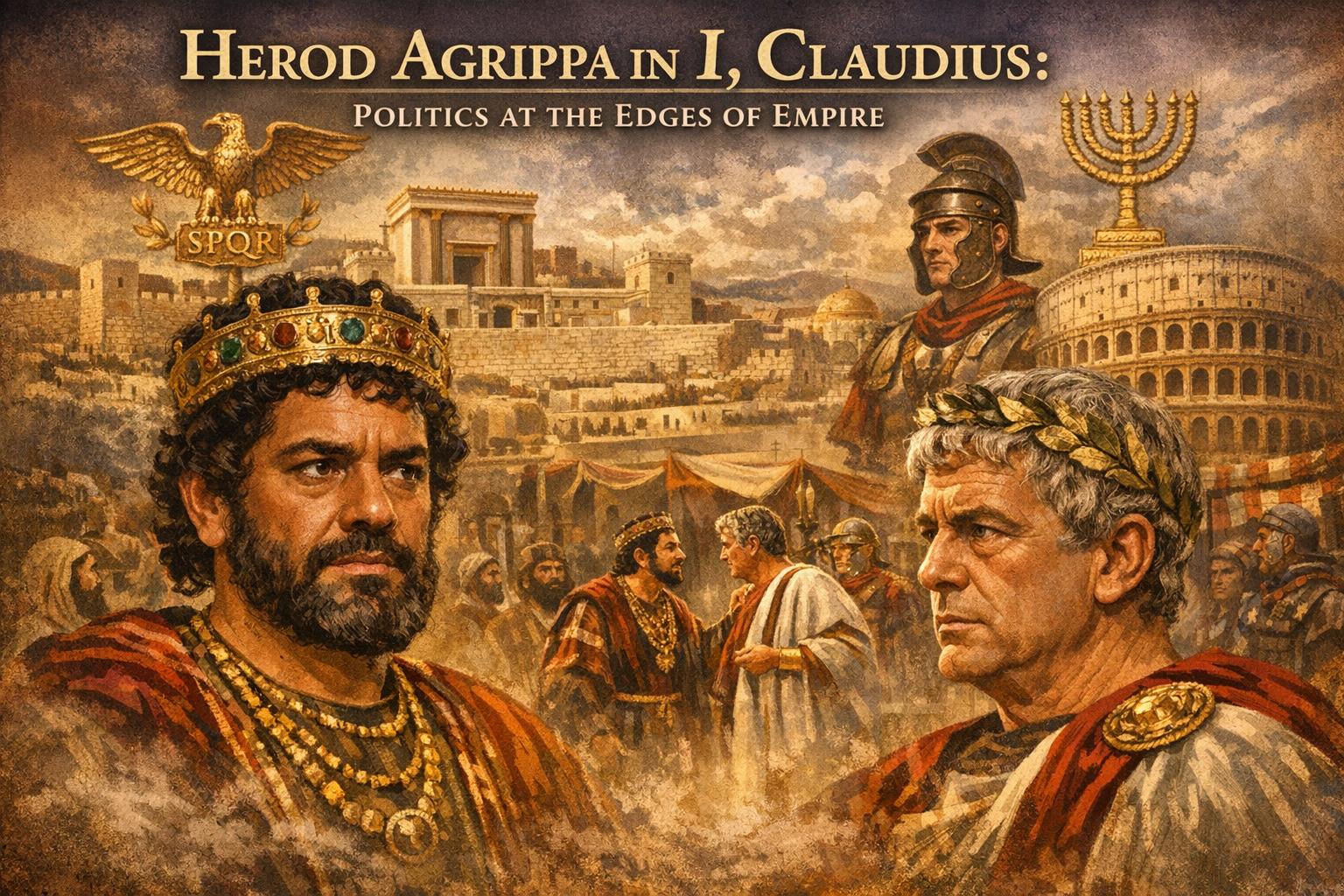
Introduction to Herod Agrippa
In the historical novel I, Claudius by Robert Graves, Herod Agrippa emerges as a carefully constructed character who reflects both the historical record and the thematic concerns of the work. The novel, presented as an autobiographical account of the Roman Emperor Claudius, explores the internal workings of the Julio-Claudian dynasty and the political culture of the early Roman Empire. Within this setting, Agrippa appears not as a marginal provincial ruler but as a participant in imperial politics whose fortunes are closely tied to developments in Rome. His presence in the narrative underscores the interconnectedness of the imperial center and its eastern territories.
Graves portrays Agrippa as intelligent, adaptable, and attentive to shifting political circumstances. Although he rules Judea, his career unfolds largely within Roman elite society. This dual orientation—toward his ancestral homeland and toward Rome—defines both his historical significance and his literary portrayal. Through Agrippa, I, Claudius illustrates how provincial kingship functioned within the structures of Roman power.
Background and Historical Context
Herod Agrippa I was born around 10 BCE into the Herodian dynasty. He was the grandson of Herod the Great, who had ruled Judea as a client king under Roman authority. The Herodian house occupied a complex position: ethnically Idumaean with ties to Judaism, politically dependent on Rome, and frequently enmeshed in internal family rivalries. Agrippa’s father, Aristobulus IV, was executed by Herod the Great on suspicion of conspiracy, leaving Agrippa to be raised in an environment shaped by intrigue and insecurity.
As a young man, Agrippa was sent to Rome, where he was educated alongside members of the imperial family. This Roman upbringing proved decisive. He cultivated friendships with individuals who would later become emperors, including Caligula and Claudius. Exposure to aristocratic Roman culture gave him fluency in the manners, expectations, and rivalries of the imperial court. It also immersed him in the financial and moral risks associated with elite life; ancient sources describe periods in which Agrippa fell into serious debt.
The early first century CE was a period of administrative experimentation in Judea. After the death of Herod the Great in 4 BCE, his kingdom was divided among his sons. Eventually, parts of Judea came under direct Roman administration through prefects and procurators. Tensions between Roman officials and segments of the Jewish population were frequent. Questions of taxation, religious practice, and political representation remained sensitive. In this environment, a ruler capable of negotiating Roman expectations while respecting local religious norms was particularly valuable.
Agrippa’s eventual accession to kingship in 41 CE came after decades of fluctuating fortune. By that time he had secured the confidence of key imperial figures. The emperor Caligula granted him territories formerly ruled by Philip the Tetrarch. After Caligula’s assassination, Agrippa played a role in supporting Claudius’ claim to power. In return, Claudius expanded Agrippa’s domain to include Judea and Samaria, effectively restoring a kingdom comparable to that of Herod the Great. Agrippa ruled from 41 to 44 CE, a brief but significant reign that temporarily reunified much of his grandfather’s territory under a native monarch loyal to Rome.
Role in I, Claudius
In I, Claudius, Robert Graves integrates Agrippa into the broader narrative of imperial succession and political survival. Because the story is told retrospectively from Claudius’ perspective, Agrippa is depicted through the lens of personal recollection. He appears not only as a regional ruler but also as a figure embedded in the intimate and often dangerous society of the Roman court.
The novel emphasizes Agrippa’s resourcefulness. He recognizes the volatility of Roman politics, particularly under Caligula, whose reign is portrayed as unpredictable and autocratic. Agrippa’s survival depends on his capacity to remain useful without appearing threatening. Graves presents him as perceptive in assessing character, cautious in speech, and deliberate in forming alliances. These attributes allow him to navigate episodes that prove fatal to less adaptable figures.
Agrippa’s relationship with Claudius is especially important in the novel. While Claudius is often underestimated by his contemporaries, Agrippa perceives his intellectual strengths and latent political viability. At the moment of Caligula’s assassination, when Rome faces uncertainty, Agrippa reportedly encourages acceptance of Claudius as emperor. This portrayal reinforces a central theme of the novel: that power frequently hinges on the calculations of individuals who stand slightly apart from the main centers of authority. Agrippa operates at such an intersection, bridging palace intrigue and provincial governance.
Political Maneuvering and Alliances
Agrippa’s historical career and his fictional depiction both highlight the importance of personal alliances within Roman political culture. The empire functioned not solely through formal institutions but through networks of patronage, loyalty, and reciprocal obligation. Agrippa acquired influence by embedding himself within these networks.
His friendship with Caligula was particularly consequential. According to ancient accounts, Agrippa spoke openly in favor of Caligula’s eventual succession during the reign of Tiberius. When this conversation was reported, Agrippa was briefly imprisoned. Upon becoming emperor in 37 CE, Caligula released him and elevated him to kingship over territories in the northeast of Judea. In I, Claudius, this episode underscores both the risks and rewards of candid alignment with a future ruler. Agrippa’s calculated loyalty ultimately yields political advantage.
After Caligula’s death in 41 CE, the imperial succession was again uncertain. The Senate considered restoring the Republic, while elements of the Praetorian Guard proclaimed Claudius emperor. In the novel, Agrippa acts as a mediator, lending support to Claudius and advising him during the delicate hours following the assassination. By assisting Claudius at a critical juncture, Agrippa strengthens his own position. Claudius, in turn, confirms and enlarges Agrippa’s kingdom.
These alliances were not merely symbolic. They translated into territorial authority. Under Claudius, Agrippa gained control over Judea, Samaria, Galilee, and surrounding regions. The consolidation of these areas under a single ruler reduced administrative fragmentation and, at least temporarily, moderated tensions between Roman officials and the local population. The arrangement served Roman interests by entrusting governance to a client king with demonstrated loyalty and cultural familiarity.
Herod’s Diplomatic Skills
Agrippa’s diplomatic skills were evident in his capacity to operate comfortably in distinct cultural frameworks. In Rome, he behaved as a member of the aristocratic circle, fluent in its customs and expectations. In Judea, he presented himself as a defender of Jewish religious tradition. Ancient sources, including Josephus and the Acts of the Apostles, suggest that he took care to observe the Law and to participate in Temple rituals. Such gestures reinforced his legitimacy among segments of the population.
One episode frequently discussed in connection with his diplomacy concerns the crisis under Caligula involving the proposed installation of the emperor’s statue in the Jerusalem Temple. The plan threatened to provoke religious unrest. Historical accounts describe Agrippa as intervening with Caligula to moderate or delay the policy. In literary adaptation, such moments reveal Agrippa’s function as an intermediary. He translated the concerns of Judea into terms comprehensible to the emperor, while presenting imperial decisions to local elites in a less confrontational manner.
Diplomacy for a client king required restraint. Agrippa could not openly oppose Rome’s authority, yet he had to prevent unrest that might threaten his rule. Graves’ portrayal accentuates this balancing act. Agrippa rarely adopts overtly confrontational positions. Instead, he works through persuasion, timing, and personal rapport. His skill lies not in public declarations but in shaping outcomes within private conversations.
Cultural and Religious Considerations
The governance of Judea demanded attention to religious tradition on a level uncommon in many other Roman provinces. Jewish law regulated aspects of public and private life, and the Temple in Jerusalem functioned as both a religious and symbolic center. Roman disregard for these structures had previously resulted in disturbances. Agrippa’s sensitivity to such matters contributed to relative stability during his reign.
In I, Claudius, this sensitivity supports his characterization as a pragmatic ruler rather than a doctrinaire partisan. He recognizes that durable governance requires accommodation. While bound by loyalty to Rome, he refrains from introducing reforms that would challenge established religious practices. His reign contrasts with that of Roman procurators who, lacking local ties, were less attuned to the implications of certain administrative decisions.
At the same time, Agrippa remained a monarch within a Roman imperial framework. He minted coins bearing imperial symbols and ensured that taxes and political obligations to Rome were fulfilled. The image that emerges is not of a separatist ruler but of a broker of interests. His success depended on persuading Rome that Judea was secure and persuading Judea that Roman oversight need not undermine religious identity.
The novel situates these dynamics within a broader examination of empire. Rome’s control was not uniform; it relied on differentiated arrangements adapted to local conditions. Client kings like Agrippa exemplified this flexible strategy. Their authority was both autonomous and constrained. Graves uses Agrippa to illustrate how such arrangements could function effectively when managed by a capable intermediary.
Agrippa’s Administration and Governance
Although I, Claudius focuses primarily on events in Rome, the implications of Agrippa’s rule in Judea are significant. Historically, his reign saw efforts to fortify cities, maintain public order, and cultivate support among influential groups. He invested in infrastructure and urban development, continuing patterns established by his grandfather while avoiding some of the latter’s more controversial policies.
Administrative stability during Agrippa’s reign can be contrasted with the turbulence that followed his death in 44 CE. After he died, Judea reverted to direct Roman administration. Within a generation, tensions escalated into the Jewish revolt of 66–70 CE. While it would be simplistic to attribute subsequent unrest solely to structural changes in governance, Agrippa’s tenure demonstrates that a client kingship under favorable conditions could mitigate conflict.
In Graves’ narrative framework, this background lends weight to Agrippa’s political presence. He is not merely a courtier but a ruler whose territory occupies a strategic location in the eastern Mediterranean. His judgments have implications for trade routes, military logistics, and regional diplomacy. Thus, when Agrippa participates in Roman deliberations, he represents more than personal ambition; he embodies the interface between imperial authority and provincial society.
Representation and Literary Function
As a literary figure, Agrippa serves several functions in I, Claudius. First, he provides an external perspective on Roman politics. While born into a dynasty shaped by Roman patronage, he is not ethnically Roman. His observations carry a degree of detachment that complements Claudius’ own analytical voice. Through conversations with Agrippa, aspects of Roman governance are clarified and contextualized.
Second, Agrippa highlights the multicultural composition of the empire. The Roman state comprised territories with distinct languages, legal traditions, and religious systems. The novel underscores this diversity not through abstract description but through characters who traverse cultural boundaries. Agrippa’s bilingual and bicultural identity exemplifies this reality.
Third, his career illustrates the precarious nature of favor. Advancement at the imperial court could be rapid, but it was never secure. Agrippa’s imprisonment under Tiberius, subsequent elevation by Caligula, and enhanced authority under Claudius demonstrate how fortunes could reverse. Readers observe that survival required attentiveness to shifting alliances and an acute sense of timing.
Conclusion
Herod Agrippa in I, Claudius is portrayed as a figure whose political effectiveness derives from adaptability, cultural fluency, and strategic alliance-building. Historically, he ruled Judea from 41 to 44 CE, overseeing a temporary restoration of unified Herodian authority under Roman auspices. Literarily, he functions as both participant and observer within the intricate politics of the Julio-Claudian court.
The novel’s depiction aligns with broader historical assessments that emphasize Agrippa’s capacity to maintain equilibrium between imperial demands and local traditions. His relationships with Caligula and Claudius illustrate how personal connections could shape provincial governance. His administration in Judea suggests that intermediate forms of rule, combining local legitimacy with imperial loyalty, could produce relative stability.
Through Agrippa, I, Claudius examines the mechanisms by which Rome sustained control over diverse regions. The character embodies the interplay between center and periphery, personal loyalty and institutional power, cultural specificity and imperial integration. In doing so, Graves provides a nuanced representation of a ruler who operated effectively at the margins of empire while remaining closely linked to its core.