
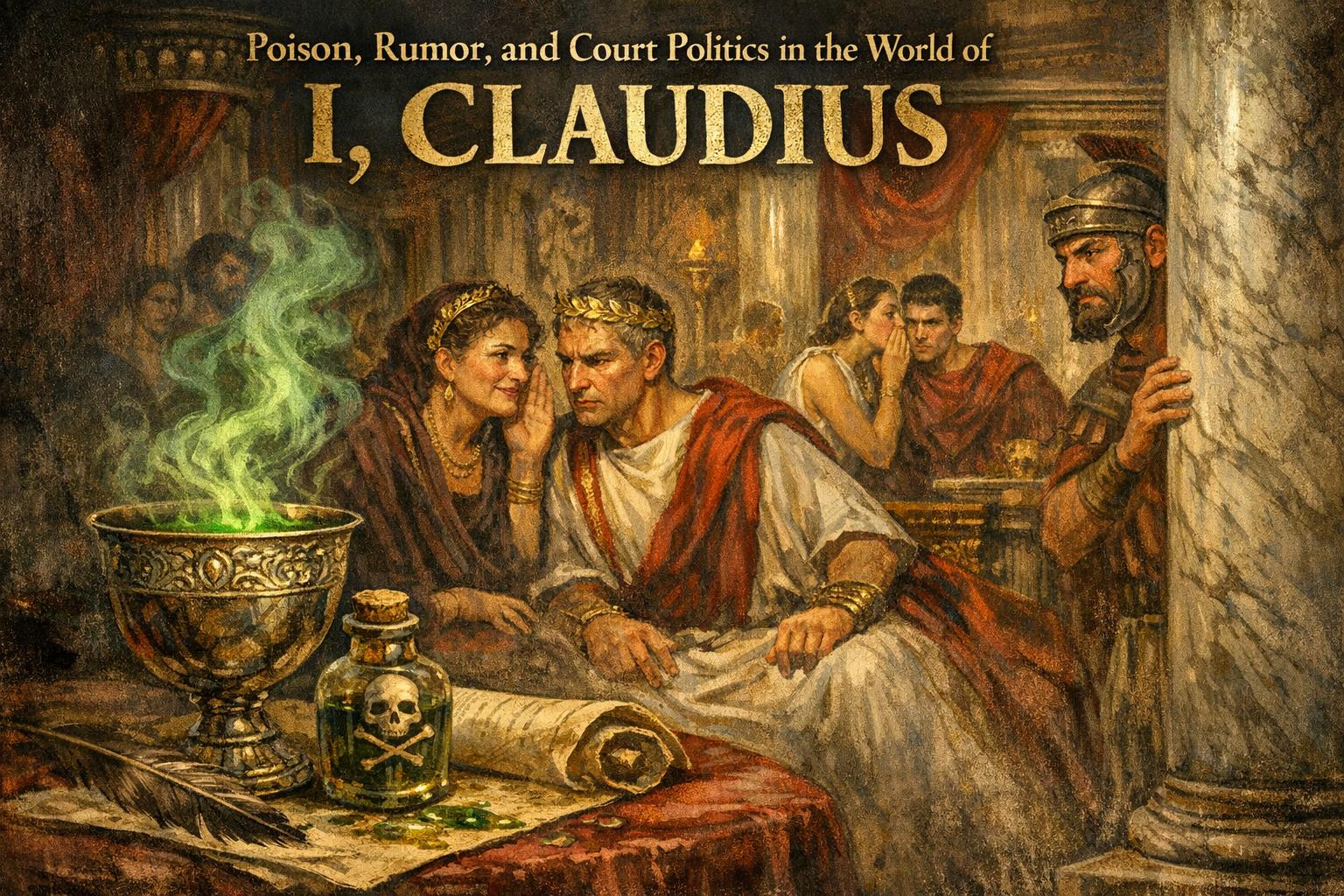
Introduction to Court Politics in “I, Claudius”
“I, Claudius” is a historical novel by Robert Graves that reconstructs the political environment of the early Roman Empire through the retrospective voice of the Emperor Claudius. Framed as a secret autobiography written late in his life, the narrative presents a detailed reconstruction of events from the reign of Augustus through the rule of Tiberius and Caligula, culminating in Claudius’s own unexpected accession. Through this literary device, Graves offers a sustained examination of court politics within the Julio-Claudian dynasty and depicts how private actions shaped public history.
The political order described in the novel is neither stable nor impersonal. Authority formally rests in established institutions such as the Senate, popular assemblies, and magistracies. In practice, however, power flows through informal networks centered on the imperial household. Family connections, personal loyalty, patronage, and influence over the emperor determine political advancement. The result is a system in which personal rivalries and domestic arrangements are inseparable from state governance.
Within this environment, poison and rumor function not merely as dramatic devices but as mechanisms embedded in the political culture of the time. The imperial court is shown as a confined social arena in which information, suspicion, and calculated violence circulate constantly. By focusing on these elements, Graves illustrates how governance in early imperial Rome was shaped as much by private manipulation as by formal authority.
The Structure of Power in the Julio-Claudian Court
The Julio-Claudian dynasty combined republican institutions with monarchical realities. Augustus, the founder of the regime, maintained the façade of republican restoration while consolidating supreme authority. In “I, Claudius,” this balance between appearance and reality is central to understanding court politics. Publicly, Augustus presents himself as a servant of the state. Privately, succession planning and familial alliances dominate his concerns.
The imperial household becomes the effective center of political life. Women, freedmen, military officers, and advisors exert influence through proximity to the ruler. Formal titles matter less than personal access. The Senate retains prestige but often lacks the power to resist imperial will. This structural imbalance creates a climate in which intrigue flourishes. Decisions about succession, adoption, and marriage carry profound political weight, and these decisions are often shaped behind closed doors.
Graves portrays the court as a constrained social ecosystem. Members of the ruling family cannot easily withdraw from political life. Every gesture is interpreted for hidden significance. Silence itself invites suspicion. In such an atmosphere, strategies for survival differ from conventional political debate. Discretion, calculation, and discretion in the use of force become necessary qualities.
The Role of Poison in Roman Politics
Poison occupies a prominent place in the narrative as a discreet instrument of political elimination. Unlike open assassination, which could provoke public unrest or military retaliation, poisoning offers deniability. Symptoms can be attributed to illness, especially in a period with limited medical knowledge. This ambiguity makes poison an attractive method in a society where direct violence against elite figures might appear destabilizing.
In the novel, Livia, the wife of Augustus, is closely associated with the calculated use of poison. Graves presents her as a determined political actor committed to securing the succession of her son Tiberius. Through measured doses administered over time, potential heirs and rivals gradually disappear. While the historical accuracy of these allegations remains debated among modern scholars, the narrative uses them to illustrate how concealed violence can shape imperial policy.
Poison in the novel is rarely impulsive. It is methodical and strategic. The preparation of toxic substances, the selection of intermediaries, and the manipulation of physicians require planning. This emphasis on method reflects a broader theme: political change at court often occurs through indirect means. Rather than dramatic confrontations, outcomes result from sustained covert action.
The social perception of poisoning is also significant. Although morally condemned in theory, it does not provoke the universal outrage that might be expected in later historical contexts. The Roman aristocracy, as depicted by Graves, recognizes poison as one of several available tools within a competitive environment. This tacit acceptance underscores a pragmatic moral framework in which the preservation of family position may justify extreme measures.
Poison and the Question of Legitimacy
The repeated appearance of suspicious deaths raises persistent questions about legitimacy. If heirs die unexpectedly and rivals vanish, succession becomes clouded with doubt. In “I, Claudius,” the ambiguity surrounding the deaths of figures such as Marcellus and Germanicus contributes to a culture of suspicion. Each loss alters the political landscape and intensifies scrutiny of those who benefit.
For Claudius as narrator, the issue of legitimacy is personal. He survives in part because he is perceived as physically weak and intellectually limited. His apparent insignificance protects him from being considered a threat. While others are eliminated through poison or execution, Claudius is overlooked. The same mechanisms that destroy ambitious figures preserve him.
The recurrence of poisoning also highlights the absence of transparent succession mechanisms. Without a fixed rule of hereditary transfer or open election, the empire relies on adoption and designation by the reigning emperor. This informal process creates openings for interference. Poison becomes one method of adjusting the line of succession without public declaration.
Rumor and its Influence on Political Standing
If poison represents physical elimination, rumor represents symbolic manipulation. In a society without rapid mass communication, information moves through conversation, correspondence, and public performance. Reputation becomes a critical political asset. A sustained rumor can damage authority, diminish military loyalty, or isolate an individual socially.
In the novel, rumor frequently precedes political action. Accusations of treason, moral corruption, or disloyalty circulate before formal charges are brought. By the time a case reaches the Senate, public perception may already be shaped. The line between truth and fabrication becomes blurred. Because investigative procedures are limited and influenced by status, rumors can acquire official recognition without conclusive evidence.
Claudius himself benefits from rumor. Reports describing him as ineffectual and intellectually incapable reduce expectations. Other members of the dynasty view him as harmless. This underestimation shields him during periods of purges and prosecutions. In this case, rumor functions defensively. It constructs a protective obscurity around him.
Conversely, rumor undermines figures such as Agrippina and Messalina. Allegations regarding sexual misconduct or conspiracy spread rapidly and justify intervention. Whether fully accurate or exaggerated, these stories alter their political positions. Reputation at court is fragile, and rumor accelerates its transformation.
Mechanisms of Gossip and Information Flow
The imperial court operates as an enclosed environment where servants, freedmen, and minor officials act as conduits of information. Private conversations rarely remain private. The hierarchical structure of Roman households facilitates upward and downward communication. A statement made in confidence may pass through several intermediaries before reaching the emperor.
Graves depicts rumor not only as spontaneous conversation but as intentional strategy. Courtiers plant information to test reactions or damage opponents. Anonymous denunciations become a recognized feature of political life, particularly under Tiberius. Fear of accusation alters behavior. Individuals limit frank speech and adopt cautious neutrality.
This climate of suspicion affects governance. Senators hesitate to propose policies that might be interpreted as criticism. Military commanders seek explicit reassurance of loyalty. Decision-making shifts from open deliberation to guarded exchanges. The prevalence of rumor thus reshapes institutional function without formal constitutional change.
Court Politics and the Quest for Power
The pursuit of authority defines the interactions of the Julio-Claudian household. Marriage alliances, adoptions, and appointments to provincial commands are calculated steps in longer strategies. Emotional attachments exist but are subordinated to political advantage. The assassination of rivals, whether through judicial proceedings or more discreet means, is integrated into succession planning.
Sejanus, the prefect of the Praetorian Guard, illustrates the risks inherent in proximity to power. Initially entrusted by Tiberius, he consolidates influence over military forces in Rome. Graves portrays him as patient and methodical, gradually isolating potential opponents. His influence demonstrates how non-dynastic actors can dominate imperial politics by controlling access to the emperor.
However, Sejanus’s fall is equally abrupt. Once suspicion turns against him, alliances dissolve rapidly. The same mechanisms that enabled his rise facilitate his destruction. Informers provide testimony, and the Senate reverses its stance. His execution underscores the precarious nature of authority derived from favor rather than formal legitimacy.
Caligula’s reign represents a different dimension of court politics. His erratic governance and public displays of dominance alter the balance between emperor and aristocracy. Fear becomes more explicit. Executions are less concealed. Yet even under overt despotism, rumor and private maneuvering persist. The court adjusts, but the underlying structure of dependence on imperial will remains.
Claudius as Observer and Participant
As narrator, Claudius occupies a dual position. For much of the story, he is a peripheral observer. His physical impairments and hesitant speech lead others to dismiss him. This marginal status grants him relative safety and access to information. He reads historical documents, listens to conversations, and reconstructs events with analytical distance.
When he becomes emperor, his perspective shifts from survival to administration. The novel suggests that his earlier obscurity equips him with caution. He recognizes the dangers of unchecked advisors and attempts to balance competing factions. Nevertheless, he cannot escape the structural realities of court politics. His dependence on wives and freedmen introduces new channels of influence.
Claudius’s reign demonstrates partial reform but not transformation. He undertakes administrative projects and extends citizenship, yet the environment of suspicion continues. Marital alliances remain politically charged. Accusations of conspiracy persist. The persistence of these patterns indicates that court politics are embedded in the imperial structure rather than limited to particular personalities.
Historical Context and Literary Interpretation
Although “I, Claudius” draws on ancient sources such as Tacitus, Suetonius, and Cassius Dio, it remains a literary reconstruction. Graves interprets gaps in the historical record by attributing coordinated action to central figures, particularly Livia. Modern historians debate the extent to which poisoning and secret manipulation shaped succession. Nevertheless, the narrative’s coherence depends on the plausibility of such acts within Roman political culture.
The emphasis on poison and rumor aligns with themes found in surviving Roman histories. Ancient writers often highlighted moral decline, corruption, and hidden crimes within the imperial household. By adopting Claudius’s voice, Graves integrates these accounts into a continuous explanation of political development.
The autobiographical framework also allows reflection on historiography. Claudius, as portrayed in the novel, critiques earlier historians and claims to reveal concealed truths. This device underscores the instability of historical reputation. Just as rumor shapes political standing within the story, written history shapes legacy beyond it.
Conclusion
“I, Claudius” presents the early Roman Empire as a system governed as much by private calculation as by public office. Within the Julio-Claudian court, poison functions as a discreet instrument for resolving succession disputes and eliminating rivals, while rumor shapes perception, isolates opponents, and protects the underestimated. These mechanisms operate within a political structure where family, patronage, and proximity to the emperor outweigh formal constitutional forms.
The novel’s depiction of court politics emphasizes instability. Authority is concentrated yet vulnerable. Favor can elevate an individual rapidly and withdraw just as quickly. Succession lacks predictable order, encouraging covert intervention. In this environment, survival depends on awareness, restraint, and adaptability.
Through the retrospective voice of Claudius, Graves examines how personal ambition intersects with institutional weakness. The narrative suggests that the early empire’s political turbulence emerges not solely from individual moral failings but from structural conditions that reward secrecy and indirect action. By integrating poison, rumor, and strategic alliance into a continuous account, “I, Claudius” offers a sustained study of power within a dynastic state.