
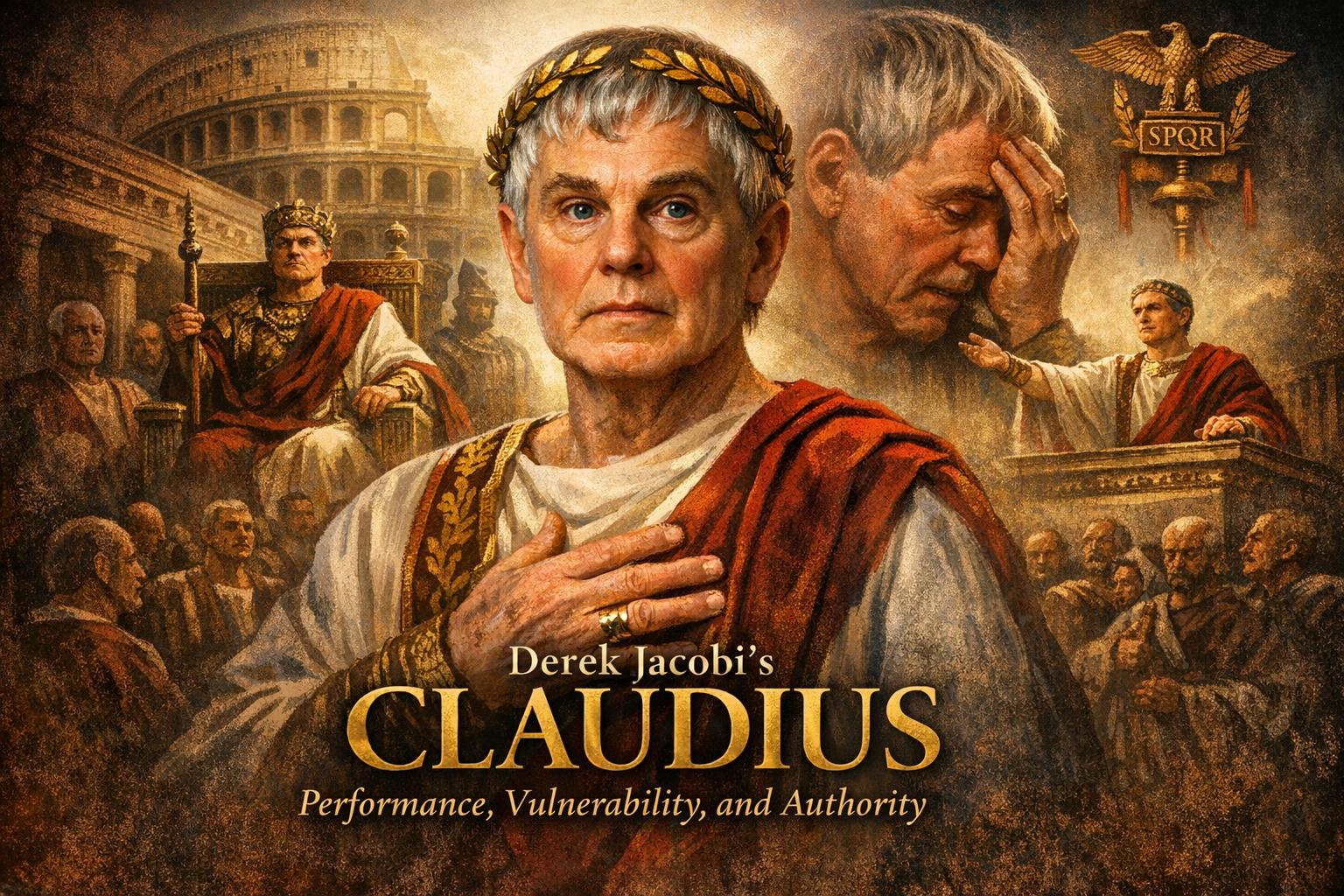
Derek Jacobi’s Portrayal of Claudius
Derek Jacobi’s performance as Claudius in the 1976 BBC television adaptation of I, Claudius, based on the novels by Robert Graves, is frequently cited as one of the most accomplished portrayals in the history of British television drama. At a time when historical serials were often staged in a restrained and theatrical manner, Jacobi brought a level of psychological intensity and technical precision that elevated the production well beyond the limitations of its budget and studio-bound format. His interpretation of Claudius combines fragility, intelligence, irony, and calculation, resulting in a portrayal that remains influential decades after its initial broadcast.
The series itself relies heavily on dialogue, performance, and character interaction rather than spectacle. In that context, Jacobi’s work becomes the central axis of the narrative. Nearly every major political development in the story is filtered through Claudius’s consciousness, and Jacobi sustains audience engagement through subtle modulation of tone, posture, and expression. The performance unfolds gradually, charting a transformation from a physically awkward and underestimated historian to a ruler acutely aware of the burdens and compromises of power.
The Complexity of Claudius
Claudius as both a historical figure and literary character presents unusual complexity. Historically, he was born with physical impairments that affected his speech and mobility. Ancient sources describe him as suffering from a stammer and involuntary head and hand movements. These characteristics contributed to his marginalization within the Julio-Claudian dynasty. Considered unsuitable for leadership, he survived the violent purges that eliminated many potential heirs during the reigns of Augustus, Tiberius, and Caligula. Ironically, those perceived weaknesses eventually positioned him as an unlikely successor when political chaos left him as the last viable male relative of the imperial household.
In Graves’s novels, Claudius narrates his own story with retrospective insight. This literary device requires the actor portraying him to balance immediacy with reflective intelligence. Jacobi embraces this duality. His Claudius is outwardly hesitant but inwardly observant. He studies those around him—particularly formidable figures such as Livia, Tiberius, Caligula, and later Agrippina—with a historian’s scrutiny. Jacobi ensures that Claudius’s watchfulness is visible even in scenes where he speaks little. His eyes track conversations carefully, and brief reactions often reveal comprehension long before other characters recognize his awareness.
The tension between appearance and reality defines the role. Publicly, Claudius is dismissed as foolish or harmless; privately, he is analytical and acutely conscious of political dangers. Jacobi renders this contrast credible by shifting subtly between awkward physicality and sharp mental engagement. The viewer is invited to perceive what other characters overlook: that Claudius’s survival depends on cultivating the illusion of incompetence while carefully assessing each threat.
Performance Nuances
One of the most striking aspects of Jacobi’s portrayal is his technical precision. The stammer that characterizes Claudius is neither exaggerated nor inconsistent. Jacobi incorporates speech hesitations that vary according to circumstance. When Claudius feels intimidated or emotionally distressed, his stammer becomes more pronounced. During moments of clarity or intellectual excitement, his speech often flows more easily, though it never entirely loses its distinctive rhythm. This variation communicates psychological states without explicit explanation.
The physical embodiment of the character is equally deliberate. Jacobi adapts his posture so that Claudius appears slightly contracted, shoulders angled inward as if attempting to occupy less space. His hands sometimes tremble, and his head movements suggest involuntary gestures described in historical accounts. These details are sustained across the series, contributing to a coherent and believable characterization.
Equally significant is Jacobi’s command of silence. Extended pauses frequently precede Claudius’s responses, suggesting both the effort required to speak and the calculation underlying his words. These pauses create tension in political conversations, especially when powerful figures underestimate him. The audience becomes aware that Claudius is weighing consequences, anticipating outcomes, and selecting language carefully. Through pacing alone, Jacobi conveys strategic thinking.
The intimacy of studio filming amplifies these choices. Close-up shots reveal minute facial adjustments—tightening around the eyes, fleeting uncertainty, restrained amusement. Jacobi uses these moments to convey internal commentary. When witnessing cruelty or manipulation within the imperial family, Claudius often registers subtle expressions that signal his moral unease. These reactions contribute to the broader thematic exploration of corruption and survival within autocratic systems.
Balancing Vulnerability and Authority
A central challenge in portraying Claudius lies in reconciling his vulnerability with the authority he ultimately commands. Before his accession, Claudius exists on the margins of power. He is ridiculed by relatives and excluded from meaningful governance. Jacobi portrays these early experiences with a convincing sense of discomfort. Claudius appears aware of his social isolation, yet he rarely displays overt resentment. Instead, Jacobi suggests an adaptive strategy: endurance through self-effacement.
Following Caligula’s assassination, Claudius’s elevation to emperor introduces a dramatic shift. The performance does not abruptly discard earlier traits; instead, Jacobi maintains the physical hesitancy while gradually introducing firmer vocal control. As emperor, Claudius still stammers, but he delivers edicts with growing steadiness. The contrast underscores a key aspect of the interpretation: authority does not erase vulnerability but coexists with it.
Jacobi avoids portraying Claudius as uniformly heroic. In scenes involving political compromise, especially those concerning the Senate and military authority, he conveys the strain of decision-making. Claudius recognizes that moral clarity is often unattainable in governance. His expressions during these sequences often reveal fatigue, suggesting that power imposes psychological costs. This dimension prevents the performance from simplifying Claudius into a figure of triumphant vindication.
The portrayal also addresses personal relationships, which complicate Claudius’s authority. His marriages, particularly to Messalina and Agrippina, expose emotional susceptibility. Jacobi emphasizes Claudius’s longing for affection and domestic stability, qualities that conflict with the ruthless demands of imperial politics. When confronted with betrayal, the performance combines disbelief with reluctant acceptance. Authority, in these instances, cannot shield him from private disappointment.
Character Dynamics and Ensemble Interaction
Although Jacobi’s Claudius anchors the series, the performance gains depth through interaction with a strong ensemble cast. Scenes with Siân Phillips as Livia illustrate how Claudius’s observational tendencies develop. In their exchanges, Jacobi conveys both fear and fascination. Claudius senses Livia’s manipulative intelligence long before others fully comprehend it. His cautious tone and attentive posture indicate admiration intertwined with apprehension.
Opposite John Hurt’s Caligula, Jacobi adopts a different dynamic. Caligula’s volatility demands heightened alertness. Jacobi responds with contained anxiety, frequently positioning Claudius as a silent witness to instability. When Claudius attempts to reason with Caligula, the dialogue reveals careful calibration; he advances arguments tentatively, gauging reactions step by step.
These relational subtleties reinforce Claudius’s identity as both participant and chronicler. Jacobi ensures that even secondary interactions contribute to the broader arc of intellectual survival. Claudius learns from each encounter, storing observations that later inform his conduct as emperor. The performance thus operates cumulatively, building character continuity across episodes.
Impact on Television and Beyond
At the time of its release, I, Claudius stood apart from many historical dramas in its emphasis on psychological realism. While technical production values were modest, the series prioritized text and acting. Jacobi’s portrayal became a reference point for how complex historical figures could be rendered accessible without reducing them to simplified archetypes.
Subsequent period dramas have often pursued greater visual spectacle, yet many continue to draw upon the example set by Jacobi’s performance in prioritizing character depth. His Claudius illustrates that authenticity in historical storytelling emerges less from elaborate sets than from disciplined characterization. The integration of documented physical traits with interpretative nuance demonstrates a methodology that actors in later productions have acknowledged as instructive.
The performance also contributed to renewed interest in Roman history among television audiences. By presenting Claudius as intellectually engaged and morally reflective, Jacobi moved beyond the caricatures sometimes found in ancient sources. The portrayal invites viewers to reconsider how physical difference and perceived weakness intersect with political capability.
Legacy of “I, Claudius”
The continued circulation of the series through broadcasts and home media has preserved Jacobi’s Claudius for new generations. Academic discussions of screen acting frequently reference the role as an example of sustained character development across episodic structure. Critics have noted the consistency with which Jacobi maintains physical and vocal choices from the opening scenes to the concluding episode.
The endurance of the performance may also derive from its structural coherence. From the outset, Claudius is presented as a man who survives by appearing insignificant. By the conclusion, he remains physically frail but politically decisive. Jacobi charts this trajectory without abrupt transformation, allowing growth to emerge gradually. Such continuity reinforces the narrative’s exploration of how identity adapts under pressure.
Historical Interpretation and Dramatic License
Any dramatization of Roman imperial history involves negotiation between historical documentation and creative interpretation. Jacobi navigates this balance by grounding imaginative elements in plausible human behavior. While the series reflects Graves’s fictionalized narrative choices, the performance does not rely on exaggeration. Instead, Jacobi locates credible motivations within the script, ensuring that even heightened dramatic moments retain psychological coherence.
Claudius’s final reflections, delivered with measured cadence, encapsulate the interpretative approach. Jacobi presents him as conscious of historical legacy, aware that future generations will evaluate his actions. The actor’s restraint prevents sentimentality, offering instead a composed acknowledgment of complexity.
Further Exploration
Derek Jacobi’s broader career contextualizes the achievement of his Claudius. His extensive work in Shakespearean theatre, including roles such as Hamlet and King Lear, demonstrates a sustained engagement with language-driven drama. The control evident in I, Claudius aligns with classical stage technique, particularly in the disciplined use of rhetoric and timing. Yet the intimacy of television required adaptation, and Jacobi successfully translated theatrical precision into camera-focused subtlety.
Throughout subsequent decades, he has continued to portray historical and literary figures with comparable rigor. However, Claudius remains distinctive because it synthesizes vulnerability, intelligence, and authority within a single, evolving characterization. The role required the depiction of long-term psychological development rather than isolated dramatic peaks.
In assessing Jacobi’s portrayal, one observes a model of performance built on preparation, restraint, and responsiveness to ensemble interplay. The characterization neither idealizes nor diminishes Claudius. Instead, it presents a ruler shaped by circumstance, intellect, and personal limitation. Through disciplined technique and sustained emotional calibration, Jacobi created a Claudius who is at once historically grounded and dramatically compelling, ensuring the enduring significance of his interpretation within the landscape of televised historical drama.