
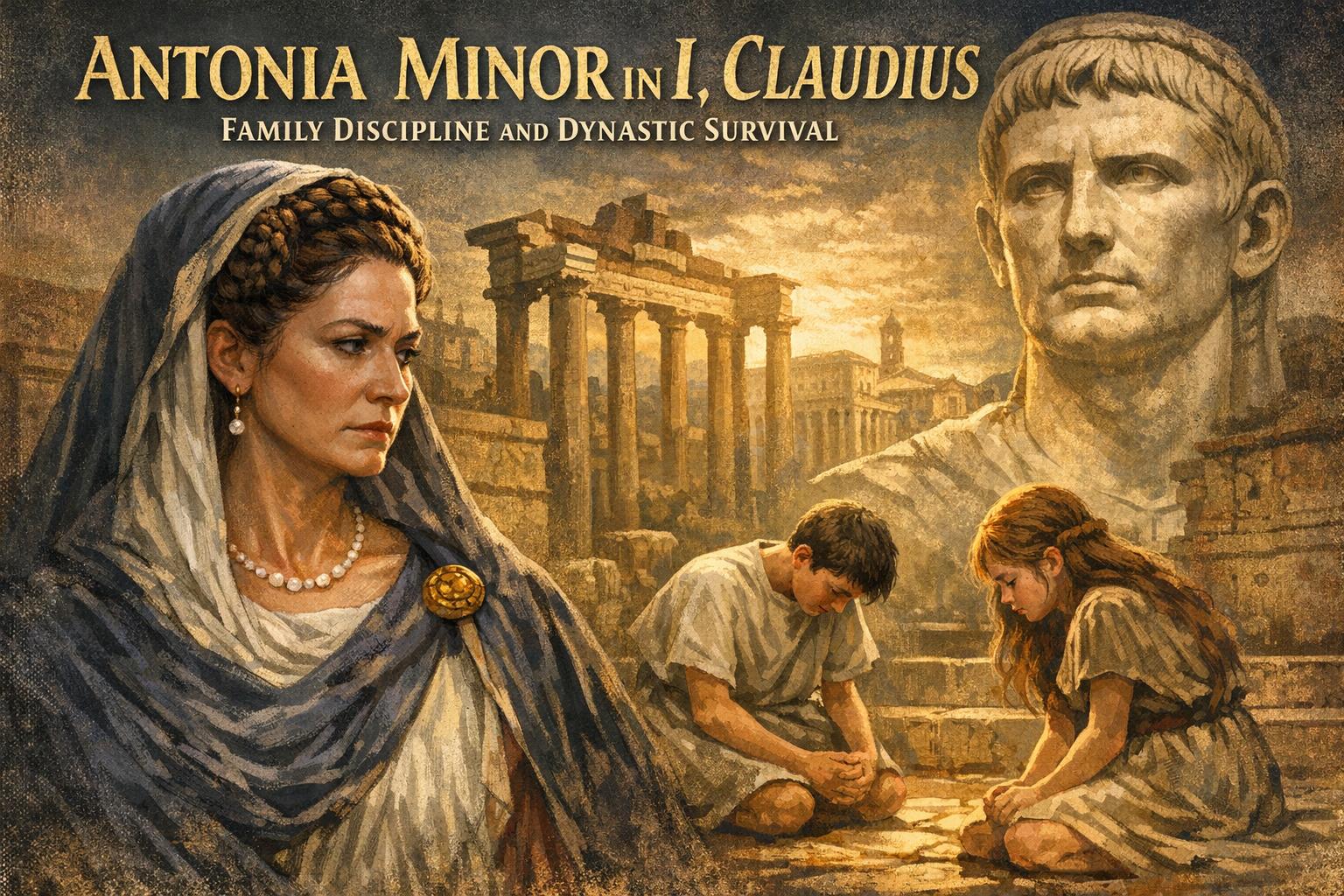
Introduction to Antonia Minor
Antonia Minor occupies a prominent place in Robert Graves’ historical novel I, Claudius, where she is depicted as one of the central matriarchal figures of the Julio-Claudian dynasty. Within the narrative, she functions not merely as a background presence but as a stabilizing and often formidable force in an imperial household marked by rivalry, suspicion, and calculated ambition. Graves presents her as a woman shaped by the demands of lineage and power, one who understands that private family choices have direct public consequences in a system where the ruling household and the state are inseparable.
Her character illustrates the burdens placed upon elite Roman women, particularly those born into ruling families. In an environment where succession was uncertain and reputations could shift rapidly, Antonia’s vigilance and discipline are portrayed as essential instruments of survival. The novel emphasizes her belief that continuity of authority depends on personal restraint, loyalty, and adherence to tradition, even when such expectations cause strain within her immediate family. Through her actions and judgments, Graves explores the broader dynamics of dynastic preservation and political caution, themes that recur throughout the narrative.
Historical Background and Lineage
Antonia Minor was born into a lineage that was central to the transformation of Rome from republic to empire. As the daughter of Mark Antony and Octavia Minor, she was connected to two powerful political traditions. Her mother was the sister of Augustus, Rome’s first emperor, while her father had been one of the principal figures in the final struggles of the Roman Republic. This heritage placed Antonia at the intersection of competing legacies: that of Antony’s earlier prominence and eventual downfall, and that of Augustus’ consolidation of authority.
In I, Claudius, this dual inheritance informs her outlook. She is conscious of the consequences of political miscalculation, having witnessed through family history the costs of rivalry with Augustus. At the same time, she remains firmly aligned with the Augustan vision of order and continuity. Graves uses her background to reinforce her sense of duty to uphold imperial stability and to avoid the excesses that had contributed to previous conflict.
Her marriage to Nero Claudius Drusus further strengthened her position within the emerging imperial structure. Drusus was the brother of Tiberius and an esteemed general whose campaigns extended Roman influence into Germania. Through this marriage, Antonia became doubly integrated into the mechanisms of imperial governance. The alliance brought together the Julian and Claudian lines, consolidating both prestige and practical authority.
Marriage and Position in the Julio-Claudian Household
In the novel, Antonia’s marriage is portrayed not as a romantic partnership but as a political and familial arrangement typical of Roman aristocratic society. She is shown to value Drusus’ discipline and military reputation, qualities that align with her own expectations regarding conduct and service to Rome. His early death, however, leaves her in a position of considerable responsibility.
As a widow, Antonia assumes increased control over the upbringing of her children and the management of her household. Roman widows of elite status could command significant autonomy, and Graves presents her as exercising this authority without hesitation. She becomes known for her insistence on moral rigor and loyalty to imperial principles. In a household where proximity to power invites constant scrutiny, she acts as both a guardian of reputation and a regulator of behavior.
Her residence functions as a microcosm of the broader imperial court. Within it, personal ambition, rivalry, and fear are constant undercurrents. Antonia’s approach to governance within the family parallels the methods required at the imperial level: observe carefully, reward consistency, and respond decisively to perceived threats. This framing reinforces Graves’ larger theme that domestic and political spheres are inseparable in an imperial dynasty.
Family Discipline and Moral Expectations
Antonia’s commitment to family discipline stands out as one of her defining characteristics in I, Claudius. She maintains strict standards regarding education, behavior, and public presentation. For Antonia, the conduct of her children reflects directly upon the emperor and the stability of the state. Any sign of weakness, indiscretion, or extravagance carries potential consequences not only for the individual but for the dynasty as a whole.
Her disciplinary methods are depicted as methodical rather than impulsive. She monitors her children’s tutors, scrutinizes their associations, and responds firmly to deviation from acceptable norms. Although Roman household authority traditionally belonged to the male paterfamilias, Antonia’s widowhood and senior status allow her to exercise a comparable degree of influence. She operates within established Roman values—emphasizing restraint, loyalty, and civic responsibility—while using them to justify rigorous oversight.
In this environment, affection is subordinated to duty. Graves portrays her as capable of attachment but unwilling to allow personal sentiment to override considerations of public reputation. The novel thus presents her discipline as a strategic function rather than an expression of temperament. The maintenance of order in her household mirrors the need for stability within the empire at large.
Relationships with Her Children
Antonia’s interactions with her children—Germanicus, Livilla, and Claudius—reveal the complexity of her maternal authority. Each child embodies a distinct response to the pressures of dynastic expectation.
Germanicus, the most celebrated of her offspring, commands public admiration and military respect. In him, Antonia sees the realization of her ideals: bravery, self-control, and loyalty to Rome. She supports and guides him, understanding that his public conduct strengthens the legitimacy of the familial line. Her pride in Germanicus, however, does not translate into indulgence. She remains attentive to the political implications of his popularity, aware that excessive acclaim might provoke suspicion within the imperial hierarchy.
Livilla presents more challenges. As a daughter in a dynasty dependent on strategic marriages, she becomes an instrument of alliance-building. Antonia’s management of Livilla’s marriage reflects Roman aristocratic practice, where personal preference yields to collective advantage. In the novel, tension arises between Livilla’s ambitions and her mother’s expectation of disciplined conformity. Antonia’s surveillance and corrective measures illustrate her awareness of the dangers posed by ambition unrestrained by caution.
Claudius and Maternal Judgment
Claudius, the narrator of I, Claudius, receives the most detailed attention in the text. Physically awkward and affected by a speech impediment, he is regarded by many family members as an embarrassment. Antonia is depicted as particularly critical, expressing disappointment in what she perceives as his deficiencies. Her assessment of him is shaped by the Roman emphasis on physical bearing and oratorical ability as markers of leadership potential.
However, Graves subtly frames this disapproval as integral to Claudius’ survival. Because he is underestimated and excluded from serious political calculations, he avoids the lethal scrutiny directed at more prominent heirs. Antonia’s skepticism contributes indirectly to this dynamic. By dismissing Claudius as unlikely to hold power, she reinforces the widespread assumption that he poses no threat. This perception allows him to observe events unnoticed and to cultivate intellectual skills that ultimately sustain him.
Antonia’s treatment of Claudius underscores a recurring theme: in the Julio-Claudian environment, perceived weakness can function as protection. Her inability to recognize his resilience illustrates the limits of even a disciplined matron’s judgment. Yet her insistence on education and decorum ensures that Claudius remains within the cultural framework expected of a Roman aristocrat, preserving the social legitimacy he later requires.
Dynastic Survival and Political Calculation
The survival of a ruling dynasty in early imperial Rome depended on more than military conquest or senatorial approval. It required careful orchestration of marriages, reputations, and alliances. In I, Claudius, Antonia emerges as a figure acutely attuned to these necessities. She recognizes that the imperial household is constantly subject to rumor and manipulation. Failure to respond decisively could invite factional consolidation among rivals.
Her strategies include close observation of shifting loyalties and an insistence on public decorum. She discourages conspicuous displays of wealth or personal grievance that might attract attention. When confronted with potential scandal, she acts to contain it, prioritizing containment over confrontation. Graves portrays her as pragmatic, aware that open conflict within the family only strengthens external opponents.
Antonia’s political awareness is complemented by restraint. Unlike figures driven by overt ambition, she does not seek direct control over imperial administration. Instead, her influence operates through counsel, reputation, and example. She embodies the Roman ideal of the authoritative matron whose moral standing undergirds the legitimacy of male leadership.
Interaction with Tiberius and the Imperial Court
After the death of Augustus, the accession of Tiberius reshapes court dynamics. Antonia’s position requires adaptation to a ruler characterized in Graves’ narrative by reserve and suspicion. Her familial connection to Tiberius offers proximity but not immunity from political tension.
She continues to advocate stability and deference to established hierarchy. In a court atmosphere often dominated by intrigue, her consistency provides a counterbalance. Although she cannot prevent the tragedies and accusations that affect her children and relatives, she responds with measured decision-making rather than public protest. This restraint aligns with Roman expectations of aristocratic composure.
Her ability to navigate the imperial environment depends upon maintaining credibility. By avoiding overt challenge and demonstrating loyalty, she preserves her household from certain forms of retaliation. Graves suggests that such moderation constitutes a form of power in itself, particularly in a system where perceived disloyalty can result in prosecution or exile.
Gender, Authority, and Roman Social Norms
Antonia’s portrayal invites examination of gendered authority in early imperial Rome. Although women were excluded from formal office, elite matrons wielded influence through family networks, patronage, and moral standing. Antonia exemplifies this indirect authority. She shapes decisions through persuasion, controls substantial property, and oversees the education of future leaders.
Graves’ narrative situates her within a tradition of Roman matronal virtue, emphasizing austerity and domestic management. Yet her influence extends beyond the private domain. Her household becomes a site of political instruction and alliance formation. In this way, I, Claudius highlights the porous boundary between domestic supervision and statecraft.
Antonia’s authority rests on conformity to expected virtues rather than deviation from them. She does not reject Roman gender norms but operates effectively within them. Her power is therefore depicted as legitimate and stabilizing rather than disruptive. This framing contrasts with other female figures in the novel whose manipulations generate instability. Through Antonia, Graves presents an alternative model: disciplined, tradition-bound, and oriented toward continuity.
Comparison with Other Influential Women
Within the broader narrative of I, Claudius, Antonia stands in contrast to figures such as Livia and Livilla, whose ambitions are associated with calculated ambition and covert maneuvering. While Livia’s influence is often linked to suspicion and alleged intrigue, Antonia’s actions are characterized by overt discipline and adherence to hierarchy.
This comparative portrayal reinforces her image as a guardian of established order rather than a disruptor. She does not seek to engineer succession through clandestine tactics but instead prepares her family to endure unpredictable shifts. The distinction is not absolute—both women operate within political realities—but Graves delineates differences in method and emphasis.
Through this contrast, Antonia’s approach appears cautious and structured. She values predictability and reputation over rapid advancement. This orientation reflects her understanding that in a volatile environment, continuity offers greater security than acceleration.
Political Alliances and Strategic Foundations
Marriage alliances were fundamental to Roman elite politics. Antonia’s marriage to Drusus unified influential branches of the ruling family and reinforced the legitimacy of their descendants. After his death, she continued to manage alliances through her children’s marriages, ensuring their integration within the imperial framework.
Her strategy emphasizes long-term positioning rather than immediate gain. She evaluates potential connections not only for prestige but for stability. By discouraging overt ambition among her offspring, she reduces the likelihood of provoking hostility from reigning authorities. In this sense, her alliance-building prioritizes durability.
The novel suggests that such calculated moderation contributes to the eventual survival of at least one branch of her family line. Claudius’ unexpected elevation to emperor, occurring after the violent reign of Caligula, illustrates how sustained legitimacy can outlast more dramatic assertions of power. Antonia’s foundational efforts, though not designed to produce this outcome, help maintain the structural credibility of her lineage.
Legacy and Historical Perception
Antonia Minor’s historical legacy is shaped by both ancient sources and literary reinterpretation. Roman historians generally assign her a reputation for severity and moral probity. Graves draws upon these attributes, amplifying them where necessary for narrative effect while preserving core characteristics.
In I, Claudius, her legacy is intertwined with the survival narrative of her son. Although she does not witness every subsequent development, her early insistence on education, restraint, and loyalty forms part of the foundation upon which Claudius builds his unexpected rule. Her skepticism toward his capacity for leadership contrasts with the reality that unfolds, adding complexity to her portrayal.
From a broader perspective, Antonia represents a model of conservative imperial stewardship. She does not initiate reforms or military campaigns; instead, she safeguards institutional continuity. In periods of transition—between Augustus and Tiberius, and later amid internal suspicion—such stewardship proves essential.
Scholarly discussion of Antonia often centers on the intersection of maternal authority and political calculation. Her example demonstrates how private governance within elite households contributed materially to imperial stability. By shaping heirs and alliances, she participates in statecraft through familial management.
Conclusion: Antonia Minor in Narrative and History
Antonia Minor, as depicted in I, Claudius, embodies the disciplined matriarch whose vigilance underwrites dynastic endurance. Her life reflects the constraints and opportunities of elite Roman womanhood, illustrating how authority could be exercised without formal office. Through strict family governance, strategic alliance-building, and consistent adherence to tradition, she sustains her position within a volatile imperial landscape.
Graves’ portrayal neither idealizes nor condemns her. Instead, he situates her within the structural demands of early imperial rule, where personal decisions carried national implications. Her commitment to order and continuity contrasts with the instability generated by more overtly ambitious figures. In doing so, the narrative presents Antonia as a stabilizing force whose influence, though indirect, proves consequential.
Her historical and literary significance resides in this interplay between domestic discipline and political foresight. By understanding the inseparability of family and state, she navigates the complexities of the Julio-Claudian world with consistency. In a dynasty marked by spectacle, rivalry, and abrupt reversals, Antonia Minor stands as a representation of controlled authority and measured strategy, contributing to the endurance of her lineage and to the broader narrative of Rome’s imperial formation.