
Introduction
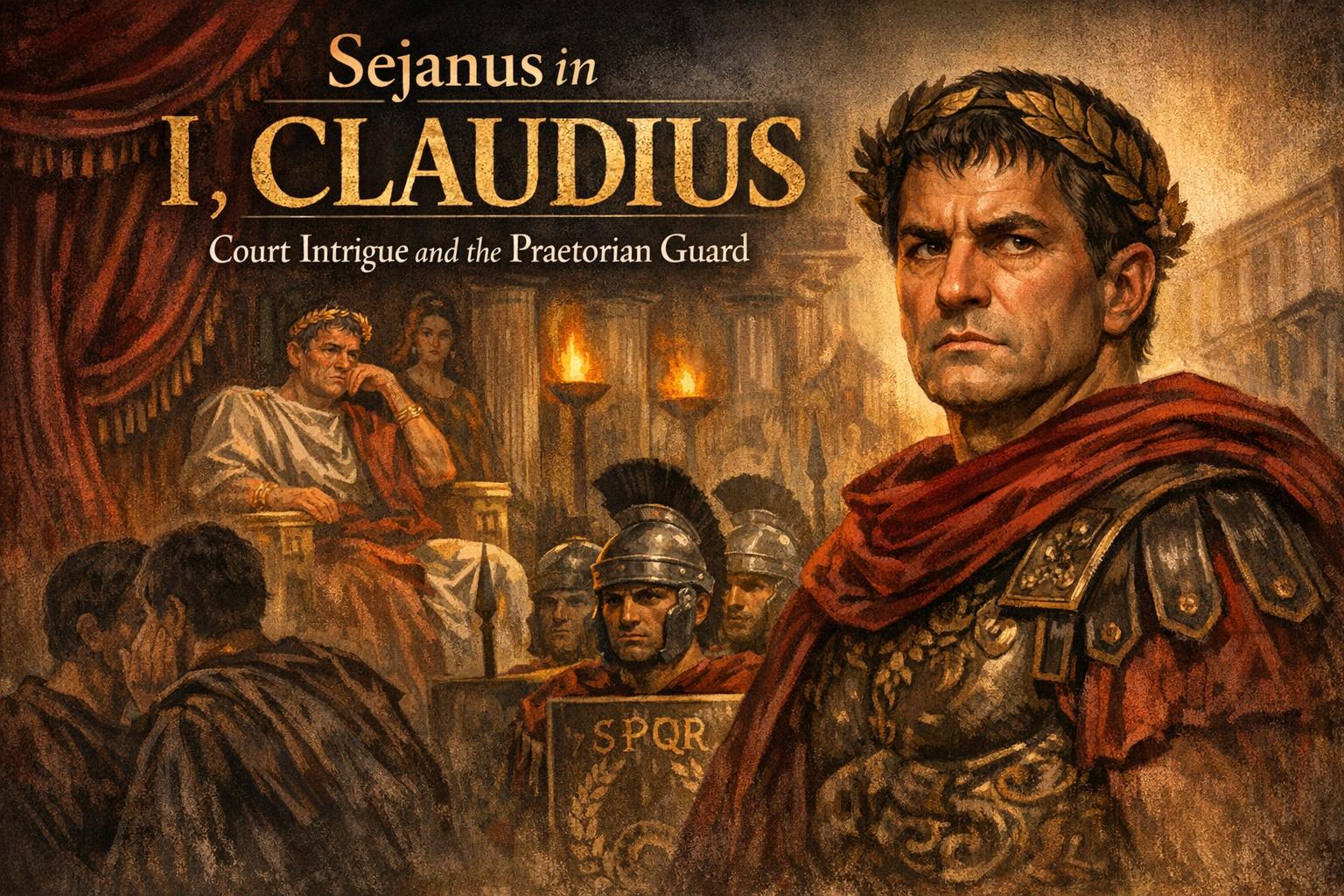
In Robert Graves’ novel I, Claudius, Lucius Aelius Sejanus stands as one of the most consequential figures in the political drama of the early Roman Empire. Presented through the retrospective narration of the Emperor Claudius, the novel reconstructs the Julio-Claudian dynasty as a period shaped by ambition, rivalry, uncertainty, and calculated maneuvering. Within this framework, Sejanus emerges not merely as a court official but as an architect of power who operates behind the façade of loyalty. His rise illustrates how authority in Rome was not secured solely by imperial lineage but also by proximity to the emperor and command over the military forces stationed in the capital.
The character of Sejanus in I, Claudius draws heavily upon historical accounts, particularly those of Tacitus and Suetonius. Graves blends documented events with psychological interpretation, portraying Sejanus as a calculating administrator who identifies structural weaknesses in the political system and exploits them. Through the command of the Praetorian Guard and strategic alignment with Emperor Tiberius, Sejanus becomes a central force in determining the fate of senators, heirs, and rivals alike. His career demonstrates how administrative authority, when coupled with personal ambition, could destabilize even an established imperial regime.
The Rise of Sejanus
Lucius Aelius Sejanus was born into the equestrian class rather than the traditional senatorial elite. His father, Lucius Seius Strabo, held the command of the Praetorian Guard before him. This origin is significant in understanding both his methods and the suspicion he later attracted. As a member of the equestrian order, Sejanus lacked the ancestral prestige that shaped Roman aristocratic politics. He was therefore dependent upon imperial favor and institutional control rather than inherited networks of loyalty.
When Emperor Tiberius appointed Sejanus as sole commander of the Praetorian Guard in AD 14, shortly after Augustus’ death, the role carried both practical and symbolic weight. The Guard functioned as the emperor’s personal bodyguard, but its influence extended far beyond physical protection. Sejanus quickly recognized that command of an armed force stationed in proximity to Rome conferred leverage unmatched by ordinary senatorial offices.
Graves’ narrative emphasizes Sejanus’s patience during his early years in power. Rather than immediately asserting dominance, he cultivated an image of disciplined efficiency and personal devotion to Tiberius. He positioned himself as indispensable to the emperor’s security and administrative stability. In both the novel and historical sources, this period is marked by an incremental expansion of responsibility. Sejanus did not seize influence abruptly; he accumulated it through regular access to the emperor and control over information.
His rise coincided with broader tensions within the Julio-Claudian family. Suspicion, succession concerns, and rivalries among potential heirs created opportunities for an ambitious administrator. By presenting himself as loyal to Tiberius’s authority while subtly undermining competing dynastic figures, Sejanus expanded his sphere of influence at court.
Sejanus and the Praetorian Guard
The Praetorian Guard was originally organized by Augustus as a dispersed protective force. Its cohorts were stationed across different locations in Italy to avoid concentrating military strength within the city. Sejanus identified this dispersion as a strategic limitation. Around AD 23, he consolidated the Guard into a single fortified camp, the Castra Praetoria, on the outskirts of Rome. This administrative reform had long-term consequences.
By centralizing the Guard, Sejanus achieved multiple objectives. First, he strengthened discipline and coordination among the cohorts. Second, he ensured that a sizeable, loyal military presence was permanently located near the capital. Third, he enhanced his own visibility as commander. The Praetorian camp became both a defensive stronghold and a political symbol. It underscored that the commander of the Guard wielded tangible force at moments of crisis.
In I, Claudius, Graves portrays this development as a turning point. The consolidation of the Guard elevated Sejanus from trusted official to power broker. Senators became aware that he commanded the only significant military force within immediate reach of the Senate and imperial residences. Although the legions stationed in the provinces were numerically superior, they were geographically distant. Within Rome itself, Sejanus’s troops were decisive.
Control over the Guard also allowed him to influence investigations, arrests, and executions. During trials for treason, known as maiestas trials, the existence of a responsive security force reinforced the climate of fear. While ultimate legal authority remained with the emperor and Senate, enforcement lay with those who carried out orders. Sejanus’s command ensured that decrees against opponents were swiftly implemented.
Consolidation of Power
As Sejanus secured military leverage, he expanded his political reach through alliances and calculated accusations. The Roman Senate during Tiberius’s reign was marked by tension between traditional aristocratic independence and imperial oversight. Sejanus positioned himself as an intermediary who managed these tensions in the emperor’s absence.
In the novel, Sejanus systematically targets members of the imperial family who might threaten his aspirations. Historically, he was widely suspected of involvement in the downfall of Germanicus’s family, including the prosecution of Agrippina the Elder and her sons. Graves integrates these events into a coherent narrative of ambition. Sejanus appears not simply as a participant in existing suspicion but as a catalyst who intensifies rivalries for personal advancement.
The method by which he discredited rivals relied upon the Roman legal system’s handling of treason. Charges of conspiracy against the emperor were potent tools. Accusations, once initiated, were difficult to refute in an atmosphere of fear and limited transparency. Informers, known as delatores, often benefited from successful prosecutions. Sejanus’s alleged use of such informers strengthened the perception that he orchestrated political eliminations while maintaining formal adherence to legal procedures.
His consolidation of power also included efforts to integrate himself into the Julio-Claudian dynasty. According to ancient sources, he sought marriage into the imperial family. Tiberius initially resisted these ambitions, wary of the precedent set by Augustus in controlling dynastic alliances. Nevertheless, Sejanus’s proximity to imperial decision-making allowed him to influence appointments, provincial commands, and Senate deliberations. By the late 20s AD, he functioned as a de facto administrator in Rome.
Sejanus and Tiberius
The relationship between Sejanus and Emperor Tiberius is central to understanding his career. Tiberius was an experienced military commander but was often described as reserved and distrustful. His withdrawal to the island of Capri in AD 26 dramatically altered the administrative structure of the empire. Though he remained emperor, physical distance from Rome created a vacuum in daily governance.
In I, Claudius, Graves interprets Tiberius’s withdrawal as both strategic and psychological. The emperor, disillusioned with senatorial politics and family intrigue, relied increasingly on trusted intermediaries. Sejanus became chief among them. Correspondence between Capri and Rome passed through his hands. He supervised trials, communicated imperial instructions, and presented summaries of political developments.
This arrangement magnified his influence. Few individuals could question directives that appeared to originate from Capri. Whether Sejanus shaped these directives or merely transmitted them has been debated by historians. In the novel, ambiguity is maintained, reinforcing Sejanus’s image as a figure who thrives in indirect control.
Despite apparent trust, Tiberius had reasons for caution. Roman political culture valued balance among elites. The concentration of authority in a single non-imperial official disrupted established norms. Over time, indications emerged that Sejanus’s ambitions extended beyond administration. Rumors circulated that he aspired to marry into the imperial line or even position himself as successor.
The tension between reliance and suspicion defined the final phase of their association. Tiberius depended on Sejanus’s organizational abilities but remained alert to the potential for betrayal. This ambivalence is vividly dramatized in Graves’ narrative, where Claudius observes the gradual deterioration of trust.
Downfall and Legacy
Sejanus’s fall in AD 31 was swift and decisive. After years of advancement, he was suddenly denounced by Tiberius in a letter read before the Senate. The precise motivations remain debated. Some historians suggest that further evidence of conspiracy reached the emperor. Others argue that Tiberius, perceiving an imbalance of power, acted preemptively.
According to traditional accounts, the Senate initially responded with hesitation, uncertain whether the imperial letter contained praise or condemnation. Once its meaning became clear, Sejanus was arrested, imprisoned, and executed the same day. His body was reportedly subjected to public indignity, and his family and supporters faced prosecution. The rapid reversal underscores the fragility of authority based on imperial favor.
In I, Claudius, the episode is presented as an example of the volatility inherent in autocratic systems. Sejanus, who had orchestrated numerous prosecutions, became the subject of similar procedures. The mechanisms he employed against rivals were turned against him. Graves portrays this outcome not as poetic justice but as a structural feature of imperial politics: concentration of power invites counteraction.
The aftermath of Sejanus’s execution included renewed purges, as associates were identified and punished. Tiberius’s suspicion intensified, contributing to a climate of repression in the later years of his reign. The Praetorian Guard, though discredited by its commander’s actions, remained a decisive institution in Roman politics. Subsequent emperors, including Claudius himself, would rely heavily upon it.
Sejanus’s legacy is therefore dual. Historically, he demonstrated how the prefecture of the Praetorian Guard could evolve into a central political office. Literarily, in Graves’ reconstruction, he functions as a study in calculated ambition within a fragile constitutional framework. His career shows that authority in the Roman Empire rested not solely on hereditary legitimacy but on the alignment of military command, administrative competence, and personal access to the emperor.
Further Exploration
The figure of Sejanus has attracted sustained scholarly attention because his career illuminates broader transitions in Roman governance. Under Augustus, the Principate was presented as a restoration of republican norms under imperial leadership. By Tiberius’s reign, the concentration of authority had become more apparent. Sejanus’s prominence reflects this evolution. The Praetorian prefecture transformed from a protective command into a political instrument capable of shaping succession and policy.
Primary sources, including Tacitus’ Annals, provide the foundation for understanding these events. Tacitus presents Sejanus as a manipulative figure who exploited Tiberius’s isolation. Suetonius and later historians contribute additional details, though with varying emphasis and reliability. Modern historians examine these accounts critically, recognizing that retrospective moral judgments may have influenced depictions of Sejanus.
In literary terms, I, Claudius integrates these historical traditions into a coherent narrative voice. Graves presents events through Claudius’s perspective, creating distance between action and narration. Sejanus is neither caricatured nor romanticized; rather, he is depicted as operating logically within circumstances that reward strategic calculation. The novel invites readers to consider how systemic incentives shape individual behavior.
Further exploration of Sejanus’s career involves examination of administrative reforms, the role of informers, and the social mobility of equestrians in imperial service. His trajectory illustrates how new men could attain prominence under the Principate, challenging traditional senatorial dominance. At the same time, his fall reveals that upward mobility was constrained by imperial discretion.
The position of Praetorian prefect continued to evolve after Sejanus. Later prefects, such as Burrus under Nero, wielded considerable influence without necessarily attempting to supplant imperial authority. The precedent set during Tiberius’s reign demonstrated that the office could serve as either a stabilizing or destabilizing force. Emperors increasingly recognized the need to balance reliance on the Guard with safeguards against overconcentration of power.
Sejanus’s story also informs broader discussions about succession in autocratic systems. Without a fixed constitutional mechanism for transferring authority, informal networks and perceptions of loyalty become decisive. The removal of potential heirs during Sejanus’s ascendancy altered the line of succession, indirectly shaping Claudius’s eventual accession. Even in failure, his actions had enduring effects.
In conclusion, the portrayal of Lucius Aelius Sejanus in I, Claudius reflects the interplay between individual ambition and institutional structure in the early Roman Empire. His mastery of the Praetorian Guard, cultivation of imperial trust, and manipulation of political processes enabled a remarkable ascent. His abrupt execution illustrates the limits of power derived from proximity rather than legitimacy. Through both historical record and literary reconstruction, Sejanus remains a central figure for understanding the dynamics of authority, loyalty, and vulnerability within Rome’s first imperial dynasty.