
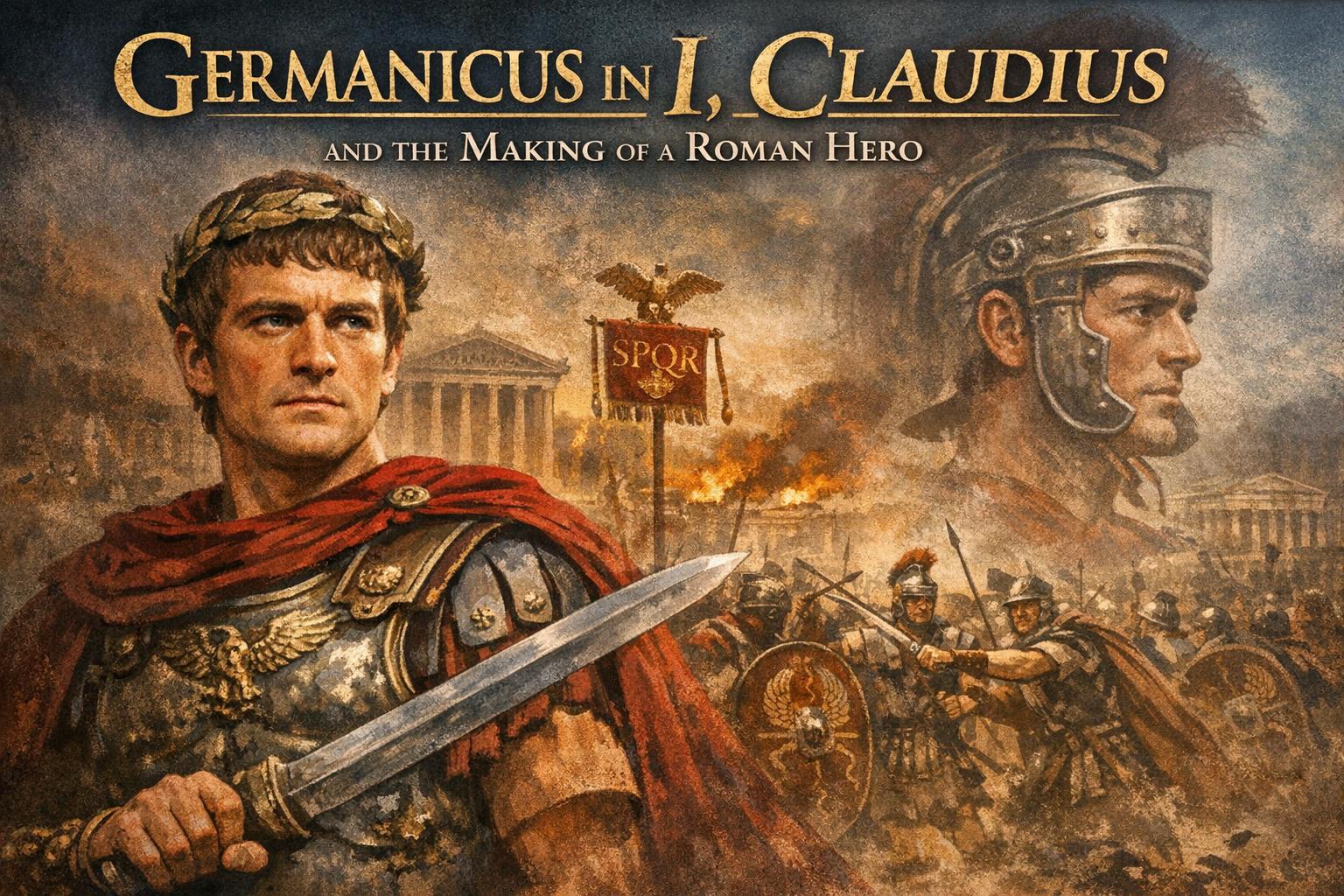
The Character of Germanicus in I, Claudius
I, Claudius, both as a historical novel by Robert Graves and as a later television adaptation by the BBC, presents a sustained exploration of power, succession, and survival within the Julio-Claudian dynasty. Among the numerous figures who populate this account, Germanicus occupies a distinctive position. Although he does not survive long within the narrative frame set by Claudius as retrospective narrator, his presence shapes the moral and political landscape of the early Empire. Graves portrays him as a model of Roman virtue, a counterpoint to corruption, and a symbol of unrealized possibility. Through this representation, Germanicus emerges as both an individual character and an embodiment of Roman ideals.
Germanicus: Historical and Narrative Background
Germanicus Julius Caesar was born in 15 BCE into the complex web of the Julian and Claudian families. The grandson of Mark Antony and Octavia, and adopted by Tiberius at the insistence of Augustus, he combined prestigious ancestry with imperial favor. Historically, he was celebrated for his military campaigns in Germania and for his popularity among both soldiers and civilians. His early death in 19 CE, under circumstances widely suspected to involve poisoning, contributed significantly to his posthumous reputation.
In I, Claudius, Graves draws upon these historical foundations but shapes them within a narrative framework dominated by Claudius’s retrospective voice. Germanicus appears not merely as a public figure but as a personal presence in Claudius’s life. This dual role—both historical hero and intimate family member—allows Graves to present him in a manner that blends admiration with poignancy. Because the novel is written as Claudius’s memoir, Germanicus is filtered through memory, respect, and a sense of irretrievable loss. This narrative distance reinforces the perception of Germanicus as representing an earlier and more honorable phase of imperial rule.
Graves’s emphasis on Germanicus’s lineage also deepens his thematic role. As the adopted son of Tiberius and a favored grand-nephew of Augustus, Germanicus embodies the continuity of the Augustan settlement. Yet his virtue and popularity stand in subtle contrast to the caution and calculation associated with Tiberius. In this way, Germanicus becomes a reminder that imperial succession might have taken a different course, had fate or political maneuvering allowed.
Heroic Traits According to Roman Ideals
In Roman political culture, the concept of heroism was closely tied to public service, military success, and adherence to traditional virtues. These included virtus (courage and excellence), pietas (duty to family, gods, and state), gravitas (seriousness of purpose), and iustitia (justice). In both historical accounts and Graves’s interpretation, Germanicus exemplifies many of these qualities.
His campaigns in Germania form a central component of his heroic identity. Following the disastrous defeat of Varus in the Teutoburg Forest, Roman prestige in the region had suffered greatly. Germanicus’s subsequent expeditions are portrayed as efforts to restore Roman honor. In I, Claudius, these campaigns demonstrate not only military competence but personal bravery. Germanicus is shown sharing hardships with his troops and earning their loyalty through visible leadership rather than distant command. This comportment reflects the Roman admiration for a general who participates actively in the struggles of his soldiers.
Graves further emphasizes Germanicus’s restraint. Although capable of decisive action, he is not depicted as driven by cruelty or ambition for its own sake. His pursuit of military objectives is framed as service to Rome rather than personal aggrandizement. This distinction is significant within the moral architecture of the novel. Where other figures pursue survival or dominance through intrigue and manipulation, Germanicus appears guided by principle. His authority derives from confidence and fairness, not fear.
Germanicus’s public demeanor also reinforces his heroic standing. In Rome, popularity could be a double-edged sword, sometimes interpreted as demagoguery. Yet in Graves’s portrayal, his popularity is presented as a natural consequence of integrity. The Roman people respond to what they perceive as authenticity and loyalty to traditional values. He treats citizens and soldiers with respect, listens to grievances, and avoids unnecessary displays of arrogance. Such behavior aligns with the republican ideal of the citizen-general, even within the framework of imperial governance.
Germanicus’s Relationship with Other Characters
Germanicus’s character is illuminated not only through deeds but through relationships. His marriage to Agrippina the Elder is presented as a partnership grounded in shared values and mutual loyalty. Agrippina is portrayed as strong-willed and politically aware, yet firmly devoted to her husband’s advancement and reputation. Their union reflects a Roman ideal in which personal and political spheres reinforce each other. Together they project stability and continuity, particularly through their children, who symbolize the future of the dynasty.
In interaction with Tiberius, Germanicus occupies a more ambiguous position. Tiberius, as emperor and adoptive father, embodies authority tinged with suspicion. Germanicus’s popularity and independent reputation inevitably create tension. Graves presents this relationship as complex rather than openly antagonistic in its early phases. Germanicus fulfills his duties and avoids overt challenge to imperial command, demonstrating formal obedience. However, his evident success amplifies Tiberius’s insecurity. This tension contributes to the broader theme of political fragility within the Julio-Claudian household.
Germanicus’s relationship with Claudius is particularly significant for the narrative structure of I, Claudius. As narrator, Claudius reflects on his brother with admiration unclouded by rivalry. Unlike other family members, Claudius does not perceive Germanicus as a threat. Instead, he regards him as a model of what a Roman noble might ideally be. This reverence enhances Germanicus’s stature within the text. Because Claudius often adopts a critical or ironic tone toward other figures, his sincerity regarding Germanicus stands out.
Furthermore, Germanicus’s ability to navigate the complexities of family politics demonstrates diplomatic skill. Within a dynasty marked by ambition and suspicion, maintaining alliances without descending into intrigue required tact. Graves suggests that Germanicus possessed this quality, though perhaps not to the extent necessary to survive the full force of imperial politics. His trust in honor and procedure ultimately contrasts with the more calculated strategies employed by figures such as Livia.
The Dramatic Impact of Germanicus’s Death
The death of Germanicus in Syria constitutes one of the most consequential events in I, Claudius. Graves presents it not simply as a biographical endpoint but as a turning point in the moral direction of the narrative. Rumors of poisoning, and suspicions directed toward the governor Piso and possibly toward Tiberius himself, heighten the political stakes. Whether or not direct culpability is established, the perception of injustice transforms Germanicus from an admired general into a symbol of betrayed virtue.
Public reaction to his death reinforces this transformation. The mourning in Rome is described as widespread and deeply felt. Citizens interpret his passing as the loss of a protector and as evidence that corruption has penetrated the highest levels of authority. In this climate, Germanicus acquires qualities associated with martyrdom—not in a religious sense, but as a figure whose death reveals the moral failings of the regime.
For Claudius as narrator, the event marks a shift from hope to endurance. Germanicus represented the possibility of principled leadership within the imperial framework. With his removal, survival becomes the dominant concern for those who remain. The political center moves further toward suspicion and consolidation of power, especially under Tiberius’s later rule. The absence of Germanicus thus reshapes interpersonal dynamics and accelerates the descent into fear and purges.
The dramatic structure of I, Claudius benefits from this early loss. By establishing Germanicus as admirable, Graves creates a standard against which subsequent rulers are measured. Caligula’s excesses, for instance, gain additional significance when contrasted with the remembered discipline and dignity of his father. The narrative also underscores the unpredictability of succession. Merit and popularity do not guarantee survival; instead, endurance often belongs to the cautious or the ruthless.
Conclusion
Germanicus in I, Claudius functions on several interconnected levels. He is a historically grounded individual, a member of the Julio-Claudian dynasty with documented achievements and a well-attested reputation. Within Graves’s narrative, however, he becomes more than a biographical figure. He embodies a set of Roman virtues that appear increasingly rare as the story unfolds. His courage, sense of duty, and moderation align with traditional ideals of leadership, while his relationships reveal loyalty and competence in both private and public spheres.
His early death reinforces his standing by preserving his image from compromise. Unlike those who continue to rule and accumulate moral ambiguity, Germanicus remains fixed in memory as a standard of what might have been. Through Claudius’s reflective narration, readers encounter not merely a lost prince but a lens through which the corruption and instability of imperial politics are made visible.
The portrayal of Germanicus thus contributes significantly to the broader themes of I, Claudius. It invites consideration of how virtue operates within structures shaped by ambition and fear. It also suggests that heroism in the Roman world was inseparable from public service and adherence to tradition, yet vulnerable to forces beyond personal control. In presenting Germanicus as both exemplary and fragile, Graves integrates historical reputation with literary design, ensuring that his influence extends beyond his limited span within the narrative.