
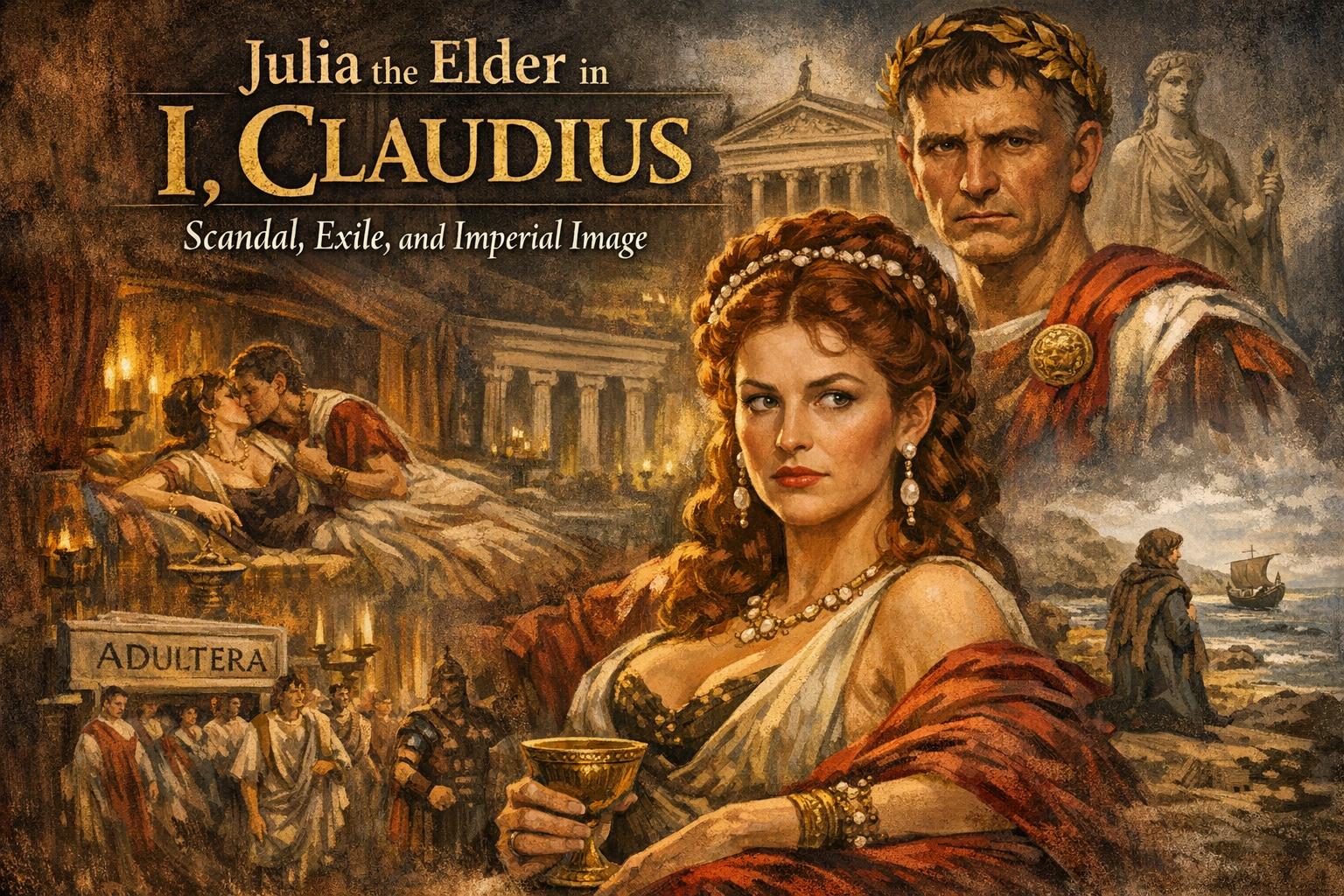
Julia the Elder: Historical Context
Julia the Elder occupied a central yet precarious position within the formative decades of the Roman Empire. As the only biological child of Gaius Octavius, later Augustus, she stood at the intersection of dynastic ambition, moral legislation, and political propaganda. Her life unfolded during a period in which the structures of the Roman Republic were being reshaped into an imperial system under a single ruler. In this context, family relationships were inseparable from affairs of state.
Born in 39 BCE in Rome, Julia entered a world still unsettled by civil war. Her father had recently consolidated his alliance with Mark Antony and Lepidus in the Second Triumvirate, and the political landscape remained volatile. From infancy, Julia’s position was defined less by personal considerations than by her function within a carefully managed network of alliances. As Augustus gradually established supremacy after his victory at Actium in 31 BCE, his need for stability and continuity elevated Julia’s role further. She was not merely a daughter in a noble household; she was the cornerstone of a nascent imperial dynasty.
Roman elite families had long used marriage to forge alliances, but Julia’s experience illustrates how these practices intensified under the emerging principate. Augustus did not publicly present himself as a monarch, yet he constructed a regime that depended upon hereditary continuity. Because he lacked a surviving son, Julia’s marriages became essential instruments for securing succession and reinforcing loyalty among Rome’s leading men.
Early Life and Education
Julia’s upbringing reflected both traditional Roman values and the social transformation that accompanied imperial rule. Augustus sought to cultivate an image of moral reform and ancestral virtue. He publicly advocated for simplicity, discipline, and adherence to ancestral custom, even as he accumulated unprecedented authority. Julia therefore grew up within an environment carefully staged to reflect these ideals.
Ancient sources such as Suetonius and Velleius Paterculus suggest that she received an education suitable for a high-born Roman woman. This likely included instruction in literature, household management, and social conduct. Members of the imperial household were expected to demonstrate modesty, restraint, and loyalty to the state. Yet as the only child of Augustus, she also inhabited a sphere of relative privilege and intellectual exposure. Rome at this time was a cosmopolitan center, and the imperial court attracted poets, rhetoricians, and philosophers.
Augustus’s moral legislation, enacted in the late 20s and early 10s BCE, aimed to regulate marriage and sexual behavior among the Roman elite. Laws such as the Lex Julia de maritandis ordinibus penalized celibacy and adultery while encouraging childbearing. These reforms were framed as efforts to restore traditional Roman morality after decades of civil unrest. Julia herself would later become deeply entangled in the consequences of these statutes.
Marriage to Marcus Claudius Marcellus
Julia’s first marriage was arranged in 25 BCE to Marcus Claudius Marcellus, the son of Augustus’s sister Octavia. At the time of the marriage, Julia was approximately fourteen years old, which was consistent with Roman aristocratic custom. Marcellus, several years older, was widely regarded as a potential heir to Augustus. The union thus represented an early attempt to secure dynastic continuity within the Julian line.
Marcellus was granted rapid advancement in public office, reportedly receiving privileges that marked him as destined for future leadership. Augustus promoted him visibly, and poets such as Virgil referenced him with cautious optimism. The marriage strengthened Augustus’s internal family alliances and signaled a possible line of succession.
However, Marcellus died in 23 BCE after a brief illness. His death disrupted Augustus’s plans and plunged Roman political circles into uncertainty regarding succession. For Julia, still in her teens, widowhood carried both personal and political implications. As the emperor’s only child, she again became central to dynastic calculations.
Marriage to Marcus Vipsanius Agrippa
Following Marcellus’s death, Augustus arranged Julia’s second marriage to Marcus Vipsanius Agrippa, his most trusted general and friend. Agrippa had been instrumental in Augustus’s military victories, including the decisive victory at Actium. Although older than Julia by nearly twenty-five years, Agrippa’s loyalty and proven competence made him an indispensable figure.
The marriage, contracted in 21 BCE, reinforced the bond between Augustus and Agrippa and provided a stable platform for the production of heirs. Julia bore five children in this union: Gaius Caesar, Lucius Caesar, Julia the Younger, Agrippina the Elder, and Agrippa Postumus. Through these children, the Julian line extended into the next generation.
Augustus adopted Gaius and Lucius as his sons and heirs, elevating them prominently in public life. Their education and visibility were carefully managed to present a seamless future for the principate. Coins, inscriptions, and public ceremonies reinforced the imagery of dynastic continuity. In this context, Julia’s role as mother became politically indispensable.
Ancient accounts suggest that Julia’s marriage to Agrippa was outwardly harmonious, though it was unquestionably shaped by political necessity. Agrippa’s frequent absences on military and administrative assignments meant that Julia likely spent extended periods in Rome, participating in courtly and social life. Her position afforded her influence within elite circles, though always under the overarching authority of Augustus.
Agrippa’s death in 12 BCE once again destabilized the succession plan. His passing not only deprived Augustus of a trusted associate but left Julia a widow for the second time. The question of succession became pressing, and Augustus turned to another member of his extended family.
Marriage to Tiberius
In 11 BCE, Julia married Tiberius Claudius Nero, the son of Augustus’s wife Livia from her previous marriage. Tiberius had demonstrated military skill and administrative capability, yet his relationship with Augustus was complex. The marriage required Tiberius to divorce his first wife, Vipsania Agrippina, whom he reportedly loved. The union with Julia, therefore, has been interpreted by ancient historians as politically motivated rather than personally harmonious.
This marriage represented a strategic attempt to consolidate the Julian and Claudian branches of the imperial family. By linking Julia with Tiberius, Augustus sought to integrate his heir designate into the direct bloodline. However, tensions appear to have characterized the relationship. Sources such as Tacitus, writing decades later, suggest mutual dissatisfaction and incompatibility.
Tiberius eventually withdrew from public life and retired to Rhodes in 6 BCE, a move that may reflect personal strain or political calculation. His departure left Julia in Rome, where her activities increasingly drew notice. The deterioration of her marriage further complicated the succession question, especially as Augustus’s adopted sons, Gaius and Lucius, were still alive and anticipated to inherit power.
The Scandal of 2 BCE
Around 2 BCE, Julia became the center of a public scandal that altered the course of her life. She was accused of engaging in multiple adulterous relationships with prominent Roman men. Among those implicated was Iullus Antonius, son of Mark Antony. The charges extended beyond private misconduct; some accounts describe gatherings in the Forum at night and suggest behavior considered incompatible with the moral laws promoted by Augustus.
The precise nature of the accusations remains debated among modern historians. Ancient sources, particularly Suetonius and Tacitus, present Julia’s conduct as openly scandalous. However, these accounts were written under later emperors and reflect moralizing perspectives. Some scholars propose that political motives may have influenced the prosecution, especially given the prominence of those accused.
Under the Lex Julia de adulteriis coercendis, adultery was treated as a public crime rather than a purely personal matter. Augustus, as both father and head of state, assumed responsibility for enforcing the law. The fact that his own daughter faced prosecution underscored the tension between private affection and public authority.
Augustus reportedly reacted with severity. Julia was formally charged and sentenced to exile. Iullus Antonius was compelled to commit suicide. The punishment demonstrated that imperial propaganda concerning moral reform would be applied even within the ruling family. Nevertheless, the episode inevitably exposed contradictions in Augustus’s reform program.
Exile on Pandateria
Julia was banished to the island of Pandateria, a small and austere location in the Tyrrhenian Sea. Conditions there were restrictive. She was reportedly forbidden wine and limited in the company she could keep. Her mother, Scribonia, chose to accompany her into exile, providing some measure of familial support.
Exile was a common Roman punishment for members of the elite whose presence in the capital was deemed politically or socially disruptive. In Julia’s case, the penalty served multiple functions. It removed her from public view, curtailed potential political intrigue, and reinforced Augustus’s commitment to his moral legislation.
After several years, her confinement was eased slightly, and she was relocated to Rhegium on the Italian mainland. Even there, however, she remained under supervision. She was excluded from the imperial household and denied participation in the public life she had once inhabited.
Succession Crises and Political Implications
The years following Julia’s exile were marked by further instability within the imperial family. Gaius and Lucius Caesar both died prematurely, in 2 CE and 4 CE respectively. Their deaths left Augustus without his chosen heirs and compelled him to adopt Tiberius formally as his successor. Agrippa Postumus, Julia’s youngest son, was also adopted but later exiled under contentious circumstances.
Julia’s disgrace weakened the perceived legitimacy of her branch of the family. The elimination, whether by death or exile, of several potential heirs reshaped the imperial succession. By the time Augustus died in 14 CE, Tiberius stood as the undisputed successor, though not without lingering questions regarding the stability of the dynastic arrangement.
Julia herself did not witness the consolidation of Tiberius’s reign. According to most accounts, she died in 14 CE, possibly from malnutrition or illness exacerbated by her prolonged marginalization. Some sources imply that Tiberius was indifferent to her fate, though definitive evidence is limited.
Impact on the Julian Family Image
Julia’s scandal had lasting implications for the public image of the Julian dynasty. Augustus had invested considerable effort in portraying his household as a model of Roman virtue. Monuments, coinage, and public ceremonies emphasized themes of fertility, piety, and continuity. The exposure of adultery within his own family threatened this carefully constructed narrative.
At the same time, Augustus’s willingness to punish his daughter reinforced his authority and the seriousness of his reforms. The tension between propaganda and reality, however, remained evident. Roman observers could not entirely separate the ruler’s legislative agenda from the failures within his own household.
The broader question of women’s roles within the imperial system is also illuminated by Julia’s experience. Elite Roman women possessed social influence but limited formal power. Their marriages served political objectives; their conduct could enhance or damage dynastic prestige. Julia’s prominence made her actions subject to intensified scrutiny. Her case demonstrates how female members of the imperial family were integrated into statecraft while remaining vulnerable to severe consequences.
Representation in Ancient and Later Sources
Ancient historians wrote about Julia within broader narratives of moral decline and imperial authority. Tacitus, composing his Annals in the early second century CE, depicted the early principate as a period of constrained liberty. His treatment of Julia reflects this critical stance. Suetonius, in his biographies of the Caesars, included anecdotes that emphasize personal misconduct.
These sources must be approached cautiously. They often relied on earlier accounts colored by political rivalry and moral interpretation. Modern scholarship has reconsidered Julia not merely as a transgressor of social norms but as a participant in complex power dynamics. Some arguments propose that the charges against her may have intersected with factional struggles within the imperial household.
Julia’s story has also influenced later cultural representations, including Robert Graves’s I, Claudius, where she appears as part of a broader narrative of intrigue and succession. Such portrayals blend historical evidence with literary embellishment, shaping popular perceptions of her character.
Conclusion
Julia the Elder’s life offers a focused lens through which to examine the political, social, and familial structures of the early Roman Empire. As the daughter of Augustus, she embodied the promise of dynastic continuity. Through three strategically arranged marriages, she facilitated alliances that underpinned the stability of the principate. As the mother of potential heirs, she became central to Augustus’s plans for succession.
Her prosecution and exile illustrate the constraints placed upon imperial women and the high stakes associated with personal conduct in a politicized environment. Whether her actions were primarily personal indiscretions or entangled with broader political tensions, their consequences were profound. Augustus’s moral legislation gained credibility through its application to his own household, yet the incident also revealed the fragility of the regime’s moral narrative.
The trajectory of Julia’s life—from privileged daughter to exiled figure—reflects the intersection of personal agency and structural necessity within Roman governance. Her experiences underscore the extent to which family, law, and power were interwoven during the formation of the imperial system. Through her story, it is possible to observe the mechanisms by which Augustus sought to secure continuity and the vulnerabilities inherent in that effort.