
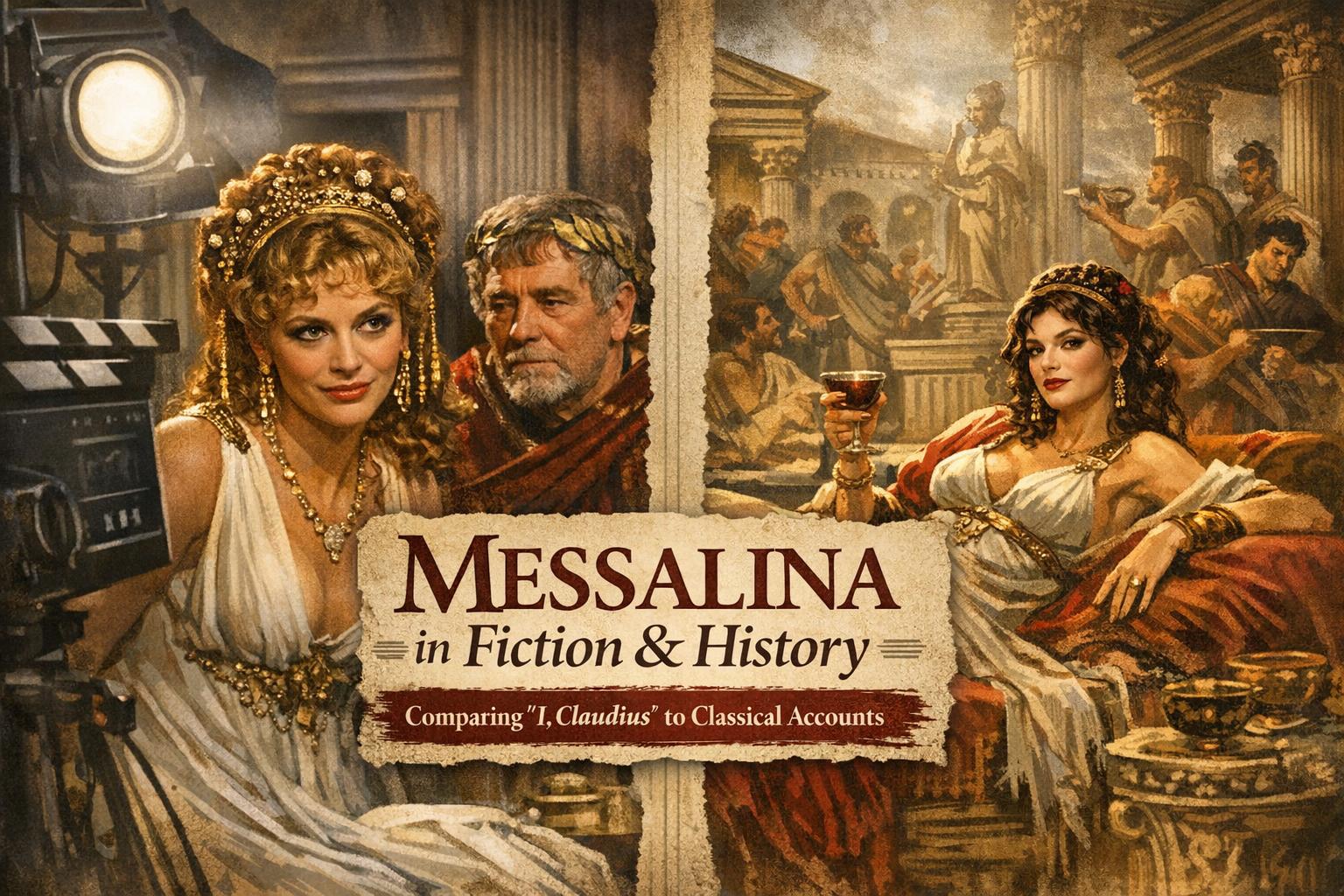
Introduction to Messalina
Messalina, formally known as Valeria Messalina, occupies a distinctive position in the history of the early Roman Empire. As the third wife of Emperor Claudius, who ruled from 41 to 54 CE, she lived at the center of imperial authority during a formative period in Roman governance. Her name has become closely associated with intrigue, political manipulation, and alleged sexual excess. The evolution of her image over time demonstrates how ancient historiography, political ideology, and later literary reinterpretations can shape the legacy of a historical figure.
Messalina’s life is documented primarily through the works of Roman historians such as Tacitus and Suetonius, writing several decades after her death. Their narratives have significantly influenced subsequent understandings of her character. In the twentieth century, Robert Graves reinterpreted her figure in his historical novel I, Claudius, blending classical sources with imaginative reconstruction. The convergence of ancient commentary and modern fiction has created a composite image that is often difficult to disentangle from the underlying historical reality.
Understanding Messalina requires attention not only to the events attributed to her but also to the political context in which the sources were written. Both ancient historians and modern novelists operated with specific intentions, audiences, and interpretative frameworks. Consequently, the figure of Messalina serves as a case study in how narrative traditions can both preserve and reshape the past.
Historical Context: The Roman Imperial Court
Messalina lived during the Julio-Claudian dynasty, a line of emperors beginning with Augustus and ending with Nero. The imperial court in this period was characterized by intricate family connections, competition among aristocratic households, and the concentration of power within the emperor’s household. Marriage alliances played a critical role in consolidating authority and ensuring succession. Women of the imperial family often found themselves positioned as intermediaries between influential networks.
Claudius became emperor after the assassination of Caligula in 41 CE. At the time, Messalina was already his wife, having married him around 38 or 39 CE. She was considerably younger than Claudius and bore him two children: Britannicus, a potential heir, and Octavia, who would later marry Nero. Through motherhood and proximity to the emperor, Messalina held a status that extended beyond ceremonial presence. The role of empress, though not formally defined in constitutional terms, involved patronage, influence in appointments, and participation in court dynamics.
The imperial court operated within a climate of suspicion and rivalry. Freedmen, senators, equestrians, and members of the imperial household competed for favor. In such an environment, accusations of conspiracy and moral misconduct were common political tools. Messalina’s alleged activities must therefore be considered within the framework of ongoing struggles for influence.
Messalina in Tacitus
Tacitus, writing in the early second century CE, provides one of the most detailed accounts of Messalina in his Annals. His portrayal emphasizes ambition and the misuse of imperial authority. Tacitus presents her as exercising substantial influence over Claudius, who is depicted as susceptible to persuasion and often unaware of court machinations.
According to Tacitus, Messalina engaged in actions intended to eliminate rivals and secure advantages for herself and her associates. He describes episodes in which she is implicated in the downfall of prominent individuals. One frequently cited narrative involves her alleged role in manipulating Claudius to remove political threats through charges of treason. Tacitus suggests that her motivations combined personal animosity with the desire to consolidate her position.
A central episode in Tacitus’s account concerns her relationship with Gaius Silius. The historian reports that Messalina entered into a marriage-like union with Silius while Claudius was still alive. This act, if accurate, represented not only personal misconduct but a political challenge, as Silius was a figure of senatorial standing. Tacitus frames the episode as the culmination of her recklessness and ambition, ultimately leading to her execution in 48 CE.
Tacitus’s narrative style is analytical yet moralizing. He often interprets events in light of broader themes about corruption under imperial rule. His depiction of Messalina aligns with his criticism of the moral decline he associates with autocracy. Although Tacitus claims adherence to factual reporting, his selection and emphasis reflect interpretative choices shaped by hindsight and senatorial perspective.
Messalina in Suetonius
Suetonius, another early second-century historian, provides a different type of account in The Twelve Caesars. His approach is more biographical and anecdotal, often emphasizing personal habits and scandals. In his portrayal of Messalina, Suetonius highlights sensational episodes that underscore her alleged sexual behavior.
One of the most frequently repeated stories in later tradition originates in Suetonius’s work. He claims that Messalina competed with a courtesan to determine who could engage in relations with the greatest number of partners within a fixed period. Although modern historians question the literal accuracy of such accounts, their inclusion illustrates how themes of excess and impropriety became central to her reputation.
Suetonius’s method differs from Tacitus in structure and purpose. Rather than constructing a continuous political narrative, he organizes material around character traits and noteworthy incidents. His treatment of Messalina contributes significantly to the enduring association between her name and promiscuity. The anecdotal format, however, leaves limited space for contextual explanation or evaluation of political motivations.
Both Tacitus and Suetonius wrote under emperors who followed the Julio-Claudian line. Their distance from the events allowed for retrospective judgment but also relied on earlier sources and possibly oral traditions that had already shaped Messalina’s image. The repetition of similar allegations in multiple accounts does not necessarily confirm their factual basis but does suggest the existence of a consistent narrative tradition.
Political Agency and Gender Expectations
The stories surrounding Messalina must also be read in light of Roman gender norms. Elite Roman women were expected to embody virtues such as modesty, loyalty, and dedication to family. Public perception of female involvement in politics was often ambivalent. When women exerted influence, especially in ways that appeared to direct male authority, they were susceptible to criticism.
Messalina’s position as empress inevitably placed her under scrutiny. Actions that might have been interpreted as strategic maneuvering in a male politician could be framed as manipulation or moral failing when attributed to a woman. Accusations of sexual excess frequently functioned as rhetorical devices to discredit female power. By portraying Messalina as driven by uncontrolled desires, ancient authors reinforced broader moral narratives about the dangers of imperial excess.
It is difficult to determine where political rivalry ends and moral accusation begins in these accounts. Some of the individuals alleged to have been eliminated through her influence were prominent senators. The survival of their perspectives or those of their allies may have contributed to negative depictions. The absence of sources sympathetic to Messalina complicates efforts to construct a balanced evaluation.
Messalina’s Downfall
The circumstances of Messalina’s death form a pivotal moment in her story. According to Tacitus, the discovery of her union with Silius prompted decisive action. Claudius, informed by his freedmen, ordered her execution. The historian describes a sequence in which imperial officials feared that Claudius might forgive her, prompting them to act quickly.
Messalina was executed in 48 CE, reportedly at her mother’s estate. After her death, the Senate issued a damnatio memoriae, an official condemnation that sought to erase her memory from public record. Statues were removed, and inscriptions were altered. Such measures indicate that her fall was framed not only as personal disgrace but as an offense against state order.
The formal condemnation contributed to the subsequent narrative environment. With her memory intentionally suppressed and no descendants succeeding immediately to power, counter-narratives favorable to her were unlikely to endure. Her son Britannicus predeceased Claudius, eliminating a direct line of defense that might have influenced imperial historiography.
Messalina in I, Claudius
Robert Graves’s I, Claudius, published in 1934, reinterprets the early empire through the fictional memoirs of Emperor Claudius. Drawing heavily on Tacitus, Suetonius, and Cassius Dio, Graves reconstructs events with added dialogue and psychological detail. In this narrative framework, Messalina emerges as a principal antagonist.
Graves intensifies the traits attributed to her in classical sources. She is portrayed as calculating, driven by personal appetite, and indifferent to ethical restraint. The novel presents her as exercising sustained control over Claudius, exploiting his perceived naivety. Political eliminations and personal betrayals are depicted with dramatic immediacy.
The fictional form permits Graves to attribute motives and internal states not recorded in historical texts. Scenes are elaborated to create narrative coherence and tension. The episode involving Silius, for example, is framed as both reckless and strategically misguided, reinforcing the progression toward her downfall.
While Graves relies on ancient accounts, he does not attempt to resolve their ambiguities in favor of rehabilitation. Instead, he constructs a consistent characterization that aligns with the most striking elements of the tradition. Readers encounter a vivid personality, yet one filtered through both ancient bias and modern storytelling conventions.
Literary Technique and Character Construction
In I, Claudius, the first-person perspective shapes the portrayal of all characters. Since the narrative voice belongs to Claudius, Messalina is seen through his retrospective lens. Graves presents Claudius as observant but constrained, aware of surrounding dangers yet reluctant to act without necessity. This framing accentuates Messalina’s dominance within domestic and courtly spheres.
The novel employs dramatic pacing, dialogue, and thematic foreshadowing. By integrating scandalous elements with political developments, Graves reinforces the perception that personal vice and public instability are intertwined. This approach mirrors, though in fictional form, the moralizing tendencies seen in Tacitus.
However, Graves’s purpose differs fundamentally from that of ancient historians. His objective is not to record history but to construct a coherent narrative that explores power, survival, and legitimacy. The result is a character who, though rooted in classical accounts, functions primarily within a literary structure.
Comparison Between Historical and Fictional Portrayals
A comparison of classical texts and Graves’s novel reveals areas of continuity and divergence. Both traditions emphasize Messalina’s influence and alleged misconduct. Both present the Silius episode as decisive. Yet the degree of elaboration differs significantly.
Tacitus provides commentary shaped by senatorial concerns about imperial authority. Suetonius offers notable anecdotes without sustained political analysis. Graves synthesizes these elements into a unified dramatic arc. Where ancient accounts sometimes present fragmented or contradictory material, the novel selects and intensifies specific traits for narrative effect.
Another difference lies in psychological depth. Ancient historians attribute motives but rarely explore interior complexity. Graves, by contrast, constructs motivations consistent with the story’s progression. As a result, readers may perceive a sense of coherence that exceeds available historical evidence.
Influence on Modern Perception
The composite image of Messalina in popular culture owes much to both ancient sources and Graves’s reinterpretation. The sensational aspects of her story have proven adaptable to various artistic forms, including drama and television adaptations of I, Claudius. These representations reinforce established themes of manipulation and excess.
Modern historical scholarship, however, often approaches Messalina with greater caution. Researchers note the prevalence of hostile tropes in Roman historiography, particularly concerning powerful women. By situating allegations within political rivalries and rhetorical traditions, scholars attempt to distinguish between demonstrable events and moralizing embellishment.
The persistence of her reputation illustrates how narrative repetition solidifies character assessments across centuries. Once embedded in canonical texts, particular themes become reference points for later retellings. Fictional adaptations can amplify such themes, further shaping collective memory.
Historical Interpretation and Narrative Bias
The case of Messalina underscores broader questions about historiography. Ancient historians wrote within elite circles and addressed audiences attuned to moral commentary. Their works often combine factual reporting with interpretation aimed at illustrating lessons about governance and virtue.
Bias does not necessarily invalidate historical testimony, but it requires careful evaluation. The repetition of accusations across sources suggests some shared underlying narrative, yet identical themes may also reflect shared conventions. Modern historians must balance skepticism with respect for surviving evidence.
The transformation of Messalina into a literary archetype demonstrates how history and fiction interact. In I, Claudius, she becomes emblematic of court corruption. In Tacitus, she represents moral decline under imperial structures. Each portrayal reflects distinct purposes, yet both contribute to the enduring image.
Conclusion
Messalina’s life and legacy illustrate the complexities of reconstructing the past. Ancient historians such as Tacitus and Suetonius provide narratives that emphasize ambition, influence, and misconduct, situating her within broader critiques of imperial Rome. Robert Graves’s I, Claudius adapts these materials into a structured literary portrayal that intensifies established characteristics for narrative coherence.
The convergence of historical record and fictional elaboration has shaped modern understanding. While certain political events, including her marriage to Claudius and her execution, are broadly accepted, many details remain filtered through interpretative frameworks shaped by gender norms, political allegiance, and literary intention. Examining these portrayals highlights the dynamic process through which historical figures are remembered, reinterpreted, and integrated into cultural tradition.