
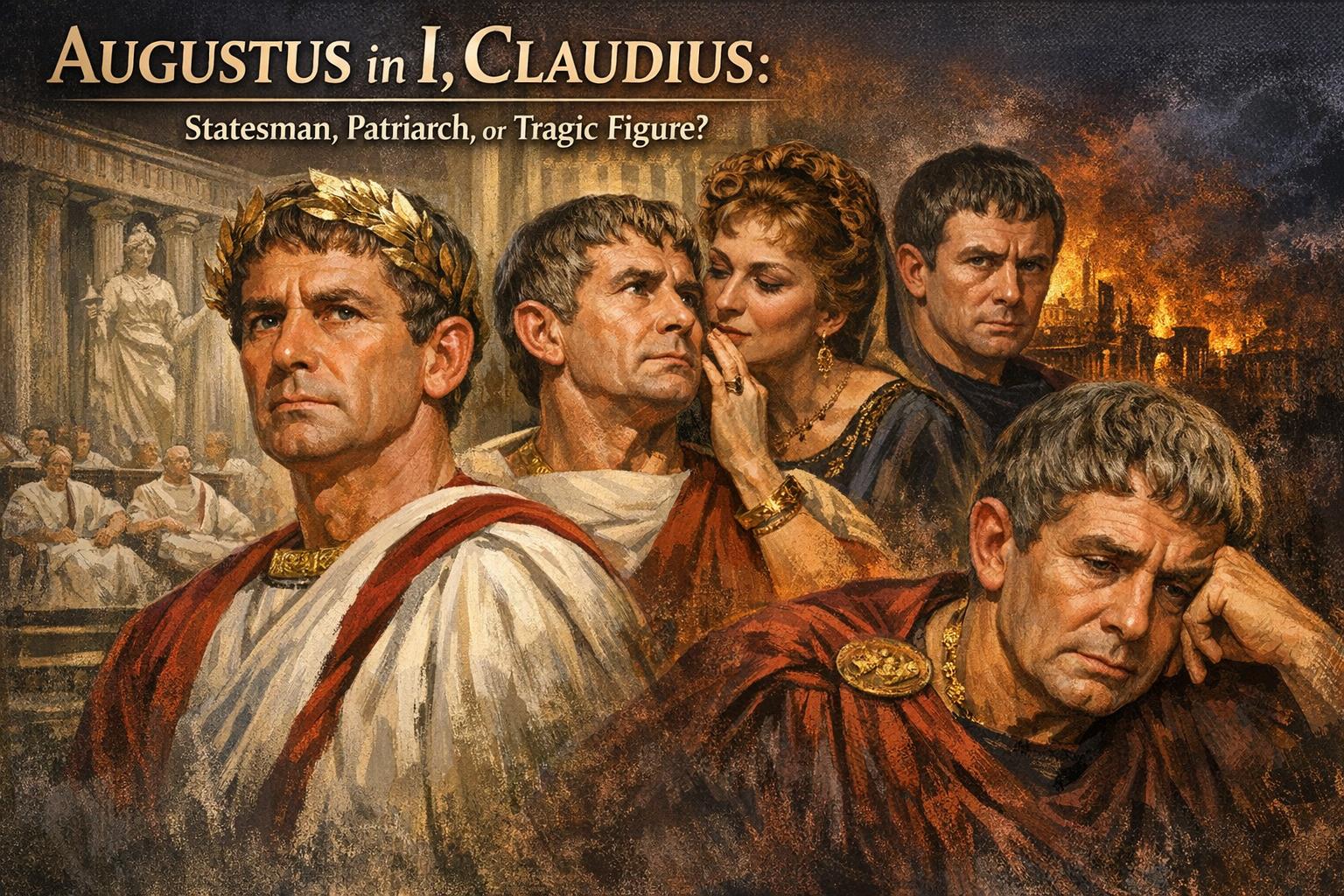
A Multifaceted Character: Augustus in “I, Claudius”
Robert Graves’ I, Claudius presents Augustus as a figure whose authority shapes not only the Roman state but also the destinies of those within his household. The narrative, conveyed through the retrospective voice of Claudius, offers a portrait that resists simple classification. Augustus appears at various moments as a calculated statesman, a conscientious patriarch, and a ruler whose personal disappointments complicate his public achievements. His conduct reflects the tensions inherent in founding a new political order while attempting to preserve traditional values. Through episodes of reform, succession planning, family conflict, and political maneuvering, Graves develops a layered representation of the first emperor.
The novel does not treat Augustus as a distant monument of history. Instead, he is rendered as an active participant in conversations, decisions, and misjudgments that affect the imperial household. His strengths are matched by limitations, and his authority coexists with uncertainty about the future. To understand Augustus in I, Claudius, it is necessary to consider how these dimensions intersect and how Graves uses his character to examine power, legacy, and historical transition.
Augustus as a Statesman
In the political sphere, Augustus embodies calculated pragmatism. Born Gaius Octavius and adopted by Julius Caesar, he emerges from civil conflict as the architect of a new governmental structure. Graves depicts this ascent not as a sudden seizure of absolute power but as a gradual consolidation achieved through diplomacy, strategic alliances, and administrative restructuring. Augustus often presents himself as a restorer of the Republic, yet his actions steadily centralize authority in his own hands. This dual approach—retaining republican forms while exercising imperial control—demonstrates his understanding of Roman political culture.
The novel portrays Augustus as acutely aware of public perception. He cultivates an image of restraint, regularly declining overt displays of monarchical ambition. Titles and honors are accepted with hesitation, reinforcing the notion that his leadership arises from necessity rather than personal desire. Through careful management of appearances, he secures cooperation from the Senate while ensuring that ultimate decision-making authority resides with him. Graves emphasizes that this balance is not accidental but the product of sustained discipline.
Administrative Reform and Stability
Augustus’ reforms in I, Claudius reflect a comprehensive approach to governance. He reorganizes provincial administration, institutes financial oversight, and strengthens the military command structure. These measures are framed as responses to the instability that had characterized the late Republic. By regularizing taxation and placing loyal officials in key posts, he reduces opportunities for corruption that had previously weakened Roman authority.
The establishment of the Pax Romana is depicted as a deliberate objective rather than an incidental outcome. Military campaigns are conducted to secure borders, yet Augustus demonstrates reluctance to pursue unnecessary expansion. Stability takes precedence over conquest for its own sake. Graves illustrates that Augustus understands the economic and social costs of prolonged warfare. The relative peace under his rule affords Rome the opportunity to invest in infrastructure, legal codification, and urban development.
Legal reforms also play a significant role in his statesmanship. The moral legislation aimed at encouraging marriage and penalizing adultery reveals his belief that social order underpins political order. Although these laws intrude into private life, Augustus justifies them as essential for preserving Roman virtues. Graves presents these policies without overt judgment, allowing readers to consider whether such measures reflect foresight or excessive regulation.
The Management of Power
Graves’ Augustus consistently seeks to harmonize personal authority with institutional continuity. He distributes responsibilities among trusted associates while retaining ultimate oversight. This delegation creates an appearance of shared governance. However, when challenges arise, Augustus acts decisively to reaffirm his control. His suppression of dissent, though measured, demonstrates that the preservation of stability takes priority over procedural niceties.
The emperor’s interactions with the Senate reveal both patience and calculation. He listens to advice and allows debate, but key policies proceed according to his design. In Claudius’ recollections, Augustus appears as a figure capable of measured compromise. Yet compromise is rarely permitted to undermine his central objectives. In this respect, Graves depicts him as neither tyrannical nor entirely self-effacing. His authority rests on a perception of indispensability.
The Patriarchal Figure
Beyond public affairs, Augustus’ role as head of the Julian household receives significant attention in the novel. His domestic life is inseparable from politics, as marriages and adoptions are used to secure alliances. Graves situates Augustus at the center of a complex family network in which loyalty, rivalry, and ambition intersect. His position as patriarch necessitates constant supervision of younger relatives whose conduct carries political consequences.
Augustus’ marriage to Livia introduces an additional dimension to his character. Livia is portrayed as intelligent and composed, exercising subtle influence within the imperial household. Augustus values her counsel, though the narrative suggests he may not fully perceive the extent of her strategic thinking. Their partnership provides stability, yet it also introduces ambiguity regarding the intentions behind certain family developments. As patriarch, Augustus must balance trust in his spouse with vigilance over the broader family structure.
Succession and Adoption
One of the recurring concerns in I, Claudius is the question of succession. Augustus’ lack of a direct male heir compels him to adopt potential successors from within the family. Each adoption—Marcellus, Agrippa’s sons, and later Tiberius—reflects both political calculation and personal hope. Graves presents these decisions as indicative of Augustus’ awareness that the durability of his system depends on a competent successor.
The death or removal of designated heirs produces instability within the household. Augustus must repeatedly adjust his plans, sometimes reluctantly. His eventual adoption of Tiberius appears driven by necessity rather than preference. Through these episodes, the novel depicts a patriarch striving to safeguard continuity while confronting the unpredictability of mortality and ambition.
Succession planning illustrates the intersection of private and public responsibilities. Augustus’ choices affect not only family members but also the state. Claudius’ narration often highlights how personal grievances within the household acquire political significance. As patriarch, Augustus bears responsibility for guiding younger relatives, yet he cannot entirely control their motives or alliances.
The Education of the Younger Generation
Graves also depicts Augustus as concerned with the moral development of his descendants. He promotes discipline and adherence to traditional Roman virtues. Claudius, observing from a distance, contrasts Augustus’ formal expectations with the concealed intrigues that permeate the imperial family. The emperor’s attempts to impose order within his household mirror his broader administrative reforms.
However, this educational role is complicated by favoritism and misjudgment. Augustus’ assessments of character do not always align with events. His confidence in certain individuals yields unintended consequences. The authority of the patriarch, therefore, is shown to have limits when confronted with secrecy or manipulation.
A Tragic Figure
While Augustus achieves political consolidation, Graves frames aspects of his personal life as marked by loss and disappointment. The repeated deaths of heirs, whether by natural causes or alleged intrigue, weigh heavily on the narrative. Although the text refrains from overt sentimentality, it depicts an aging ruler confronting the erosion of carefully constructed plans. This dimension introduces a tragic element without diminishing his competence.
The portrayal of tragedy arises not from sudden downfall but from cumulative strain. Augustus endures setbacks that complicate his vision of an orderly succession. The contrast between the stability of the empire and the uncertainty of his household underscores the limitations of authority. No level of administrative control can eliminate the vulnerabilities inherent in family relationships.
The Consequences of Ambition
Ambition functions in the novel as both a constructive and disruptive force. Augustus’ early ambition enables him to defeat rivals and institute reform. Yet the same drive to secure permanence incentivizes intense competition within the imperial household. Relatives positioned as potential heirs acquire political significance that shapes their behavior. The structures designed to guarantee stability create circumstances in which rivalry becomes inevitable.
Graves suggests that Augustus recognizes these dangers but cannot entirely neutralize them. His reliance on adoption, strategic marriage, and legal authority demonstrates a consistent attempt to manage risk. Nevertheless, each intervention generates new complexities. The tragic dimension lies in the gap between intention and outcome. Augustus seeks continuity and order; what emerges is a mixture of achievement and unresolved tension.
Perception and Miscalculation
Claudius’ retrospective perspective allows room for irony. Augustus is depicted as perceptive in public affairs yet occasionally misled in assessing private intentions. His trust in certain individuals may stem from a desire to believe in familial loyalty. The narrative does not portray him as naive, but as subject to the same interpretive limitations that affect any leader.
This interplay between perception and miscalculation reinforces the tragic undertone. Even a ruler who commands legions and directs policy cannot fully predict human behavior. Augustus navigates allegations, suspicions, and shifting alliances within his own circle. The authority that stabilizes Rome does not grant complete transparency in personal matters.
Augustus Through Claudius’ Narrative Lens
The characterization of Augustus is shaped by the narrative voice of Claudius. As a younger member of the imperial family, Claudius observes Augustus with a mixture of respect and analytical distance. His account emphasizes the structural achievements of the reign while recording domestic complications. This dual perspective prevents Augustus from being reduced to either idealization or condemnation.
Claudius’ survival depends partly on remaining inconspicuous, and his reflections on Augustus convey a cautious evaluation of power. He recognizes the benefits of the system Augustus establishes while noting the vulnerabilities embedded within it. Through this perspective, readers encounter a ruler who is effective yet constrained by circumstances beyond his control.
Historical Transition
Graves situates Augustus at the threshold between Republic and Empire. His reign represents both culmination and beginning. The careful preservation of republican terminology alongside imperial authority signifies an attempt to reconcile tradition with innovation. Augustus stands as the mediator of this transition.
The long-term durability of his reforms suggests success. Yet the novel implies that stability requires continual vigilance. Augustus’ death does not conclude the uncertainties surrounding succession or governance. Instead, it marks the transfer of unresolved tensions to his successors. In this sense, his legacy is institutional rather than personal.
Conclusion
In I, Claudius, Augustus emerges as a ruler of strategic intelligence, administrative discipline, and measured authority. His contributions to the consolidation of Roman governance are presented as deliberate and sustained. At the same time, his role as patriarch introduces complexities that reveal the limits of even comprehensive power. Succession planning, family discord, and unforeseen developments complicate his objectives.
Graves’ portrayal resists simple categorization. Augustus is neither solely a triumphant architect of empire nor merely a victim of familial intrigue. He is a figure navigating overlapping responsibilities in a period of structural change. His statesmanship secures a framework that endures beyond his lifetime, while his personal experiences illustrate the constraints inherent in leadership.
By presenting Augustus as a multifaceted character—statesman, patriarch, and figure marked by unintended consequences—Graves provides a study of power exercised within historical and domestic contexts. The novel invites consideration of how authority functions across public and private domains and how legacy depends on both design and contingency. Through this balanced depiction, Augustus occupies a central position in the narrative, shaping events not only through policy but through the complex inheritance he leaves to Rome and to his family.