
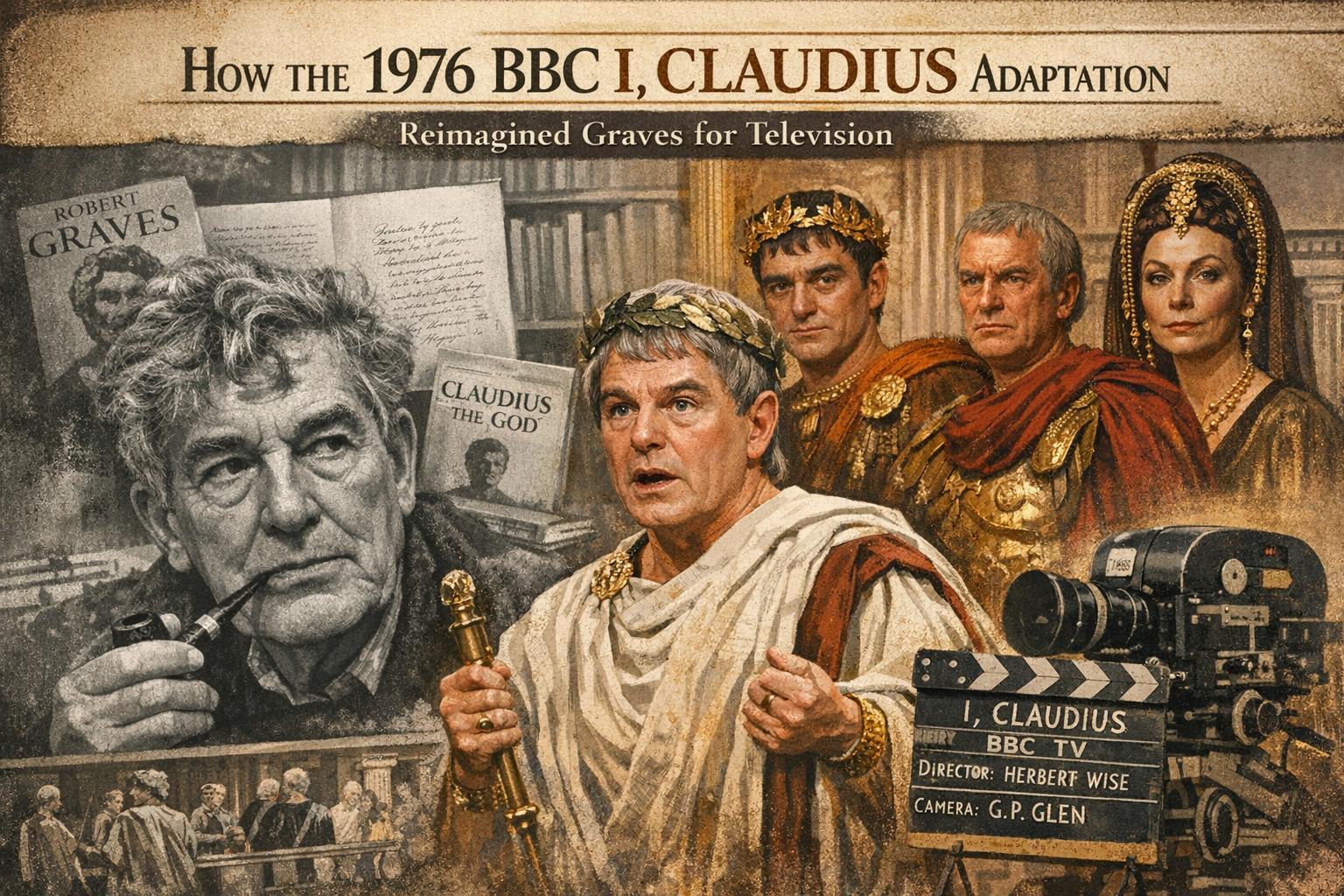
The Transition from Page to Screen
The 1976 BBC adaptation of I, Claudius represents a notable example of how complex historical literature can be translated into a compelling television drama. Robert Graves’ novels, I, Claudius (1934) and Claudius the God (1935), present a detailed fictional autobiography of the Roman Emperor Claudius, tracing the political and familial turbulence of the Julio-Claudian dynasty. Transforming this expansive narrative into a thirteen-part television series required more than simple condensation. It demanded structural reconfiguration, interpretive clarity, and a careful understanding of how visual storytelling differs from prose fiction.
The transition from page to screen involved reconsidering how information is conveyed. Graves’ novels rely heavily on retrospective narration. Claudius recounts events from the vantage point of old age, offering interpretation, speculation, and commentary. Television, by contrast, depends on performance, dialogue, staging, and pacing. The BBC production had to preserve the intellectual texture of the novels while ensuring narrative momentum suitable for episodic broadcast. The result was a series that balanced fidelity to the source material with the practical demands of television drama in the 1970s.
Adapting Graves’ Narrative
Graves structured his novels as memoirs written by Claudius, blending historical record with imaginative reconstruction. This structure allows for commentary on the moral and political decline of Rome, as well as the psychology of its rulers. In adapting this approach, the BBC series retained the premise of Claudius as narrator, using direct address in key moments to preserve the autobiographical frame. However, much of the narrative had to be externalized into dialogue and action.
The source material spans decades, from the reign of Augustus through the rule of Tiberius, Caligula, and finally Claudius himself. The density of political maneuvering, familial betrayals, and shifting alliances could easily overwhelm viewers if presented without careful organization. The adaptation therefore privileged certain arcs, particularly the gradual consolidation of power by Livia, the deterioration of Tiberius’ authority, and the volatile reign of Caligula. By structuring episodes around decisive turning points, the series provided clarity while maintaining continuity.
Narrative compression was unavoidable. Several historical figures who appear in the novels were either omitted or merged with others to streamline the story. Certain subplots were reduced to brief references, ensuring that the central conflicts remained intelligible. These decisions illustrate an important principle in adaptation: fidelity does not require reproducing every detail but rather preserving thematic coherence and narrative purpose.
Dialogue became the primary vehicle for conveying political complexity. Graves’ prose contains extensive explanation of motives and circumstances. The television version translated this explanatory style into sharp exchanges between characters, allowing audiences to infer context through performance. This shift exemplifies how adaptation requires rethinking, rather than merely repeating, the original material.
Character Driven Storytelling
The success of the series rests significantly on its emphasis on character. Graves’ novels present historical figures not as distant statues but as individuals shaped by ambition, fear, loyalty, and calculation. The adaptation preserved this framework by centering the drama on interpersonal relationships.
Derek Jacobi’s portrayal of Claudius is particularly central. Presented initially as physically impaired and socially underestimated, Claudius survives in a dangerous political environment by cultivating the appearance of weakness. Through gesture, tone, and subtle shifts in expression, Jacobi conveys intellectual alertness beneath apparent vulnerability. This performance allows viewers to understand Claudius not merely as a passive observer but as an active participant navigating a perilous court.
Siân Phillips’ depiction of Livia offers another example of how performance shaped the adaptation. In the novels, Livia is portrayed as a calculating strategist whose influence over Augustus defines much of the early narrative. On screen, her authority is articulated through controlled speech, measured pacing, and deliberate stillness. The absence of overt dramatization enhances the suggestion of power, illustrating how restraint can convey dominance.
The supporting cast likewise contributed to a sense of layered characterization. John Hurt’s Caligula embodies instability not through exaggerated spectacle but through unpredictable shifts in mood and intention. Brian Blessed’s Augustus transitions from pragmatic ruler to aging patriarch confronted with the consequences of his succession plans. These portrayals allowed the series to foreground personality as the engine of historical change.
Character-driven storytelling also enabled audience accessibility. Roman political structures and succession laws can appear distant to modern viewers. By focusing on familial tensions—parents and children, spouses and rivals—the series grounded historical events in recognizable dynamics. This emphasis aligns with Graves’ interpretation of Roman history as shaped by domestic conflict as much as by military conquest.
Historical Context and Authenticity
Although produced on a modest budget, the BBC adaptation invested considerable effort in conveying a credible sense of the Roman world. Rather than relying on expansive outdoor spectacle, the production emphasized interior settings that reflected political spaces: senate chambers, imperial residences, and private quarters. The limited physical scope contributed to an atmosphere of confinement, appropriate to a narrative centered on intrigue and surveillance.
Costume design played a significant role in establishing historical texture. Garments signaled rank, allegiance, and transformation over time. The gradual shift in Claudius’ attire from scholar to emperor visually marked his evolving status. Attention to fabric, color, and ornamentation reinforced distinctions within the ruling elite without overwhelming the narrative.
Props and set decoration, though constrained by studio conditions, were chosen to evoke Roman material culture. Sculptural elements, mosaics, and architectural motifs provided visual cues to the setting. These aesthetic decisions were complemented by careful language choices. While the dialogue was delivered in modern English, its rhythm and formality suggested classical rhetoric without becoming inaccessible.
Consultation with historians informed many aspects of the adaptation. Although Graves himself took considerable liberties with historical fact, his novels were grounded in ancient sources such as Tacitus, Suetonius, and Cassius Dio. The series maintained this engagement with historical scholarship, presenting events such as the succession crises and political purges in ways broadly consistent with established interpretations. In doing so, the adaptation functioned not only as drama but also as an introduction to a formative period in Roman governance.
The emphasis on authenticity extended to procedural details. Meetings of the Senate, rituals of succession, and legal formalities were depicted with attention to structure. These elements reinforced the idea that political power in Rome operated within established traditions, even when those traditions were manipulated.
Challenges in Adaptation
Adapting I, Claudius posed several structural and practical challenges. One primary difficulty lay in managing temporal scope. The story spans over half a century, encompassing generational shifts. Television episodes, each with limited duration, required selective focus. The writers addressed this by using transitional dialogue and occasional narrative framing to signal the passage of time, thereby maintaining coherence without excessive exposition.
Budgetary constraints also influenced creative decisions. Unlike cinematic epics that depict large-scale battles or expansive urban landscapes, the BBC production adopted a theatrical style. This constraint, rather than diminishing the series, contributed to its distinctive tone. Concentration on dialogue-heavy scenes heightened attention to language and performance. The limited visual scale emphasized political maneuvering over military spectacle.
Another challenge involved balancing historical documentation with dramatic effectiveness. Graves’ novels present certain controversial interpretations, including the suggestion of systematic poisoning orchestrated by Livia. Translating these claims to screen risked either overstating speculation or diluting narrative tension. The adaptation opted for measured ambiguity, allowing viewers to assess evidence through character interaction rather than explicit confirmation.
Censorship and broadcasting standards of the 1970s imposed additional limitations. Roman history contains themes of violence, sexuality, and brutality. The series approached such material with restraint, implying rather than graphically depicting extreme behavior. This approach maintained narrative seriousness while conforming to contemporary expectations of public broadcasting.
Finally, the adaptation had to consider audience familiarity. Many viewers lacked detailed knowledge of Roman dynastic history. The script therefore incorporated clarifying dialogue and repeated references to familial relationships. These elements ensured that the complexity of succession politics did not obscure the central narrative.
Legacy and Continuing Relevance
The enduring status of the 1976 I, Claudius adaptation reflects its integration of literary fidelity, disciplined performance, and thoughtful production design. Its influence can be observed in later historical dramas that prioritize character psychology and political dialogue over spectacle. The series demonstrated that historical material can sustain extended television treatment when anchored by coherent structure and focused acting.
For contemporary audiences, the adaptation remains instructive as an example of how televised drama can engage with classical history without resorting to simplification. Themes of governance, legitimacy, and institutional fragility retain analytical relevance. By presenting political authority as contingent and vulnerable, the series invites reflection on the mechanisms through which power is acquired and maintained.
In translating Robert Graves’ work from page to screen, the BBC did not merely illustrate the novels. It reinterpreted them within the possibilities and constraints of television production. Through deliberate narrative restructuring, emphasis on character, and commitment to contextual credibility, the adaptation achieved a form that stands independently while remaining rooted in its literary origin. The 1976 I, Claudius thus endures as a significant case study in adaptation, demonstrating how complex historical fiction can be reshaped into a sustained and coherent visual narrative.