
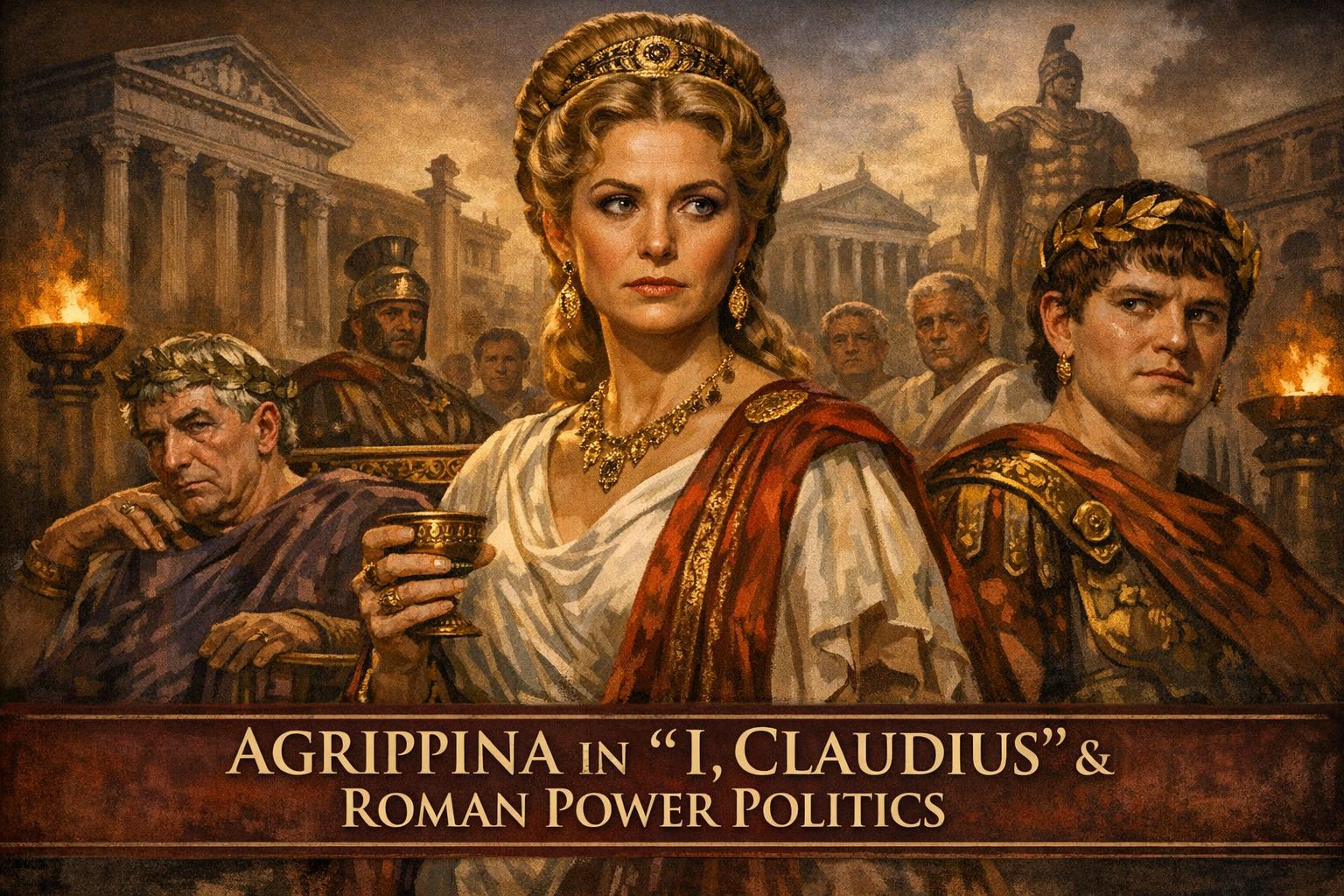
Agrippina the Younger: A Powerful Figure in “I, Claudius”
“I, Claudius” is a historical drama series adapted from the novels by Robert Graves, first broadcast by the BBC in 1976. The series presents a dramatized account of the Julio-Claudian dynasty, tracing the transformation of Rome from a republic into a centralized imperial system under rulers whose personal ambitions shaped political institutions. Told from the perspective of the Emperor Claudius, the narrative explores dynastic rivalries, succession crises, and the concentration of authority within a ruling family. Among the many historical figures depicted, Agrippina the Younger emerges as one of the most politically astute and consequential individuals in the story.
The series situates Agrippina within a lineage characterized by instability and competition. The imperial system lacked a clear hereditary structure, and succession often depended on adoption, alliances, and the favor of influential elites. In this context, women of the imperial household could play decisive roles, particularly when they were mothers of potential heirs. “I, Claudius” portrays Agrippina as someone who fully understood these conditions and acted with strategic purpose. Her influence extends beyond personal relationships, shaping decisions that determine who governs Rome.
Understanding Agrippina the Younger
Agrippina the Younger was born in AD 15, the daughter of the respected general Germanicus and Agrippina the Elder. Through her father, she was the granddaughter of Drusus and the great-granddaughter of Augustus, the first Roman emperor. Through her mother, she descended from Marcus Agrippa and Julia, the daughter of Augustus. This ancestry placed her firmly within the core of the Julio-Claudian dynasty and gave her a dynastic legitimacy that few others could claim. From childhood, she lived within the political sphere of imperial power.
Her early life was shaped by instability. After the death of her father under suspicious circumstances, her mother fell into conflict with Emperor Tiberius. Several members of her family were exiled or executed. These experiences formed the backdrop against which Agrippina matured. The series suggests that such events cultivated in her a clear understanding of the hazards of imperial politics. Survival required calculation, and advancement required the careful management of alliances.
Agrippina was married three times. Her first husband, Gnaeus Domitius Ahenobarbus, was the father of her son Nero, originally named Lucius Domitius Ahenobarbus. Her second marriage to the wealthy Gaius Sallustius Crispus Passienus further consolidated her economic and social standing. Her third marriage—to her uncle, the Emperor Claudius—proved decisive. Roman law at the time prohibited marriages between uncles and nieces, but the Senate passed a decree permitting the union. This legislative change illustrates the flexibility of institutions when confronted with imperial authority.
Throughout her life, Agrippina demonstrated an acute awareness of lineage. The Julio-Claudian dynasty relied heavily on the symbolism of continuity from Augustus. Adoption was frequently used to designate heirs, and association with the Augustan line strengthened political legitimacy. Agrippina’s strategy centered on presenting her son Nero as the most suitable successor within this dynastic framework. She emphasized his descent from Germanicus and Augustus, reinforcing the perception that his accession would restore stability to the imperial household.
Agrippina’s Representation in “I, Claudius”
“I, Claudius” dramatizes Agrippina as a calculating and disciplined figure. The portrayal, performed by actress Barbara Young, emphasizes controlled speech, measured gestures, and decisive actions. This characterization aligns with the tradition in ancient historiography, particularly in the works of Tacitus and Suetonius, who depicted her as influential and uncompromising. However, the series also frames her actions within the logic of dynastic survival rather than portraying them as isolated personal ambitions.
The narrative presents Agrippina as fully aware of the vulnerabilities of Emperor Claudius. Claudius is shown as intelligent but hesitant, often influenced by those closest to him. Agrippina’s marriage to him is depicted not merely as a personal arrangement but as a political maneuver designed to secure Nero’s future. Once married, she works systematically to elevate her son’s position. Nero is adopted by Claudius and given the name Nero Claudius Caesar Drusus Germanicus. The adoption positions him ahead of Claudius’s biological son, Britannicus, in the line of succession.
The series portrays Agrippina’s methods as subtle rather than overt. She cultivates allies within the Senate and among influential freedmen. She manages public appearances carefully, ensuring that Nero is visible and associated with the emperor in ceremonies. This emphasis on optics reflects historical reality: imperial imagery was essential in shaping perceptions among Rome’s elites and military commanders. By highlighting Nero’s youth, noble lineage, and connection to Augustus, Agrippina supports his candidacy without formal confrontation.
“I, Claudius” also underscores the limitations placed upon women in Roman public life. Agrippina cannot hold official office or command legions, yet she exercises power through domestic authority and personal influence. In several scenes, she is shown advising Claudius, questioning his decisions, and presenting political arguments framed as practical solutions. This depiction illustrates how informal channels of influence could rival formal institutions in effectiveness.
The series does not present Agrippina as operating in isolation. Her actions occur within a network of competing interests, including senators, military leaders, and imperial freedmen. By contextualizing her behavior within this structure, “I, Claudius” highlights the interdependence of personal relationships and state governance. Agrippina’s success depends upon her ability to anticipate resistance and to neutralize alternative claimants.
Agrippina’s Role in Roman Power Politics
Agrippina’s historical role demonstrates how imperial women could shape succession without holding constitutional authority. The Roman Empire did not establish a fixed method for selecting successors during the first century AD. Emperors frequently adopted heirs, and the support of the Praetorian Guard and the Senate was crucial. Agrippina understood that succession required coordination across these constituencies.
One of her most significant achievements was securing Nero’s betrothal to Claudius’s daughter, Octavia. By marrying Nero to Octavia, Agrippina further integrated him into the imperial household. This combination of adoption and marriage created overlapping bonds of legitimacy. Britannicus, though the biological son of Claudius, was younger and lacked the same carefully constructed public profile. Agrippina capitalized on these differences.
Ancient sources allege that Claudius’s death in AD 54 may have involved poisoning, with Agrippina implicated in the plot. While the historical accuracy of these claims is debated, “I, Claudius” adopts the traditional narrative that Agrippina orchestrated events to hasten Nero’s accession. The series frames this decision as the culmination of a long preparation process. Upon Claudius’s death, Nero is immediately presented to the Praetorian Guard and proclaimed emperor. The speed of this transition illustrates the effectiveness of Agrippina’s planning.
After Nero’s accession, Agrippina’s position changed. Initially, she appears to exercise substantial influence over her son. The series depicts her attending meetings, receiving foreign envoys, and attempting to guide Nero’s policies. Coins from the early years of Nero’s reign show mother and son facing one another, indicating her prominent status. However, the structure of Roman political culture placed limits on sustained maternal authority over an adult emperor.
As Nero grew more independent, conflicts emerged. The series portrays tension between Agrippina and advisors such as Seneca and Burrus, who sought to moderate Nero’s behavior. Agrippina’s earlier dominance becomes increasingly contested. This shift reflects broader structural dynamics: once Nero secured the allegiance of the military and elite supporters, he no longer required the same level of maternal guidance.
The deterioration of Agrippina’s position culminates in her death. Historical accounts describe multiple attempts on her life, including a collapsing boat incident, before her eventual assassination in AD 59. “I, Claudius” presents her death as the final chapter in a struggle between maternal authority and imperial autonomy. The episode underscores a recurring theme: in the Roman Empire, proximity to power offered influence but also exposed individuals to significant danger.
Agrippina’s career illustrates that political participation in Rome extended beyond formal office-holding. Patronage networks, marriage alliances, and dynastic symbolism were central components of governance. Her activities did not dismantle Roman institutions; rather, they operated within existing frameworks. By maneuvering through adoption laws, Senate decrees, and familial bonds, she maximized the tools available to her.
Dynasty, Gender, and Historical Interpretation
Agrippina’s representation raises broader questions about gender and authority in Rome. Roman ideology emphasized male dominance in political life, yet imperial women could exert power in indirect ways. The absence of formal roles did not eliminate influence. Instead, it redirected authority into familial and symbolic channels. Agrippina’s example demonstrates how these channels functioned in practice.
Ancient historians often portrayed politically active women with suspicion, attributing to them excessive ambition. Tacitus, for instance, describes Agrippina as determined to dominate her son’s reign. However, modern scholarship frequently reassesses these accounts, noting the biases inherent in elite male narratives. When evaluated within the context of dynastic survival, Agrippina’s actions align with patterns observable among male rivals for succession.
“I, Claudius” draws heavily from classical sources, yet it also reflects twentieth-century perspectives on power and psychology. The series invests in character motivation, suggesting that Agrippina’s strategies were consistent with her upbringing and experiences under previous emperors. By situating her ambition within structural conditions—uncertain succession, factional competition, and dynastic fragility—the drama encourages viewers to interpret her conduct as rational within its environment.
The program further explores how memory shapes legacy. Later portrayals of Nero as a tyrant cast retrospective judgment on those who facilitated his rise. Agrippina’s reputation became intertwined with her son’s governance. If Nero’s rule is characterized as destructive, her efforts to secure his succession appear misguided. However, at the time of his accession, Nero was young and supported by respected advisors. The long-term outcomes were not predetermined.
Conclusion: Agrippina’s Legacy in Roman History
Agrippina the Younger remains a significant figure in the study of early imperial Rome. Her life intersects with major transitions within the Julio-Claudian dynasty, from the reign of Tiberius to that of Nero. Through marriage, adoption, and strategic alliances, she shaped the succession process and influenced the distribution of authority within the imperial household.
In “I, Claudius,” Agrippina functions as both a historical character and a narrative mechanism through which the instability of Roman succession is examined. Her portrayal emphasizes calculation, preparation, and the use of dynastic symbolism. The series integrates her actions into a broader account of governance, illustrating how private family decisions could determine public outcomes.
Agrippina’s legacy lies not only in her relationship with Nero but also in her demonstration of the capacity for imperial women to direct political developments. Her career reveals the layered nature of power in Rome, where formal titles coexisted with informal influence. By analyzing her representation in historical drama alongside surviving ancient sources, it becomes possible to appreciate the complexity of her position within the Julio-Claudian order.
The continued interest in Agrippina reflects the enduring relevance of questions surrounding succession, legitimacy, and the interaction between personal ambition and institutional structure. Within both historical scholarship and dramatic interpretation, she stands as a case study in how authority can be accumulated and exercised without constitutional designation. Her depiction in “I, Claudius” underscores the interplay between individual agency and systemic constraint, offering insight into the mechanisms that governed one of history’s most studied dynasties.