
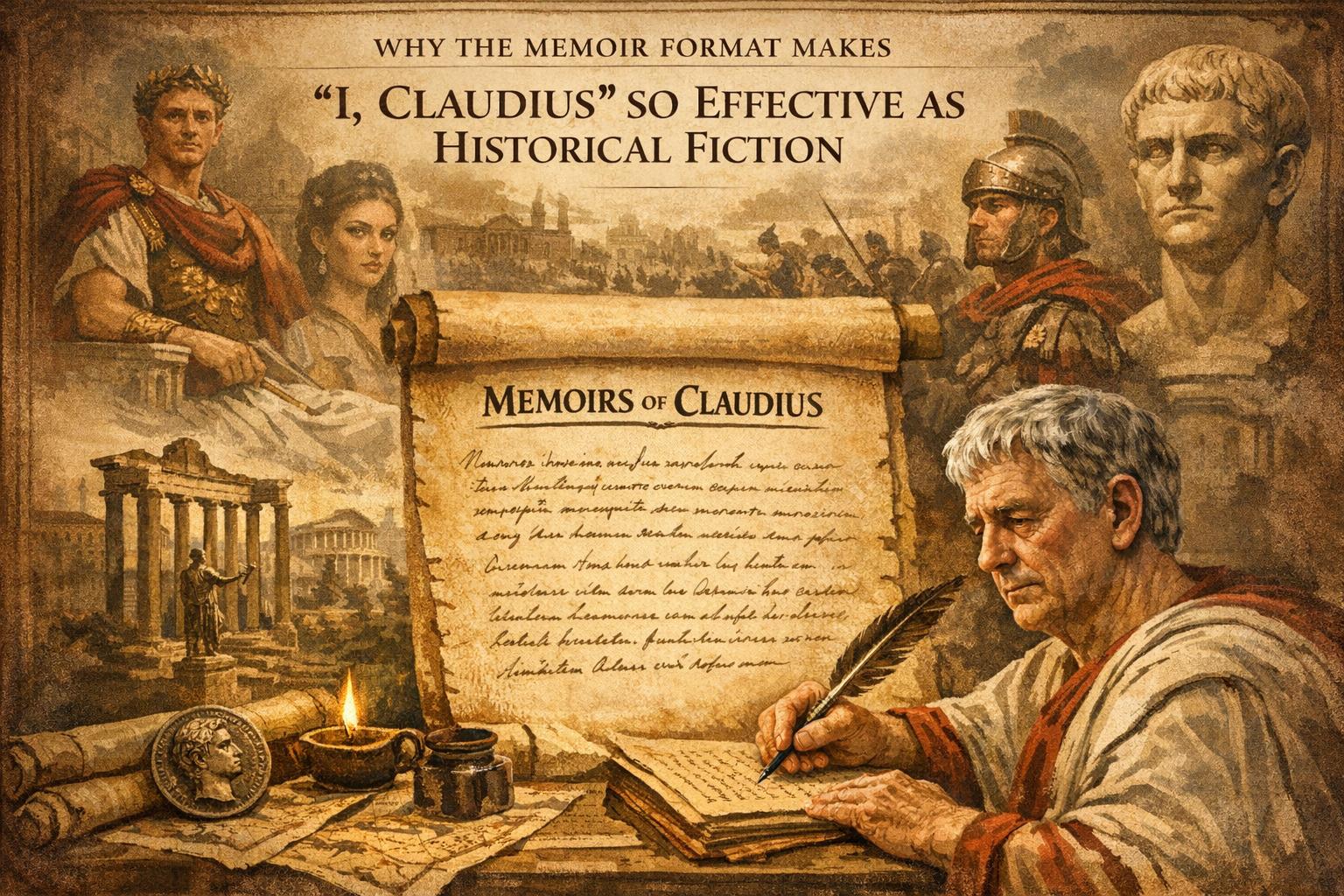
The Appeal of the Memoir Format
The memoir format is a literary device that personalizes historical events, allowing readers to engage directly with the narrative voice of a central figure. Rather than presenting history as a sequence of documented facts, the memoir approach reframes it as lived experience. In the case of I, Claudius, this method proves particularly effective for historical fiction. By presenting the story as a first-person account attributed to the Roman Emperor Claudius, the novel situates readers within the volatile political structure of the early Roman Empire. The result is a narrative that combines documented historical frameworks with interpretive storytelling.
The memoir framework provides a structural logic that supports the unfolding of events across several reigns, scandals, alliances, and betrayals. Instead of moving mechanically through a timeline, the narrative progresses through recollection, interpretation, and reflection. This perspective transforms well-known historical developments into episodes filtered through memory and judgment. It also enables the author to manage complex genealogies and political transitions in a way that feels internally coherent, because the narrator himself has experienced them.
In historical fiction, the challenge often lies in balancing factual accuracy with narrative engagement. The memoir format addresses this tension by embedding historical exposition within personal testimony. Political conspiracies, legal reforms, military campaigns, and court rivalries are not introduced as detached information; they are part of the narrator’s life story. This structural choice gives coherence to material that might otherwise appear fragmented or overly technical.
Authenticity and Personal Insight
The use of a memoir format lends an air of authenticity and intimacy to a historical narrative. I, Claudius is structured as an autobiography written late in Claudius’s life. Although fictionalized, the conceit suggests that the emperor is deliberately recording his version of events for posterity. This device creates the impression of direct testimony, encouraging readers to interpret the narrative as a primary account rather than a secondary reconstruction.
Authenticity in this context does not depend solely on factual precision. Instead, it arises from the consistency of voice and the plausibility of perspective. Claudius is portrayed as intellectually capable yet underestimated due to physical disabilities and social marginalization. As narrator, he comments not only on political actions but also on how others perceived him. This dual awareness adds dimension to the narrative. Readers encounter both the public image of Claudius and his internal evaluation of that image.
The memoir structure also allows the text to present conflicting motivations without breaking narrative unity. When Claudius describes figures such as Augustus, Livia, Tiberius, or Caligula, his portrayals are shaped by his personal proximity to them. He may admire certain traits while questioning others. The resulting depiction feels layered rather than absolute. This technique mirrors the way real autobiographical writing often operates: individuals recount events through interpretation rather than neutral description.
Moreover, the framework of retrospective narration enables Claudius to analyze earlier stages of his life from a position of later knowledge. He can foreshadow political outcomes or acknowledge misunderstandings in his youth. Such reflections contribute to a sense of intellectual credibility. The narrative voice appears conscious of history’s broader arc, even while recounting individual incidents.
Through this personalized lens, the novel bridges the gap between recorded history and speculative interiority. Official records rarely preserve the inner lives of rulers or their private calculations. By adopting the memoir form, the narrative supplies what historical documentation cannot: detailed introspection grounded in documented chronology.
Enhanced Character Development
Employing a memoir format significantly enriches character development, particularly for a figure as historically complex as Claudius. In conventional third-person historical fiction, characterization may rely heavily on action and dialogue. In contrast, a first-person retrospective account enables sustained examination of motive, perception, and internal conflict.
Claudius, as narrator, explains his intellectual interests in history and scholarship. He contextualizes his political caution within his experience of court intrigue. He interprets his apparent passivity as strategic survival. These explanations complicate what might otherwise appear as weakness. Because readers receive information directly from his consciousness, they are positioned to evaluate his reliability while also understanding his reasoning.
The memoir format also provides insight into how Claudius navigates the dominant personalities around him. The Julio-Claudian dynasty is characterized by figures exerting power through manipulation, symbolism, or intimidation. Claudius’s survival depends on careful observation. His narrative commentary frequently highlights moments where he chooses silence over confrontation, or intellectual distance over direct engagement. Such decisions become intelligible because he narrates them as deliberate calculations.
In addition to Claudius, secondary characters gain depth through the filtered perspective of memoir. Characters such as Livia or Tiberius are not introduced as abstract political actors but as relatives, mentors, threats, or rivals. Claudius remembers conversations, gestures, and rumors. Through these recollections, they acquire psychological dimension. The emphasis is less on their documented policies and more on how their behavior influenced those around them.
Because the narrative voice remains consistent, character development unfolds cumulatively. Early impressions are revised as events reveal new information. Claudius may initially misunderstand a political maneuver, only to reinterpret it later. This process of reinterpretation reinforces the sense that characters evolve over time rather than remaining static symbols of power.
The memoir structure also highlights Claudius’s growth. His early marginalization contrasts with his later authority. The narrative traces not only external elevation to the imperial role but also shifts in self-conception. Readers observe how intellectual detachment gradually intersects with governing responsibility. Such development appears credible because it is articulated from within the consciousness of the individual undergoing change.
Immersion in Historical Context
A memoir format permits comprehensive immersion in historical context by situating large-scale developments within personal experience. The Roman Empire during the Julio-Claudian period involved extensive political administration, military engagement, and social transformation. Presenting this complexity through Claudius’s recollections allows the historical environment to emerge organically.
For example, court rituals, senatorial debates, and succession protocols are not presented as explanatory digressions. Instead, Claudius describes them as environments he inhabits. When he recounts a ceremony or legal reform, the information serves the narrative because it affects his position within the hierarchy. This integration reduces the sense of expository interruption that can characterize historical fiction.
The memoir approach also accommodates detailed genealogical information without overwhelming the reader. The Roman imperial family was marked by overlapping alliances, adoptions, and rivalries. Because Claudius references relatives as part of his lived context, these relationships are introduced progressively. Readers learn about family structures the way the narrator experienced them: as ongoing realities influencing his survival.
Cultural practices likewise become embedded in narrative action. Social expectations regarding honor, public image, and lineage inform decisions made by the characters. Claudius’s commentary clarifies how the Roman elite perceived reputation and legitimacy. Rather than abstractly describing Roman values, the memoir form shows how those values shaped behavior at court.
Military and provincial matters enter the narrative when relevant to the emperor’s authority. Claudius can reflect on military campaigns or administrative reforms as aspects of leadership that he inherited or evaluated. Because he narrates from personal involvement, such discussions are grounded in responsibility rather than neutrality.
This immersive quality contributes to the educational dimension of the novel. Readers gain understanding of Roman political mechanisms not through detached explanation but through integrated storytelling. The historical background functions as an operational setting rather than decorative context.
Realism in Historical Narrative
The memoir format strengthens realism by constructing the illusion of lived testimony. Although I, Claudius is a work of fiction, its adoption of autobiographical form creates a narrative that resembles historical documentation. The plausibility lies not in the claim that Claudius literally wrote the text, but in the disciplined alignment between voice, context, and known historical outcomes.
Realism is further reinforced by limitations inherent in first-person narration. Claudius can only recount events he witnessed or learned about indirectly. When he relies on rumor or secondhand information, he often signals uncertainty. These acknowledgments mirror the incomplete nature of historical knowledge. By admitting gaps or ambiguities, the narrative feels consistent with the constraints faced by actual historians.
The memoir structure also encourages reflective commentary on power and governance. Claudius does not merely list events; he assesses them. He considers why policies succeeded or failed, and he interprets the consequences of personal decisions. Such evaluations simulate the kind of retrospective analysis that real rulers or statesmen might undertake in later life.
Furthermore, presenting events as memories allows selective emphasis. Certain experiences occupy extended narrative space because they shaped the narrator’s trajectory. Other developments are condensed. This uneven distribution aligns with how memory functions. Not all historical incidents carry equal personal significance. By modeling this selectivity, the narrative avoids the artificial uniformity sometimes found in chronicle-style storytelling.
The grounding effect of personal perspective also mitigates the tendency of historical fiction to romanticize or dramatize excessively. Events gain weight through interpretation rather than sensational description. Political violence, intrigue, and succession crises are described as elements of governance rather than spectacle. This restraint supports credibility.
The Memoir as Interpretive Framework
Beyond realism and characterization, the memoir format operates as an interpretive framework for understanding history itself. By allowing Claudius to explain how he interprets predecessors such as Augustus or Tiberius, the novel illustrates how historical narratives are constructed. Readers become aware that even firsthand accounts involve perspective and selection.
This awareness encourages critical engagement. While immersed in Claudius’s voice, readers may question his reliability. Is he emphasizing his intellectual foresight to justify later authority? Is he minimizing errors committed during his reign? The memoir form does not present objectivity as an assumption. Instead, it dramatizes the process by which historical meaning is shaped by narrators.
In this sense, the structure invites reflection on historiography. Claudius, portrayed as a scholar of Roman history within the novel, understands the power of written record. His decision to document his own experience suggests an awareness that future generations will interpret his reign through available texts. The narrative therefore becomes both story and commentary on the production of history.
The interpretive dimension extends to themes of legitimacy and succession. Because Claudius survived while others perished, his testimony carries retrospective authority. Yet he continually situates his rise within accidental circumstances and strategic endurance. This balance between contingency and design reinforces the memoir’s analytical role.
Blending History and Fiction
The memoir format effectively bridges the genres of history and fiction. Documented events anchor the narrative in recognized chronology, while imagined thoughts and dialogues fill gaps left by historical sources. By framing these imaginative elements as Claudius’s recollections, the novel integrates invention seamlessly with fact.
This blending does not compromise coherence because the first-person voice provides consistency. Readers accept speculative reconstructions as part of the narrator’s understanding. The illusion of continuity reduces friction between what is known and what is creatively supplied.
In addition, the memoir approach offers flexibility in pacing. Claudius can linger on formative childhood impressions before accelerating through later political developments. This flexibility mirrors personal storytelling more closely than standardized historical exposition.
The accumulated effect of these elements is a narrative that educates while maintaining literary integrity. The memoir form permits detailed exploration of governance, family dynamics, and imperial ideology without resorting to overt instruction. Information is conveyed within the logic of personal recollection.
Conclusion
The memoir format of I, Claudius demonstrates the capacity of first-person historical fiction to merge documentary structure with narrative depth. By presenting the life of the Roman Emperor Claudius as an autobiographical account, the novel achieves authenticity through consistent voice, complexity through introspection, and contextual immersion through lived experience. Character development benefits from direct access to motive and reflection, while the broader political environment becomes comprehensible through integration with personal narrative.
This approach also enhances realism by acknowledging the limitations and selectivity inherent in memory. Readers encounter history not as an abstract record but as an interpreted sequence of events shaped by perspective. Through this method, the novel effectively bridges the conventions of history and fiction, offering a sustained exploration of power, governance, and survival within the Roman Empire.