
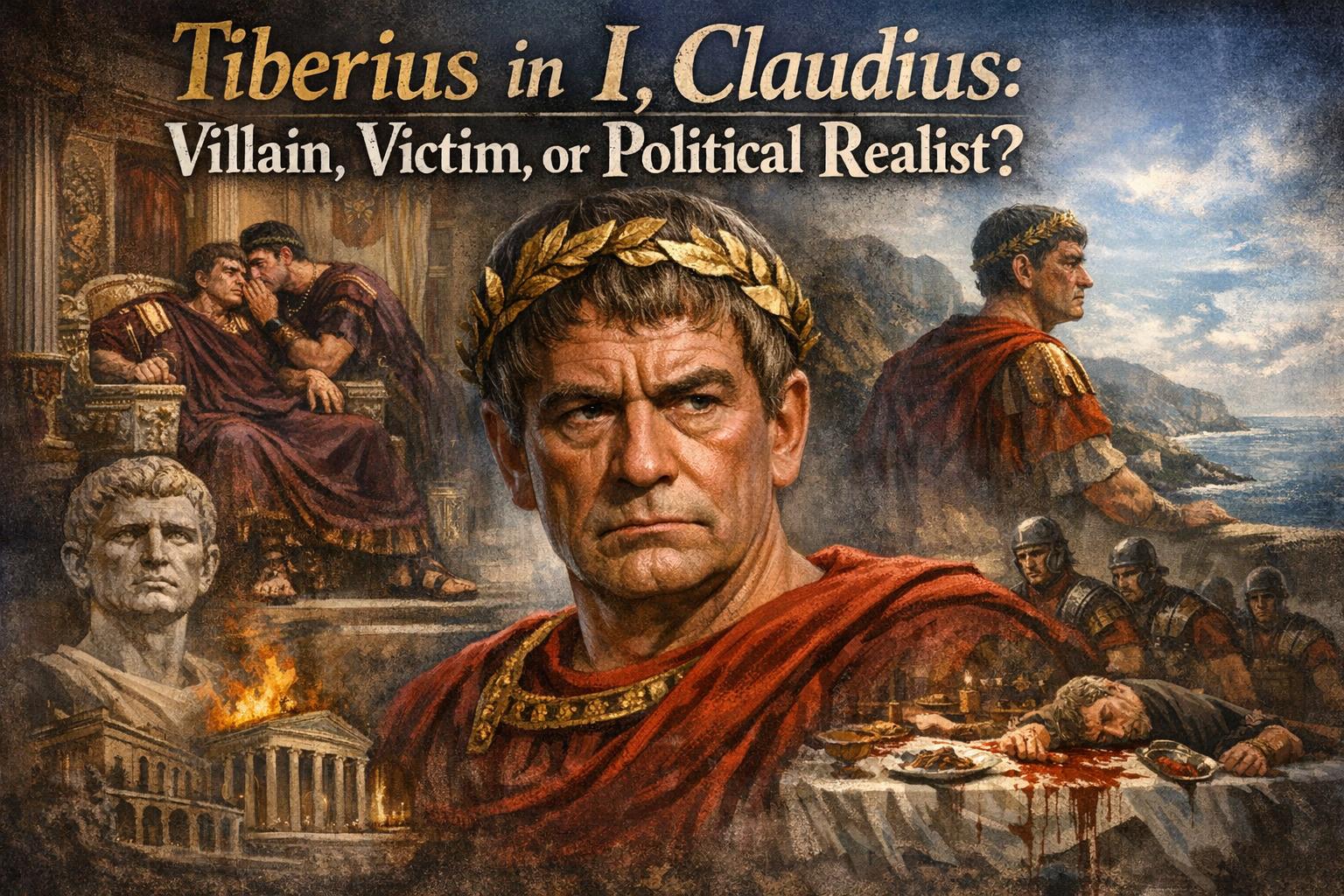
Introduction
Robert Graves’s I, Claudius presents the early Roman Empire through the retrospective narration of Claudius, who recounts the intrigues, betrayals, and calculated maneuvers that shaped the Julio-Claudian dynasty. Among the most complex figures in the narrative is Tiberius, the second Roman emperor. Graves adapts ancient sources, especially Tacitus, Suetonius, and Cassius Dio, and filters them through Claudius’s voice, creating a layered portrait that resists simple moral classification. Tiberius appears at various points as harsh, withdrawn, competent, embittered, restrained, and calculating.
The question of whether Tiberius should be regarded as a villain, a victim, or a political realist cannot be answered without examining the interplay between narrative perspective, historical tradition, and the structural realities of Roman power. Graves does not render Tiberius as a one-dimensional tyrant. Instead, he situates Tiberius within a political system defined by instability, succession crises, and entrenched aristocratic competition. Through this lens, Tiberius’s conduct can be interpreted in different ways depending on which features of his reign are emphasized.
Tiberius: The Villain Perspective
From one perspective, Graves’s Tiberius embodies many characteristics commonly associated with tyrannical rule. His principate includes numerous treason trials, political executions, and a climate of suspicion. As emperor, he presides over a period in which accusations of disloyalty become tools for eliminating rivals. The machinery of repression—particularly the use of informers—gains prominence in the later years of his reign.
In the novel, Tiberius’s temperament increasingly appears austere and harsh. He is portrayed as withdrawn and capable of emotional rigidity. His distrust of those around him contributes to decisions that consolidate power while narrowing the circle of individuals he considers trustworthy. The deaths of potential rivals, real or perceived, occur in an environment where imperial suspicion carries decisive consequences.
Graves aligns aspects of this portrayal with ancient historiography. Tacitus, in particular, describes Tiberius’s later reign as marked by fear and manipulation, suggesting that treason laws were expanded in practice if not formally. Suetonius adds allegations of cruelty and moral misconduct, shaping a traditional image of Tiberius as a ruler who deteriorated morally over time. Although modern historians often reassess these claims critically, Graves includes enough of these elements to sustain a reading of Tiberius as morally compromised.
The novel also emphasizes Tiberius’s complicity in political violence. While Augustus, his predecessor, often cloaks authority in republican forms, Tiberius appears less adept at maintaining the illusion of shared governance. His reign exposes the fragility of senatorial autonomy. In moments when he allows or endorses prosecutions against members of the elite, he reinforces the perception that imperial authority overrides traditional structures.
Furthermore, Tiberius’s withdrawal to Capri intensifies his isolation from Rome and contributes to an image of detachment. In literary terms, this physical separation symbolizes an emperor removed from civic responsibility. Whether physically absent or psychologically distant, Tiberius appears to relinquish direct oversight to subordinates whose actions further deepen the climate of fear. This withdrawal can be interpreted not as prudent delegation but as negligence or indifference.
If one emphasizes the executions, the treason trials, the informers, and the concentration of authority, Tiberius fits the structure of a villain within the narrative. His rule becomes synonymous with repression, and his personal limitations appear to exacerbate systemic instability.
Tiberius: The Victim Perspective
An alternate interpretation presents Tiberius as constrained by forces beyond his control. Graves crafts a narrative in which Tiberius grows up within a carefully managed dynastic system. His mother, Livia, is depicted as politically astute and highly strategic. Through her influence, succession is orchestrated in ways that sideline competitors and privilege Tiberius. While this facilitates his accession, it also complicates his autonomy.
In this view, Tiberius inherits not simply imperial authority but also the burden of expectations shaped by Augustus’s long reign. Augustus establishes standards of governance that emphasize stability, prosperity, and calculated diplomacy. Succeeding such a figure would prove challenging under any circumstances. Tiberius, by contrast, is characterized by a more reserved personality and a narrower social ease. He does not cultivate public adoration in the same manner, which affects how his actions are perceived.
Graves also portrays Tiberius as reluctant to assume power. His earlier life includes periods of exile and emotional estrangement, particularly in relation to his marriage arrangements, which are shaped by dynastic expediency rather than personal preference. These experiences can be read as formative. Tiberius appears as someone conditioned to subordinate personal inclination to political necessity.
Within the imperial household, alliances and rivalries unfold continuously. The deaths of potential heirs, whether natural or engineered, create an atmosphere of suspicion that Tiberius does not invent but inherits. The accusations and conspiracies that define his later rule often originate within a broader culture of ambition and competition among Roman elites. As emperor, he occupies a position that makes him the focal point of every grievance and ambition.
In this context, Tiberius can be understood as reacting to pressures embedded in the system. The treason trials, for example, may reflect not solely his paranoia but the Senate’s willingness to weaponize loyalty for personal advancement. Informers exploit imperial authority for private gain, and prosecutions serve as opportunities to eliminate rivals. Tiberius’s responsibility lies in permitting such dynamics to persist, yet he does not operate in isolation.
Moreover, the deterioration of his public image suggests that Tiberius becomes a symbolic repository for dissatisfaction. His reserve and reluctance to engage in overt displays of popularity may heighten misunderstandings. The portrayal of excess in his later years, particularly during his residence on Capri, derives largely from hostile sources. Graves’s adaptation of these accounts preserves ambiguity, allowing readers to question how much is substantiated fact and how much is retrospective defamation.
Reading Tiberius as a victim does not absolve him of agency, but it situates his conduct within relational constraints. Surrounded by manipulated succession, dependent on advisors of variable loyalty, and measured constantly against Augustus, he emerges as a ruler whose freedom of action is narrower than imperial rhetoric suggests.
Tiberius: The Political Realist Perspective
A third interpretation considers Tiberius primarily as a political realist. This perspective emphasizes structural imperatives rather than moral character. The Roman Empire in the early first century CE was characterized by precarious legitimacy. The principate preserved republican forms while consolidating personal authority in the emperor. This arrangement required continuous negotiation between appearance and control.
Tiberius demonstrates awareness of these tensions. He is shown as cautious about accepting honors and reluctant to assume overt monarchical trappings. In some passages, he resists excessive flattery and deflects grandiose titles. Such behavior can be interpreted as an attempt to maintain a republican façade, sustaining senatorial dignity while retaining ultimate authority.
As a military commander prior to becoming emperor, Tiberius acquired practical experience in frontier management. His administrative capacity is reflected in policies that favor continuity rather than expansion. Unlike some rulers who seek legitimacy through conquest, Tiberius consolidates existing territories and avoids unnecessary military campaigns. This restraint may reflect strategic calculation rather than weakness.
Domestically, his reliance on legal mechanisms to address dissent illustrates the formalization of imperial control. Treason laws, though controversial, provide procedural justification for actions that might otherwise appear arbitrary. The distinction between political repression and legal enforcement becomes blurred, yet from a strictly institutional perspective, Tiberius operates within established frameworks.
His withdrawal to Capri can also be reinterpreted as strategic distancing. By removing himself physically from Rome, he may have sought to shield himself from factional pressures or to test the loyalty of subordinates. The delegation of authority, particularly to figures entrusted with administrative responsibility, reveals a model of governance that does not depend on constant public presence. The downside of such delegation is the risk of overreach by intermediaries, but the principle itself aligns with a broader imperial practice.
A political realist reading underscores Tiberius’s recognition that power within the Roman system depends on controlling succession, managing elite rivalry, and maintaining military loyalty. His harsh measures, while consequential, can be seen as preventive tools in a political culture accustomed to conspiracy. Roman history prior to the principate includes proscriptions, civil wars, and violent purges. Tiberius’s actions, though severe, follow established precedents.
In Graves’s narrative, this realism is conveyed through Claudius’s measured commentary. Claudius does not idealize Tiberius, but he often contextualizes his decisions within broader patterns. The result is a depiction of rulership defined less by ideology than by survival. Tiberius’s apparent coldness may reflect deliberate control rather than cruelty for its own sake.
Historical Context
The portrayal of Tiberius in I, Claudius derives heavily from ancient historical accounts. Tacitus offers a detailed and often critical narrative of Tiberius’s reign, emphasizing decline over time. Suetonius supplements this with anecdotal material, some of which concentrates on alleged personal excesses. Cassius Dio adds further elaboration. These sources, however, were composed decades after Tiberius’s death and during subsequent reigns that benefited politically from contrasting themselves with earlier rulers.
Roman historiography frequently interprets emperors through moral frameworks. Rulers are assessed as virtuous or corrupt, restrained or decadent. Such categorizations reflect senatorial values and political agendas. Since Tiberius’s later years saw increased tension with segments of the Senate, historians aligned with senatorial perspectives may have amplified negative interpretations.
Modern scholarship often questions the extent of Tiberius’s tyranny. Administrative records suggest fiscal prudence and relative stability in provincial governance. The empire remained territorially secure, and military discipline was maintained. These elements complicate the notion of unmitigated despotism.
Graves, writing in the twentieth century, is aware of these historiographical challenges. His novel retains many negative anecdotes but embeds them in a broader narrative that invites scrutiny. Because the story is told by Claudius, who survives multiple reigns by careful observation, the reader is constantly reminded that perception and survival shape the record. This framing device encourages a critical stance toward inherited reputations.
Literary Construction and Narrative Voice
The characterization of Tiberius is inseparable from the narrative structure of I, Claudius. Claudius presents himself as a reluctant participant who observes political developments from a marginal position. His apparent physical vulnerability contrasts with his intellectual attentiveness. Through this lens, Tiberius appears both formidable and constrained.
Claudius’s narration neither fully condemns nor absolves Tiberius. Instead, it highlights inconsistencies and tensions. This narrative strategy prevents readers from adopting a single interpretive framework. Because the story is retrospective, readers are aware that outcomes shape judgments. Decisions that appear ruthless may have been defensively motivated; actions that seem restrained may conceal coercion.
Graves’s prose style further contributes to this complexity. By blending documented history with imaginative reconstruction, he generates plausibility without claiming absolute authority. Tiberius exists at the intersection of documented events and interpretive inference.
Conclusion
In I, Claudius, Tiberius resists reduction to a single moral category. Interpreted as a villain, he presides over executions, fosters an atmosphere of suspicion, and withdraws from civic life, leaving repression in his wake. Viewed as a victim, he inherits a volatile dynastic structure shaped by manipulation and ambition, constrained by expectations established by Augustus and influenced by familial strategy. Considered as a political realist, he acts in accordance with the demands of a fragile imperial order, prioritizing stability and survival within a competitive elite environment.
Graves’s novel does not resolve these perspectives but sustains their coexistence. By situating Tiberius within the broader framework of Roman political culture and by filtering his actions through Claudius’s reflective narrative, the text encourages readers to examine how power shapes character and how historical memory shapes reputation. Tiberius remains a figure defined as much by interpretation as by action, illustrating the difficulty of categorizing rulers within binary moral frameworks.