
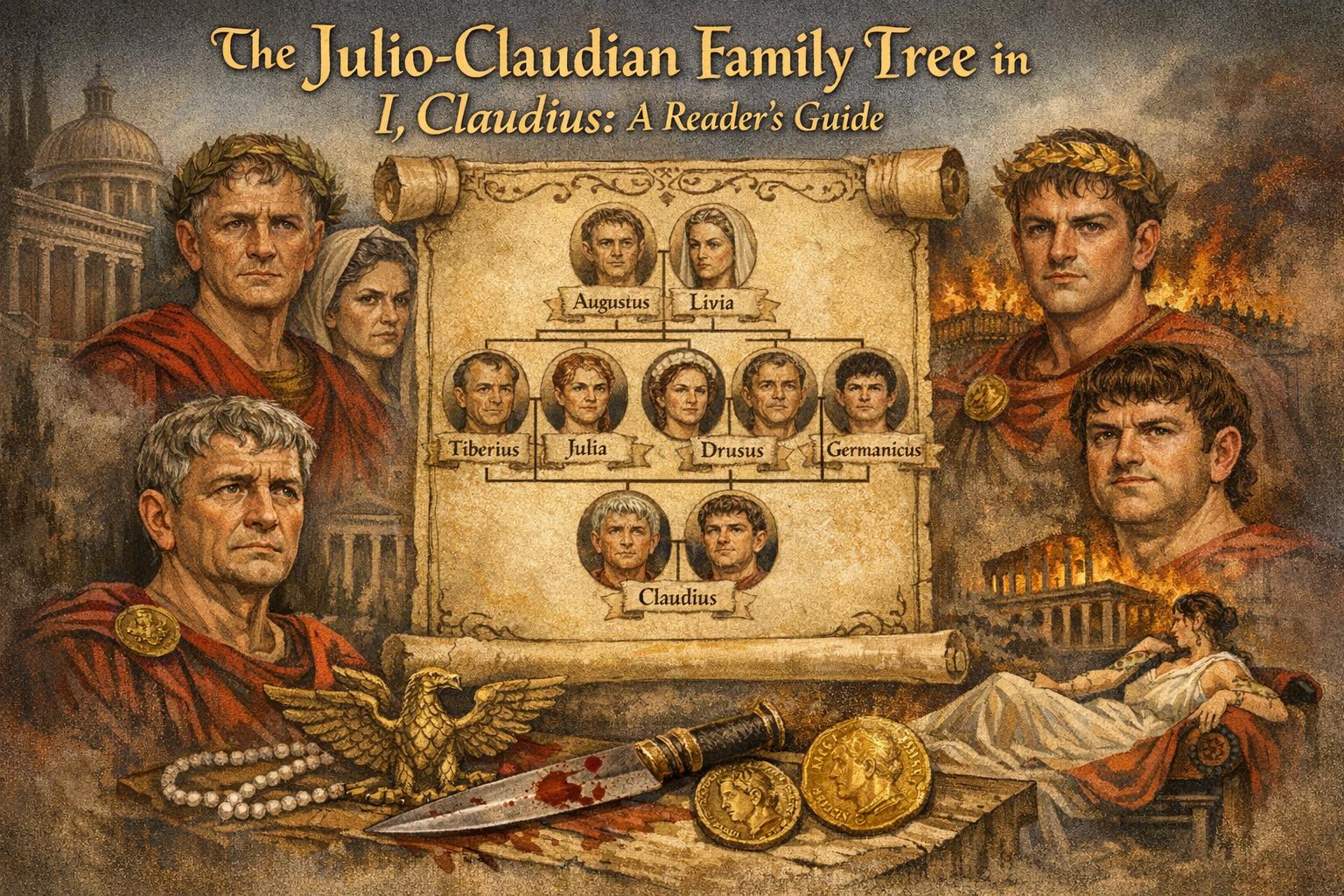
The Julio-Claudian Family: An Overview
The Julio-Claudian dynasty occupied the center of Roman political life during the formative decades of the Roman Empire. Spanning from the rise of Augustus in 27 BCE to the death of Nero in 68 CE, the dynasty encompassed the first five emperors of Rome. Although later Roman history would produce many more rulers, the frameworks of imperial authority, court politics, and dynastic succession were largely defined during this foundational period.
The term Julio-Claudian reflects the union of two prominent Roman families: the gens Julia, to which Julius Caesar and Augustus belonged, and the gens Claudia, an ancient patrician house represented most prominently by Livia Drusilla and her son Tiberius. Through marriage, adoption, and calculated alliances, these families formed a ruling network that shaped the early imperial state.
The dynasty is frequently explored in literature and popular culture, most notably in Robert Graves’ historical novel I, Claudius and its television adaptation. While such portrayals dramatize events, they are grounded in ancient sources such as Tacitus, Suetonius, and Cassius Dio. These sources document a political environment marked by ambition, strategic marriages, shifting loyalties, and evolving constitutional practices.
The Transition from Republic to Empire
Understanding the Julio-Claudian family requires attention to the collapse of the Roman Republic. Julius Caesar’s dictatorship and assassination in 44 BCE triggered a series of civil wars that ended the republican system. Caesar had no legitimate sons, but he adopted his grandnephew Gaius Octavius in his will. This act of adoption was not merely symbolic; in Roman law it created a legally binding filiation, positioning Octavian as Caesar’s political heir.
Octavian, who later assumed the name Augustus, consolidated power after defeating Mark Antony and Cleopatra in 31 BCE. Rather than proclaiming himself king, a politically unacceptable title in Rome, he crafted a new constitutional arrangement. In 27 BCE, he accepted the title princeps, meaning “first citizen,” and accumulated a range of republican offices that collectively granted him supreme authority. This carefully managed transition allowed Rome to maintain the appearance of republican governance while establishing what historians call the Principate.
The new system required a method of succession. Unlike monarchies with established hereditary rules, Rome possessed no formal mechanism for transferring imperial power. The Julio-Claudian approach relied heavily on adoption and family alliances, embedding political authority within a constructed dynastic framework.
Key Members of the Family
The Julio-Claudian line was not a straightforward hereditary sequence. Instead, it was shaped by premature deaths, strategic marriages, and repeated adoptions. The five emperors—Augustus, Tiberius, Caligula, Claudius, and Nero—were connected through blood, marriage, or legal adoption, forming a complex but continuous ruling house.
Augustus
Augustus governed from 27 BCE until 14 CE, presiding over an extended period of internal stability often referred to as the Pax Romana. His administrative reforms reorganized provincial governance, standardized taxation, and established a professional standing army loyal to the emperor rather than to individual generals. He also created the Praetorian Guard, an elite unit tasked with protecting the emperor, though this body would later play a decisive political role in imperial succession.
Augustus’ personal life had significant political implications. His marriage to Livia Drusilla linked him to the Claudian family. Although Augustus had a daughter, Julia, he lacked a surviving male heir. Over the course of his reign, several potential successors—including his grandsons Gaius and Lucius Caesar—died prematurely. Ultimately, Augustus adopted Livia’s son Tiberius, making him his legal heir. This adoption effectively merged the Julian and Claudian lines.
Augustus’ death in 14 CE marked the first orderly transfer of imperial power. The Senate confirmed Tiberius as emperor, reinforcing the perception that succession, though influenced by family arrangements, required formal recognition by Rome’s political institutions.
Tiberius
Tiberius ruled from 14 to 37 CE. A capable general before becoming emperor, he had achieved military successes in Germany and along the Danube frontier. His accession, however, was shaped by personal reluctance and political caution. Ancient historians often describe Tiberius as reserved and suspicious, characteristics that influenced his governing style.
Initially, Tiberius continued Augustus’ administrative policies. He maintained fiscal discipline and avoided major military overextensions. Over time, however, his relationship with the Senate deteriorated. Charges of treason, known as maiestas trials, became more frequent, contributing to an atmosphere of anxiety among the political elite.
In 26 CE, Tiberius withdrew to the island of Capri, leaving much of Rome’s administration in the hands of the Praetorian Prefect Sejanus. Sejanus consolidated considerable authority before being executed in 31 CE after accusations of conspiracy. Tiberius’ later years were marked by purges and growing distrust within the ruling circle.
Despite negative portrayals in historical sources, modern scholarship often reassesses Tiberius as a cautious and administratively competent ruler whose reputation suffered from hostile senatorial accounts.
Caligula
Caligula, born Gaius Julius Caesar Germanicus, was the son of the popular general Germanicus and Agrippina the Elder. He was adopted by Tiberius and succeeded him in 37 CE. His nickname, meaning “little boots,” originated from his childhood presence in military camps.
Caligula’s early months as emperor were welcomed by many, as he was associated with his esteemed father. However, ancient sources describe a dramatic change in behavior following a serious illness. His reign from 37 to 41 CE was characterized by heavy financial expenditures, public spectacles, and strained relations with the Senate.
Accounts of extreme actions, including alleged plans to elevate his horse to high office, appear in later histories and are often interpreted as exaggerations or symbolic narratives reflecting elite disapproval. Nonetheless, his administration depleted the imperial treasury and generated discontent among key groups. In 41 CE, members of the Praetorian Guard assassinated him, marking the first violent removal of a Roman emperor.
Claudius
Claudius, uncle of Caligula, became emperor in unexpected circumstances. Following Caligula’s assassination, members of the Praetorian Guard reportedly discovered Claudius and proclaimed him emperor. The Senate ultimately accepted this decision, demonstrating the Guard’s growing political influence.
Claudius had previously been marginalized within the family, possibly due to physical impairments and a scholarly disposition. However, his reign from 41 to 54 CE was marked by administrative diligence and territorial expansion. The conquest of Britain in 43 CE added a significant province to the empire. Claudius also extended Roman citizenship to provincial elites and reformed the judicial system.
His reliance on freedmen administrators drew criticism from traditional aristocrats. His marriages additionally shaped dynastic politics. After the execution of his third wife, Messalina, Claudius married his niece Agrippina the Younger, a union that strengthened the Julian line. Agrippina persuaded Claudius to adopt her son Nero, positioning him ahead of Claudius’ biological son Britannicus in the line of succession.
Claudius died in 54 CE, with later sources alleging poisoning orchestrated by Agrippina. While the exact circumstances remain uncertain, Nero’s accession followed swiftly.
Nero
Nero ruled from 54 to 68 CE, becoming emperor at the age of sixteen. Initially guided by advisors such as Seneca and Burrus, his early administration was relatively stable. Over time, however, he asserted greater personal control.
Nero’s reign confronted significant challenges, including military revolts and financial strain. The Great Fire of Rome in 64 CE devastated much of the city. Ancient sources report that Nero initiated rebuilding efforts and introduced new urban regulations. Allegations that he blamed Christians for the fire contributed to later Christian portrayals of persecution.
In foreign policy, Nero’s generals secured a diplomatic settlement with Parthia over Armenia. Nevertheless, provincial unrest grew, culminating in revolts in Gaul and Spain. In 68 CE, faced with opposition from multiple fronts and abandonment by the Praetorian Guard, Nero committed suicide. His death ended the Julio-Claudian line and ushered in the turbulent Year of the Four Emperors.
Intrigues and Relationships
The internal dynamics of the Julio-Claudian family combined political calculation with Roman legal traditions. Marriage served as a tool of alliance-building, while adoption allowed emperors to select heirs based on strategic considerations. Women such as Livia and Agrippina the Younger played visible roles in succession politics, though ancient historians often portray them through hostile narratives.
The repeated use of adoption reflects the absence of fixed hereditary laws. Augustus adopted Tiberius; Tiberius adopted Germanicus and later Caligula; Claudius adopted Nero. Each adoption altered the line of succession, sometimes displacing biological offspring in favor of politically advantageous candidates.
Assassination and exile were recurring features of the period. Imperial authority existed alongside senatorial institutions, and tensions between these bodies shaped political outcomes. The Praetorian Guard emerged as a decisive force, demonstrating that military loyalty was central to imperial survival.
Administration and Governance
Beyond family dynamics, the Julio-Claudians established durable administrative norms. They expanded the imperial bureaucracy, relying increasingly on equestrians and freedmen rather than exclusively on senators. Provincial governance was systematized, and direct imperial control extended over key regions.
Financial management remained a consistent concern. Augustus accumulated resources through conquest and taxation, Tiberius maintained surpluses, Caligula expended significant funds, Claudius invested in infrastructure, and Nero faced mounting fiscal pressures. These economic patterns influenced political stability.
The emperors also cultivated public presence through architecture and spectacle. Temples, forums, aqueducts, and roads functioned as instruments of authority, reinforcing the central role of the imperial household in Roman civic life.
Legacy and Cultural Influence
The Julio-Claudian dynasty established precedents that shaped subsequent centuries of Roman rule. The very concept of the emperor as princeps, balancing autocratic authority with republican forms, originated with Augustus and persisted long after the dynasty’s fall. The challenges of succession, the influence of the military, and the interplay between personal relationships and public governance became recurring themes in imperial history.
Literary and artistic representations have ensured the dynasty’s enduring visibility. Ancient historians crafted narratives that emphasized moral decline and dramatic conflict. Modern works such as I, Claudius reinterpret these narratives, presenting the dynasty as a study in political survival and structural tension within an evolving empire.
By the time of Nero’s death, the Roman Empire was firmly established as a centralized state governed by an emperor. Although the Julio-Claudian bloodline ended in 68 CE, the institutions they shaped endured, influencing Roman governance for generations. Their reigns illustrate the processes by which Rome transformed from a republic dominated by a senatorial elite into a monarchical system supported by administrative innovation and military authority.