
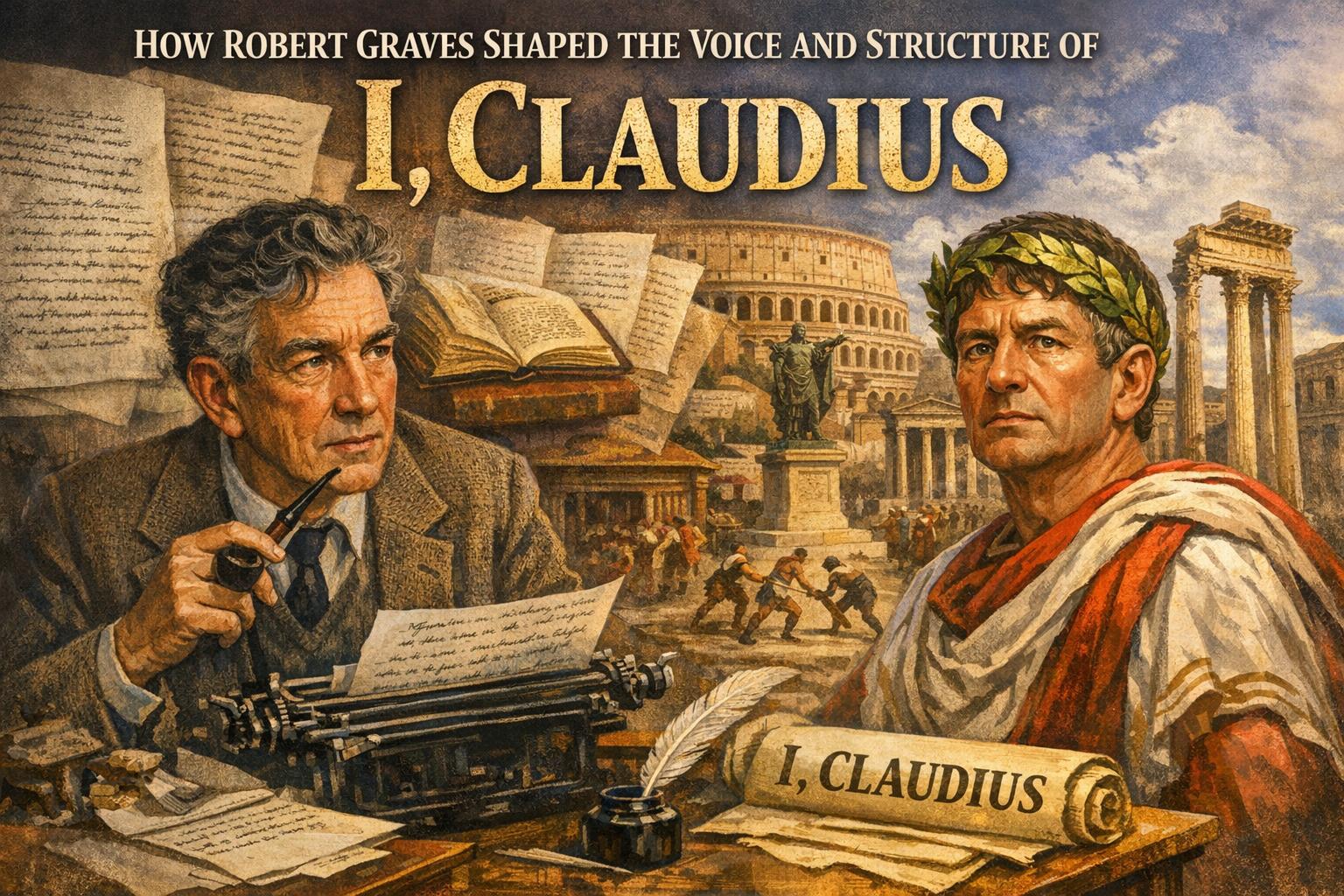
Robert Graves and the Crafting of I, Claudius
I, Claudius stands as one of the most carefully constructed historical novels of the twentieth century. Robert Graves approached the ancient world not merely as a scholar assembling facts but as a craftsman shaping voice, structure, and perspective into a coherent narrative form. The novel, published in 1934 and followed by Claudius the God, reconstructs the early Roman Empire through the purported memoirs of Tiberius Claudius Drusus Nero Germanicus, later Emperor Claudius. While grounded in classical sources, the work functions primarily as a literary creation, shaped by deliberate narrative strategies. Graves’ methods reveal a thoughtful engagement with questions of authorship, historical credibility, characterization, and dramatic pacing.
The Narrative Voice
The most defining feature of I, Claudius is its sustained first-person narration. Graves frames the book as a secret autobiography written by Claudius in old age, intended for future generations. This voice establishes authority while simultaneously inviting scrutiny. By presenting Claudius as historian and participant, Graves creates a layered effect in which events are filtered through memory and retrospective judgment.
The use of an autobiographical format allows for a personal tone rarely found in conventional historical accounts. Claudius reflects on his childhood illnesses, his stammer, his limp, and the condescension of his family. These details are not incidental embellishments but essential components of the narrative voice. Graves’ Claudius is observant, patient, and intellectually rigorous. Because others underestimate him, he survives political purges that remove more prominent members of the Julio-Claudian dynasty. His physical vulnerabilities become narrative advantages, positioning him as a keen witness to imperial corruption.
This voice also offers analytical commentary on Roman institutions. Claudius frequently digresses into explanations of republican traditions, legal reforms, and military campaigns. Such passages provide structural stability to the historical material while maintaining the fictional illusion that the emperor himself authored the account. The tone remains measured rather than sentimental. Claudius does not present himself as a heroic figure but as a cautious chronicler intent on explaining how events unfolded.
Graves constructs this voice through careful linguistic choices. The prose avoids overtly modern idioms while remaining accessible to contemporary readers. The style suggests translation from Latin without imitating archaic stiffness. In doing so, Graves achieves a balance between authenticity and readability. The character’s intelligence reinforces the plausibility of the memoir format, as the historical Claudius was indeed known for scholarly interests.
The Illusion of Historical Authenticity
A central challenge in writing historical fiction lies in persuading readers that the narrative could have existed within its depicted era. Graves addresses this challenge by embedding references to established Roman historians such as Tacitus, Suetonius, and Livy. Claudius occasionally comments on how future historians may misinterpret events, creating a subtle dialogue between the fictional memoir and the surviving ancient sources.
This technique reinforces the realism of the narrative. Because readers recognize names drawn from documented history, the fiction gains credibility. Graves does not present the memoir as a modern reinterpretation; instead, he implies that it predates and even corrects later historical accounts. The suggestion that Claudius’ writing might have been suppressed or lost enhances the plausibility of the fictional premise.
The novel’s authority also derives from its consistent internal logic. Political motivations, alliances, betrayals, and reforms are explained within the framework of Roman cultural practices. The system of patronage, the role of the Senate, and the influence of the Praetorian Guard receive detailed treatment. Rather than simplifying these elements, Graves integrates them into the consciousness of his narrator. Claudius’ analysis of these structures supports the illusion that he writes as a participant deeply immersed in Roman political life.
Structural Approach
The structure of I, Claudius follows a broadly chronological path, beginning with Claudius’ ancestry and childhood and concluding with his reluctant elevation to emperor. This linear progression emphasizes causality. Each development arises from prior events, suggesting an almost inevitable convergence toward Claudius’ accession.
Graves does not compress decades into a rapid summary. Instead, he organizes the narrative into episodes that highlight turning points within the dynasty. The reign of Augustus, the growing influence of Livia, the exile of potential heirs, and the ascent of Tiberius form distinct narrative phases. Within each phase, Graves selects incidents that illuminate character dynamics and shifting balances of power.
The episodic design prevents the narrative from becoming overwhelmed by its historical scope. Each chapter functions as a focused study of particular intrigues or crises. Yet these segments accumulate, creating a comprehensive portrait of systemic instability. The death of one political figure leads to the advancement of another; marriages create alliances that later unravel. Through such careful sequencing, Graves maintains narrative coherence while reflecting the interdependent nature of imperial politics.
Chronology also allows readers to observe Claudius’ development over time. His youthful fascination with history matures into a cautious understanding of political survival. Early episodes portray him as marginal, even comic in the eyes of relatives. Later sections reveal his growing awareness of the dangers surrounding him. By the time he inherits power, readers recognize how prior experience has shaped his perspective.
Characterization and Political Observation
Although the novel centers on Claudius, Graves devotes sustained attention to secondary figures. Augustus emerges not merely as the founder of the Empire but as a calculating ruler balancing republican forms with autocratic authority. Livia, perhaps the most formidable presence in the narrative, embodies strategic patience and influence exercised through domestic channels. Tiberius appears complex rather than uniformly tyrannical, shaped by insecurity and political pressure.
Graves’ method avoids reducing these individuals to caricatures. Instead, Claudius interprets their actions through evidence and personal recollection. The narrative acknowledges rumor and propaganda while distinguishing them from substantiated events. This measured approach encourages readers to consider the instability of historical reputation.
The depiction of political maneuvering forms a central thematic thread. Successions are determined not by straightforward inheritance but by calculated elimination. Adoption, exile, and marriage become tools of consolidation. Graves portrays the imperial household as a space where private relationships intersect with state interests. By presenting these dynamics through Claudius’ analytic voice, the novel examines power without overt dramatization.
Balancing Fact and Fiction
Graves’ engagement with classical sources demonstrates thorough research. Tacitus provides extensive material on the Julio-Claudian emperors, while Suetonius contributes anecdotal details. Yet the ancient record contains gaps and contradictions. Graves addresses these uncertainties by supplying plausible motivations and dialogue.
The fictional components serve several functions. They bridge chronological gaps, clarify ambiguous events, and provide continuity between documented incidents. Dialogue, in particular, allows Graves to explore psychological nuance. Conversations between Claudius and other figures often reveal strategic reasoning not explicitly recorded in historical texts.
At the same time, Graves refrains from contradicting major historical conclusions without justification. When he departs from traditional accounts, he grounds those departures in interpretative possibilities suggested by ancient sources. This restrained approach lends stability to the novel’s imaginative expansions.
The balance between documentation and invention reflects a broader understanding of historical writing. Even ancient historians shaped their narratives through rhetorical choices. Graves’ fictionalization can thus be viewed not as distortion but as participation in a longstanding tradition of interpretive historiography.
Thematic Focus on Power and Survival
Beyond recounting events, I, Claudius analyzes the mechanics of survival within an autocratic system. Claudius’ endurance results less from ambition than from invisibility. His perceived weaknesses render him nonthreatening. Graves uses this premise to examine how authoritarian structures create incentives for suspicion and elimination.
The novel does not frame Claudius’ rise as a triumph but as a consequence of structural decay. Successive deaths narrow the line of succession until the least likely candidate remains. This outcome underscores the instability inherent in dynastic politics. Claudius’ awareness of this instability informs his retrospective tone; he writes as someone who understands that power rests on circumstance rather than destiny.
Language and Literary Method
Graves’ prose style reflects discipline and clarity. Sentences are constructed to convey complex information without obscurity. Descriptions of ceremonies, military campaigns, and domestic settings are precise yet economical. Such restraint aligns with the narrative’s documentary premise.
At times, Claudius adopts a didactic tone, explaining Roman customs to anticipated foreign readers. These passages serve dual purposes: they educate modern audiences while reinforcing the authenticity of the memoir. The balance between exposition and narrative momentum requires careful pacing, which Graves maintains by alternating analytical sections with scenes of dramatic interaction.
The integration of scholarship and storytelling distinguishes the novel from purely academic histories. Graves does not footnote his sources within the fictional framework, yet his command of material is evident in the density of contextual detail. This approach allows the narrative to function simultaneously as literature and as an introduction to early imperial history.
Legacy and Influence
The construction of I, Claudius influenced subsequent historical fiction by demonstrating how a strong narrative voice can unify expansive material. Graves showed that first-person narration need not limit scope; instead, it can provide coherence by filtering events through a single consciousness. Later writers adopted similar strategies when reimagining historical figures as memoirists.
The enduring interest in the novel also reflects its structural integrity. Because events unfold through causally connected episodes, the narrative sustains engagement across political transitions. The credibility of the voice encourages readers to accept its premises, even when aware of the fictional basis.
Conclusion
Robert Graves’ crafting of I, Claudius reveals sustained attention to narrative voice, structural design, and historical method. By presenting the story as a first-person memoir, he created immediacy and interpretive depth. His chronological yet episodic structure organizes complex political developments into coherent progression. Through careful balance of documented fact and imaginative reconstruction, he constructed a narrative that aligns with ancient sources while extending beyond them.
The result is a work that functions as both literary achievement and historical exploration. Graves’ method demonstrates how disciplined narrative technique can transform extensive historical material into a unified and persuasive account. In shaping Claudius’ voice with consistency and analytical clarity, Graves established a model for historical fiction that continues to inform the genre.