
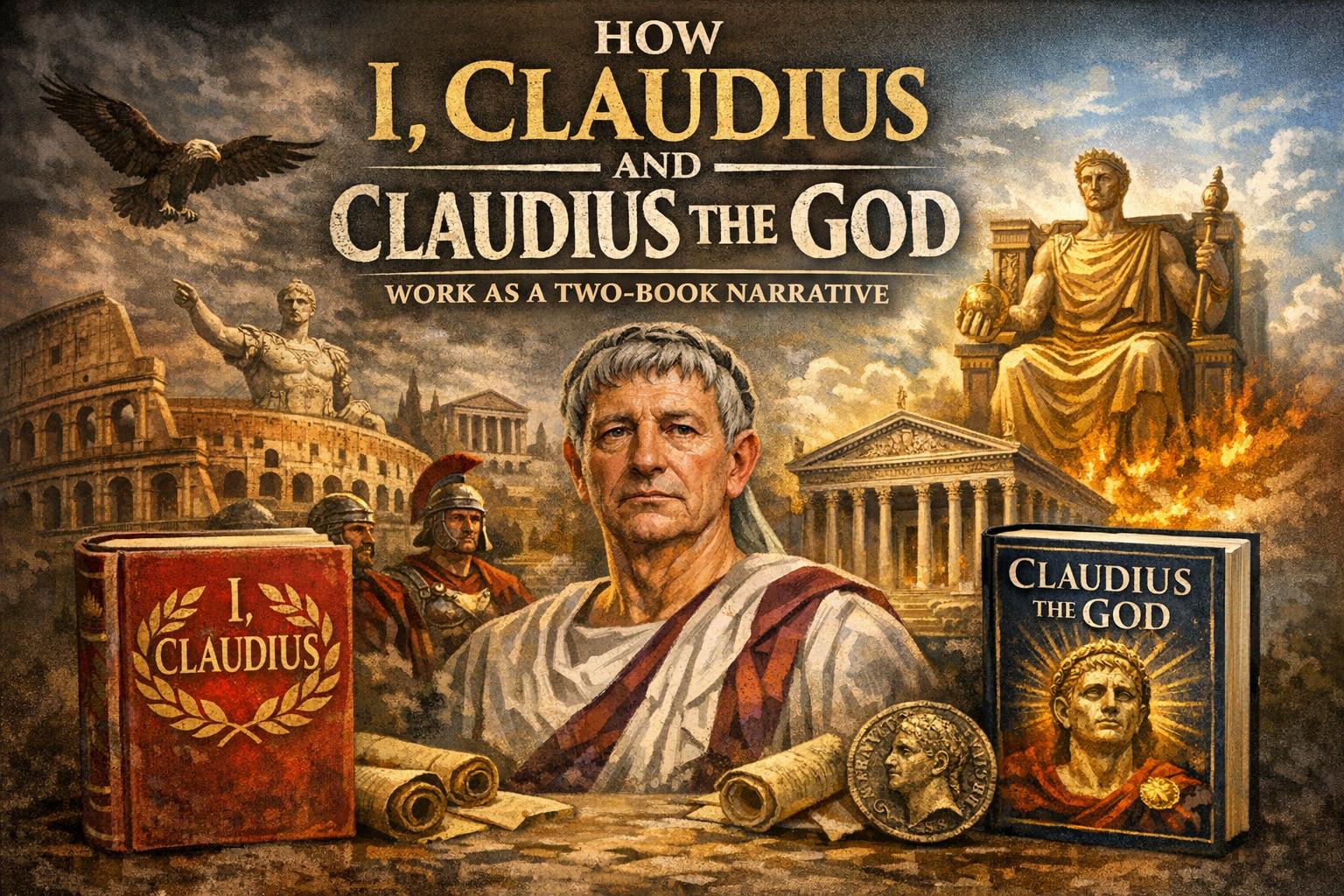
The Narrative Structure of “I, Claudius” and “Claudius the God”
“I, Claudius” and “Claudius the God” by Robert Graves together form an extensive fictional autobiography of the Roman Emperor Claudius. Published in 1934 and 1935 respectively, the novels reconstruct the political and domestic history of the Julio-Claudian dynasty through the retrospective voice of Claudius himself. Graves structures the two books as a continuous personal memoir, blending documented historical events with imaginative reconstruction. The result is a sustained exploration of political power, historical interpretation, and the private psychology of a ruler who was long dismissed by his contemporaries.
The two novels are designed to be read as a single extended narrative. The first volume traces Claudius’s life from childhood through the reigns of Augustus, Tiberius, and Caligula. The second follows his unexpected elevation to emperor and the challenges of governing Rome. Together they establish a carefully organized progression from marginalization to authority, and from observer to participant in imperial power.
Autobiographical Framing and Retrospective Voice
A defining feature of both novels is their presentation as documents written by Claudius late in life. Graves constructs the narrative as a secret history intended for future generations. This autobiographical framing creates several structural effects. First, it allows the author to provide commentary on events with the benefit of hindsight. Claudius frequently anticipates outcomes, clarifies rumors, and evaluates his earlier judgments. Second, it allows Graves to reconcile contradictions in the ancient sources by presenting them as deliberate distortions or misunderstandings within the Roman court.
The memoir structure also introduces a controlled reliability. Claudius presents himself as truthful and methodical, motivated by a historian’s desire to record events accurately. Yet the first-person perspective inevitably filters reality through personal bias. His resentments, loyalties, and private fears influence the way other figures are depicted. Augustus becomes a calculating statesman whose public image conceals pragmatic ruthlessness. Livia appears as a strategist whose influence shapes succession politics. Tiberius emerges as a ruler gradually isolated by suspicion. Caligula is portrayed as unstable and erratic, though Claudius’s own survival during Caligula’s reign shapes the tone of this portrayal.
By using retrospective narration, Graves transforms what might have been a conventional historical chronicle into a layered account of perception and memory. The novels examine not only what happened, but how it was experienced and recorded.
Overview of “I, Claudius”
The first novel establishes the foundations of the narrative in Claudius’s childhood. Physically impaired by a stammer, a limp, and involuntary tics, he is considered intellectually deficient by many members of his family. His mother Antonia and grandmother Livia see him as an embarrassment to the distinguished Julio-Claudian lineage. This early marginalization shapes the central structural pattern of the book: Claudius survives because he is underestimated.
Graves organizes “I, Claudius” around successive imperial reigns. The rule of Augustus provides the initial framework. Claudius recounts the political maneuvering surrounding succession, the strategic marriages within the imperial family, and the removal of potential rivals. Through detailed episodes, the narrative builds tension around the question of who will inherit authority. Though Claudius remains peripheral, he observes patterns of manipulation and consolidation that define the emerging imperial system.
The second phase centers on Tiberius. Here the narrative structure darkens and becomes more insular. The court atmosphere grows increasingly suspicious. Trials for treason, denunciations, and quiet eliminations of rivals dominate the political landscape. Claudius’s scholarly pursuits shield him, but he witnesses the destructive consequences of concentrated power. The island retreat of Capri functions as both a geographical and narrative symbol of detachment from accountable governance.
The final portion of the first novel addresses the reign of Caligula. The structural rhythm accelerates as Caligula’s erratic behavior destabilizes the court. Claudius describes episodes of humiliation and danger, maintaining his façade of incompetence to avoid confrontation. The climax occurs with Caligula’s assassination by members of the Praetorian Guard. In a moment defined less by ambition than by circumstance, Claudius is discovered hiding and proclaimed emperor. The first novel ends at this turning point, completing the arc from insignificance to unexpected authority.
Structural Progression from Marginality to Power
The architecture of “I, Claudius” depends on contrast. Claudius, initially marginalized, serves as a constant observer while more dominant personalities rise and fall. This repetition of succession crises establishes a cycle of ambition, intrigue, and elimination. Each reign introduces new configurations of power, yet similar methods persist. Through this cyclical pattern, Graves underlines structural weaknesses within the imperial system.
Claudius’s growth is gradual rather than dramatic. His intelligence emerges through reflection rather than action. He studies history, recognizing parallels between Republican decline and contemporary politics. This intellectual framework prepares him for the authority he will later assume, though he does not actively seek it. The narrative thereby shifts focus from external conquest to internal calculation. Survival becomes the central achievement of the first volume.
Continuation in “Claudius the God”
The second novel begins at the moment of Claudius’s proclamation as emperor. Structurally, this marks a decisive shift. No longer an observer, Claudius becomes responsible for the governance he once analyzed from the margins. The memoir form remains, but its tone changes. Practical administration replaces passive observation.
Graves organizes “Claudius the God” around challenges of rule. Claudius attempts to reconcile imperial authority with Republican traditions, seeking to restore elements of senatorial governance. He works to reform legal procedures, extend citizenship, and consolidate provincial administration. Particular attention is given to the conquest of Britain, an episode framed as both strategic necessity and political validation. These administrative measures provide narrative substance distinct from the domestic intrigues of the earlier volume.
However, political reform does not eliminate personal vulnerability. The second novel devotes extensive attention to Claudius’s marriage to Messalina. Her infidelities and the scandal surrounding her eventual downfall create a domestic parallel to earlier court conspiracies. The personal sphere remains inseparable from imperial stability. Later, Claudius’s marriage to Agrippina introduces a renewed dynamic of succession politics, echoing the manipulations associated with Livia in the first novel. Through this repetition, Graves emphasizes the persistence of dynastic ambition.
The novel concludes with Claudius confronting the limitations of his reform efforts. His aspiration to revive republican values proves ultimately incompatible with entrenched autocracy. The memoir tone becomes reflective, acknowledging that structural conditions limit even well-intentioned reform.
Thematic Parallels Between the Two Volumes
Although the novels differ in focus, they share interconnected thematic patterns. Both examine the tension between appearance and reality. In the first book, Claudius cultivates an appearance of weakness. In the second, he must project authority while privately doubting the durability of his policies. Public performance remains central to political survival.
Another structural parallel involves the role of prophecy and historical inevitability. Claudius frequently references prophecies that predict his rise and Rome’s future transformation. These elements lend coherence to events that might otherwise appear chaotic. Yet Graves presents prophecy not as supernatural certainty but as interpretative narrative. Characters act in accordance with beliefs about destiny, thereby shaping political outcomes.
Family relationships also constitute a repeated framework. Intermarriage within the Julio-Claudian house intensifies rivalry. The novels depict succession not as a purely institutional process but as a familial negotiation. This blending of domestic and political spheres reinforces the instability of autocratic systems dependent on heredity.
Character Development and Historical Context
Claudius’s development across the two novels is cumulative. In youth he is observant and cautious. As emperor he becomes deliberate and administratively capable, though not entirely decisive. His physical impairments remain present but cease to define his political agency. Graves does not portray him as an idealized ruler; rather, he emerges as pragmatic and occasionally compromised.
The supporting cast is drawn from historical records, including Augustus, Livia, Tiberius, Germanicus, Caligula, Messalina, and Agrippina. Graves draws heavily on ancient sources such as Tacitus, Suetonius, and Cassius Dio. Where historical accounts conflict, he selects or synthesizes material to produce narrative continuity. In doing so, he transforms fragmentary history into sustained dramatic arcs.
The depiction of Roman society extends beyond court politics. Religious rituals, military campaigns, legal reforms, and provincial administration receive attention. The empire is not merely a backdrop but an active structural component. Provincial unrest, economic pressures, and cultural diversity influence political decisions. By embedding personal narrative within broader historical context, Graves maintains balance between individual agency and systemic forces.
Narrative Techniques
The sustained first-person perspective generates immediacy while preserving analytical distance. Claudius comments on speeches, motives, and subsequent outcomes. Dialogue is reconstructed in detail, providing dramatic texture without abandoning memoir form. Graves often employs extended conversations to clarify political dilemmas or ideological differences.
Chronological organization underpins both novels. Events unfold sequentially, anchored in identifiable reigns and milestones. Yet within this linear progression, Claudius occasionally offers thematic digressions. He discusses Roman religion, historiography, or linguistic development. These analytical pauses reinforce his identity as scholar and historian.
Irony functions as a structural device. Early insults directed at Claudius become reversed when he assumes authority. Predictions that he will never hold office prove incorrect. Nevertheless, irony remains restrained rather than emphatic. The tone consistently suggests measured evaluation rather than dramatic triumph.
Power, Governance, and Institutional Limits
A central concern of the combined narrative is the nature of autocratic governance. Through successive reigns, the novels demonstrate the concentration of authority in a single figure, even when republican forms persist. Claudius recognizes this contradiction. His attempts to empower the Senate illustrate both idealism and practical difficulty.
Graves portrays administration as a complex task requiring delegation. Freedmen advisers such as Narcissus and Pallas become influential in Claudius’s court. Their presence highlights tension between traditional aristocratic authority and merit-based advancement. The emperor’s reliance on bureaucratic support marks a transition toward more structured imperial governance.
Military expansion and provincial integration further complicate rule. The conquest of Britain, for example, serves both strategic and symbolic purposes. It reinforces imperial legitimacy while extending administrative responsibilities. Through such episodes, the narrative situates Claudius within broader imperial development rather than confining him to palace intrigue.
Language, Style, and Historical Imagination
Graves adopts a clear, formal prose style intended to evoke classical historiography. Sentences are measured and explanatory. Descriptions prioritize political context over sensory detail. The absence of ornate language reinforces the memoir illusion.
At the same time, the author employs imaginative reconstruction to fill historical gaps. Motives are assigned, private conversations invented, and cause-and-effect relationships clarified. This blending of documented record and speculative interiority defines the novels as historical fiction rather than academic history.
The balance between invention and research is maintained through consistent tone. Even in moments of dramatic tension—assassinations, betrayals, public scandals—the narration remains controlled. Such restraint contributes to the credibility of Claudius as a reflective historian.
Conclusion
Taken together, “I, Claudius” and “Claudius the God” constitute a unified exploration of imperial Rome through the constructed memoir of a ruler often underestimated by tradition. The narrative structure progresses from marginal observation to direct governance, maintaining continuity through retrospective voice and chronological organization. Historical context is interwoven with character development, transforming documented events into sustained dramatic arcs.
Graves’s method relies on first-person narration, thematic repetition, and careful reconstruction of political dynamics. The novels examine succession, institutional constraint, and the challenges of reform within an autocratic framework. By presenting Claudius as both historian and emperor, the narrative invites consideration of how history is recorded and interpreted.
The two volumes function not merely as biographies of a Roman ruler but as structural studies of power, legitimacy, and survival within a dynastic system. Their enduring significance lies in the disciplined integration of historical record with imaginative narration, creating a continuous autobiography that situates individual experience within the broader transformations of the early Roman Empire.