
Introduction
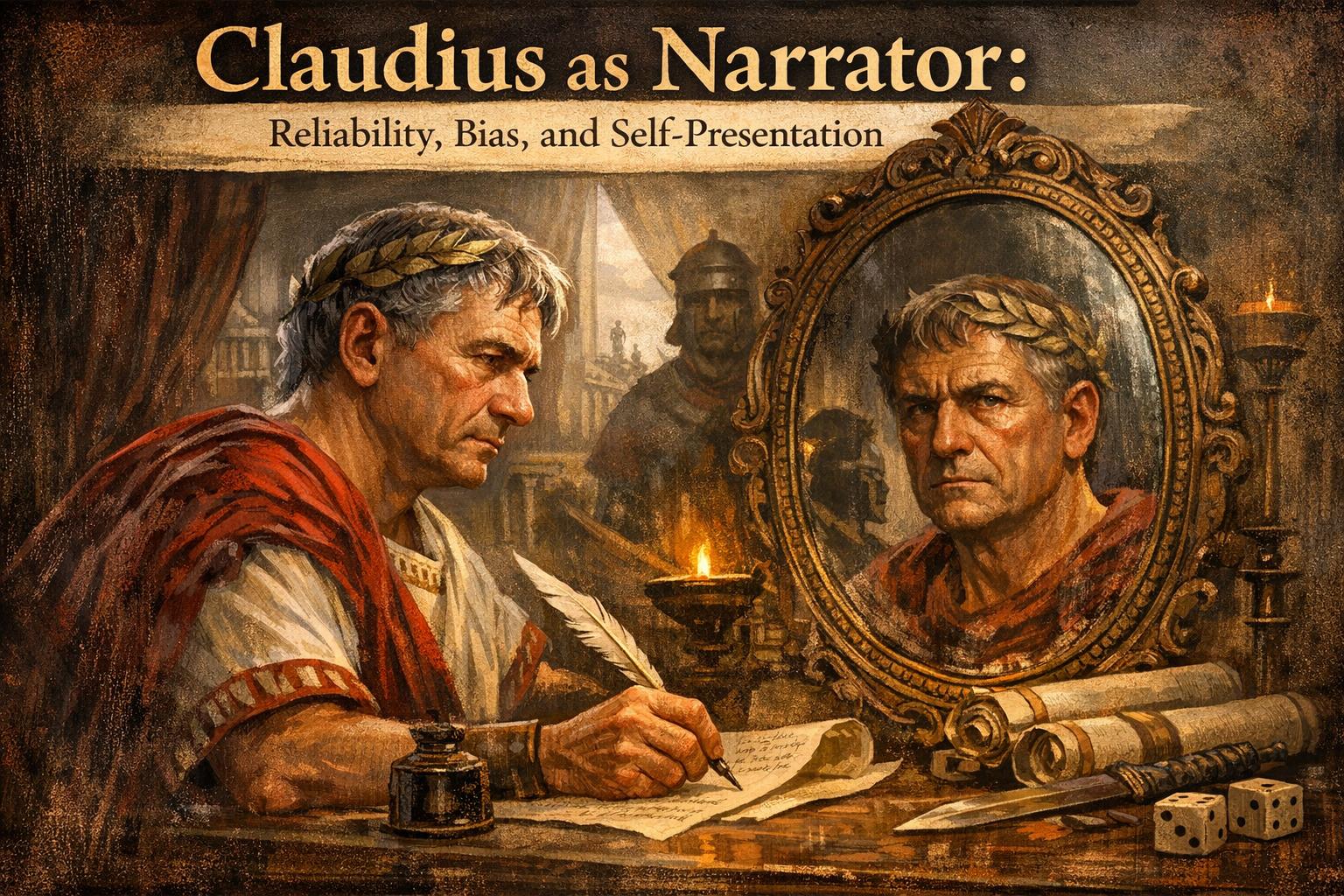
In literary analysis, the concept of the narrator is central to understanding how a story is constructed and interpreted. A narrator may present events directly, as in a first-person account, or shape the audience’s perception indirectly through dialogue, reported action, and rhetorical framing. In dramatic works such as William Shakespeare’s Hamlet, narration does not occur through a single storytelling voice. Instead, narrative authority is distributed across characters whose speeches, silences, and decisions guide the audience’s interpretation of events. Within this dramatic framework, Claudius occupies a position of particular importance. Although he is not a narrator in the formal sense, his control over public discourse, political messaging, and interpersonal exchanges allows him to function as a powerful narrative agent.
Understanding Claudius as a form of narrator requires examining how he presents information, how he shapes the court’s interpretation of political events, and how his private admissions contrast with his public statements. His reliability is therefore not assessed in terms of storytelling accuracy alone, but in relation to truthfulness, consistency, and moral coherence. By analyzing Claudius’s reliability, bias, and self-presentation, readers gain insight into the broader thematic concerns of the play, including legitimacy, deception, authority, and the instability of truth within political systems.
Claudius’s Role in “Hamlet”
Claudius enters the play as the newly crowned King of Denmark. He has assumed the throne following the death of his brother, King Hamlet, and has married Queen Gertrude shortly thereafter. From his first public speech, Claudius establishes himself as the dominant voice at court. He frames the recent events—the death of his brother and his own accession—not as a disruption but as a necessary consolidation of state power. Through carefully structured rhetoric, he merges references to mourning with declarations of continuity and stability. In doing so, he positions himself as both responsible ruler and emotional moderate.
This opening address illustrates his narrative function. He does not merely report events; he interprets them. He provides the court with a version of reality that seeks to close debate about succession and moral legitimacy. By balancing references to grief with pragmatic political action, Claudius constructs a narrative of orderly transition rather than opportunistic seizure. The effect is to normalize what might otherwise be regarded as suspicious or premature.
Beyond formal speeches, Claudius influences the progression of the plot through strategic delegation. He appoints ambassadors, directs surveillance of Hamlet, and orchestrates plans for resolution. Each of these actions has narrative consequences. Through him, information circulates, misunderstandings are cultivated, and suspicions are redirected. His authority allows his version of events to appear official, even when it is grounded in concealment.
While Hamlet delivers soliloquies that reveal private thoughts directly to the audience, Claudius’s narrative role operates on two levels: the public stage of political discourse and the private space of confession. The tension between these two modes underscores questions of truth and reliability.
Reliability of Claudius as a Narrative Authority
Reliability in literature typically refers to the extent to which a speaker’s account can be accepted as accurate or truthful. Although Claudius does not narrate events to the audience in a conventional manner, he frequently provides explanations, interpretations, and justifications. These function similarly to narrative commentary. His reliability must therefore be measured by comparing what he says publicly, what he admits privately, and what the broader dramatic action reveals.
The most significant challenge to his reliability is his concealed crime: the murder of King Hamlet. The audience becomes aware of this act through the Ghost’s testimony in Act I and later through Claudius’s own soliloquy in Act III. The existence of this concealed truth establishes that Claudius’s public narrative rests on falsehood. His account of King Hamlet’s death as the result of natural causes is demonstrably untrue. Consequently, any claim he makes regarding the legitimacy of his reign must be evaluated against this underlying deception.
However, Claudius’s unreliability is not absolute in every context. When he speaks pragmatically about political matters, he often demonstrates clarity and strategic reasoning. His concerns about Hamlet’s erratic behavior reflect genuine apprehension. His recognition that Hamlet poses a threat is accurate. In these instances, Claudius provides assessments that align with observable circumstances. This partial reliability contributes to his complexity; he is neither irrational nor delusional. His deception is deliberate and calculated rather than incidental.
A crucial moment in evaluating Claudius’s reliability occurs in his private prayer scene. Alone on stage, he acknowledges his guilt: he admits to murdering his brother and articulates the moral weight of his actions. Here, his language shifts from persuasive rhetoric to introspective confession. Because there is no apparent audience within the play and no immediate political advantage to be gained, his admission appears sincere. Yet even in this private moment, he reveals a divided consciousness. He desires forgiveness but remains unwilling to surrender the rewards of his crime—the crown and the queen. This conflict highlights a fundamental tension: Claudius can articulate truth, but he does not fully act upon it. His reliability in recognizing moral reality does not translate into corrective behavior.
Therefore, Claudius functions as selectively reliable. He is capable of accurate perception and truthful acknowledgment, but he chooses when and how truth will be expressed. Reliability, in his case, is governed by expediency rather than principle.
Bias in Claudius’s Narrative Perspective
Bias refers to the presence of personal interest or prejudice that shapes interpretation. Claudius’s bias is consistent and rooted in self-preservation. Every narrative framing he constructs serves to secure his authority and diminish threats. This bias affects both his public declarations and his private strategies.
In his dealings with Hamlet, Claudius consistently interprets the prince’s behavior through the lens of political danger. While Hamlet’s grief and philosophical introspection are genuine, Claudius reduces them to instability that must be managed. He encourages others—Polonius, Rosencrantz, and Guildenstern—to gather information under the guise of concern. By doing so, he legitimizes surveillance as protective governance. His bias leads him to frame suspicion as prudence.
Claudius’s manipulation of Rosencrantz and Guildenstern demonstrates how bias shapes secondary narratives. He presents Hamlet’s condition as a matter requiring friendly intervention, yet his instructions ultimately place the young courtiers in a position of complicity. The framing of their mission disguises the coercive nature of the king’s authority. His bias thus transforms political control into apparent benevolence.
Similarly, when arranging Hamlet’s dispatch to England, Claudius constructs a diplomatic narrative masking lethal intent. To the court, the decision appears administrative; to the audience, it represents an attempt at extrajudicial elimination. His language obscures the severity of his plan. The gap between stated motive and actual purpose exemplifies narrative distortion rooted in bias.
It is important to note that Claudius’s bias extends beyond self-preservation to the maintenance of institutional stability. He consistently emphasizes the health of the state. External threats, such as Fortinbras, are addressed through diplomacy. Internal disorder is treated as a political liability. Although his personal survival is central, he often aligns his interests with those of Denmark. This conflation complicates interpretation: actions motivated by guilt and fear may simultaneously contribute to short-term order. The coexistence of pragmatic governance and concealed crime reinforces the ambiguous quality of his bias.
Self-Presentation and Political Performance
Self-presentation is central to Claudius’s exercise of power. As king, he performs authority through ceremonial language, measured tone, and calculated generosity. His speeches are structured to display composure and rationality. He invokes collective identity by referring to “our” decisions and shared concerns, embedding his leadership within communal consensus.
Language is his principal instrument. Claudius demonstrates rhetorical control in balancing opposites, framing contradictions as harmonious unity. In his opening address, he combines mourning and celebration, constructing a narrative in which his marriage to Gertrude offsets national grief. The linguistic technique creates an impression of equilibrium. By mastering tone, he projects stability.
His self-presentation also relies on selective transparency. He openly addresses certain matters, such as diplomacy with Norway, thereby reinforcing his image as attentive ruler. Yet on critical issues—most notably the circumstances of his brother’s death—he remains silent or evasive. This calibrated openness fosters trust where it serves him, insulating more dangerous secrets.
The contrast between Claudius and Hamlet in their modes of speech underscores the role of self-presentation. Hamlet’s language frequently exposes uncertainty, irony, or contradiction. Claudius strives for clarity and resolution. While Hamlet questions surfaces, Claudius reinforces them. The result is a tension between introspective analysis and authoritative declaration. Through this contrast, Claudius emerges as a figure of controlled narrative performance.
Private Conscience and Public Authority
One of the most significant aspects of Claudius’s narrative function lies in the gap between private conscience and public authority. His soliloquy in Act III reveals genuine awareness of wrongdoing. He recognizes the moral consequences of his actions and articulates the impossibility of sincere repentance while retaining unjust gains. This acknowledgment positions him differently from purely self-deceiving characters in other literary works.
However, this awareness does not alter his external narrative. After the attempted prayer, he resumes political strategy. His confession remains isolated, without institutional acknowledgment. The separation illustrates the structural limitations of his reliability. Claudius can narrate truth internally but cannot integrate that truth into his public role without forfeiting power. His authority depends on the maintenance of a false narrative, and he chooses continuity over confession.
This internal division complicates moral assessment. Claudius is not unaware of ethical standards; he measures himself against them. Yet his calculation privileges sovereignty over redemption. In dramatic terms, this choice sustains conflict. A fully repentant Claudius would dissolve the central tension of the play. By refusing transformation, he preserves the unstable equilibrium that drives the tragedy.
Claudius and the Construction of Political Reality
In a broader sense, Claudius represents the capacity of political leadership to construct reality through discourse. Royal speech in the play carries institutional authority. When Claudius declares something publicly, it becomes the recognized account unless contested by forceful evidence. The Ghost’s revelation to Hamlet functions as a counter-narrative, but it operates initially in secrecy. Publicly, Claudius’s version prevails.
This dynamic illustrates how narrative power intersects with hierarchy. Truth within the court depends not solely on factual accuracy but on endorsement by authority. Claudius uses ceremony, diplomacy, and administrative efficiency to reinforce his credibility. His constructed reality endures until disrupted by theatrical exposure, most notably in the “play within the play.” When his reaction confirms his guilt before witnesses, the stability of his narrative weakens. Performance, in this case, exposes performance.
The use of theater as a mechanism to test Claudius’s conscience is significant. Hamlet understands that direct accusation lacks force without proof acknowledged by others. The staged reenactment forces Claudius’s internal knowledge to manifest externally. For a moment, the private and public narratives intersect. His abrupt departure communicates more than speech could. Even here, however, he attempts to regain control through subsequent planning.
Conclusion
Claudius’s function in Hamlet extends beyond that of antagonist. Although he is not a narrator in formal structural terms, he exercises narrative authority through political rhetoric, strategic framing, and controlled disclosure. His reliability is compromised by deliberate deception, yet he remains perceptive and capable of truthful acknowledgment in private. This selective reliability reinforces the play’s exploration of uncertainty and interpretation.
His bias, grounded in self-preservation and institutional control, shapes the presentation of events and influences the actions of other characters. Through calculated self-presentation, he constructs legitimacy while concealing guilt. The tension between his private conscience and public authority reveals the limits of moral recognition when power is at stake.
By analyzing Claudius as a bearer of narrative power, readers gain insight into how truth operates within the hierarchical structures of the play. Information is filtered through intention, shaped by rhetoric, and validated by authority. Claudius exemplifies how leadership can define reality for others, even while suppressing conflicting truths. His complexity contributes to the enduring interpretive richness of Hamlet, inviting continued examination of the relationship between narration, power, and moral responsibility within dramatic art.