
Introduction
The character of Caligula in the television adaptation of I, Claudius offers an extended meditation on the relationship between personality, power, and perception in the early Roman Empire. The series, based on the novels by Robert Graves, draws from classical sources while shaping them into a coherent dramatic narrative. Within this framework, Caligula becomes more than a historical figure; he functions as a case study in how the concept of madness can be constructed, interpreted, and deployed in political storytelling. His portrayal stands at the intersection of documented history, senatorial hostility, literary tradition, and modern dramatic interpretation.
The question of whether Caligula was genuinely mentally unstable, politically manipulative, or the victim of hostile historiography remains a subject of scholarly examination. The series does not present a diagnostic analysis in modern psychological terms, but it does offer a sustained exploration of how absolute authority can amplify personality traits and remove restraints that might otherwise moderate behavior. In doing so, it reflects broader concerns about governance, legitimacy, and institutional fragility within autocratic systems.
Caligula in “I, Claudius”
In the television series, Caligula emerges gradually from the shadow of Tiberius’ rule. Initially depicted as a survivor within a dangerous imperial household, he appears intelligent, observant, and capable of calculated performance. This introductory phase is significant because it complicates any simple interpretation of him as inherently irrational. Instead, the narrative suggests that adaptation to a climate of suspicion and violence required strategic concealment and performative obedience.
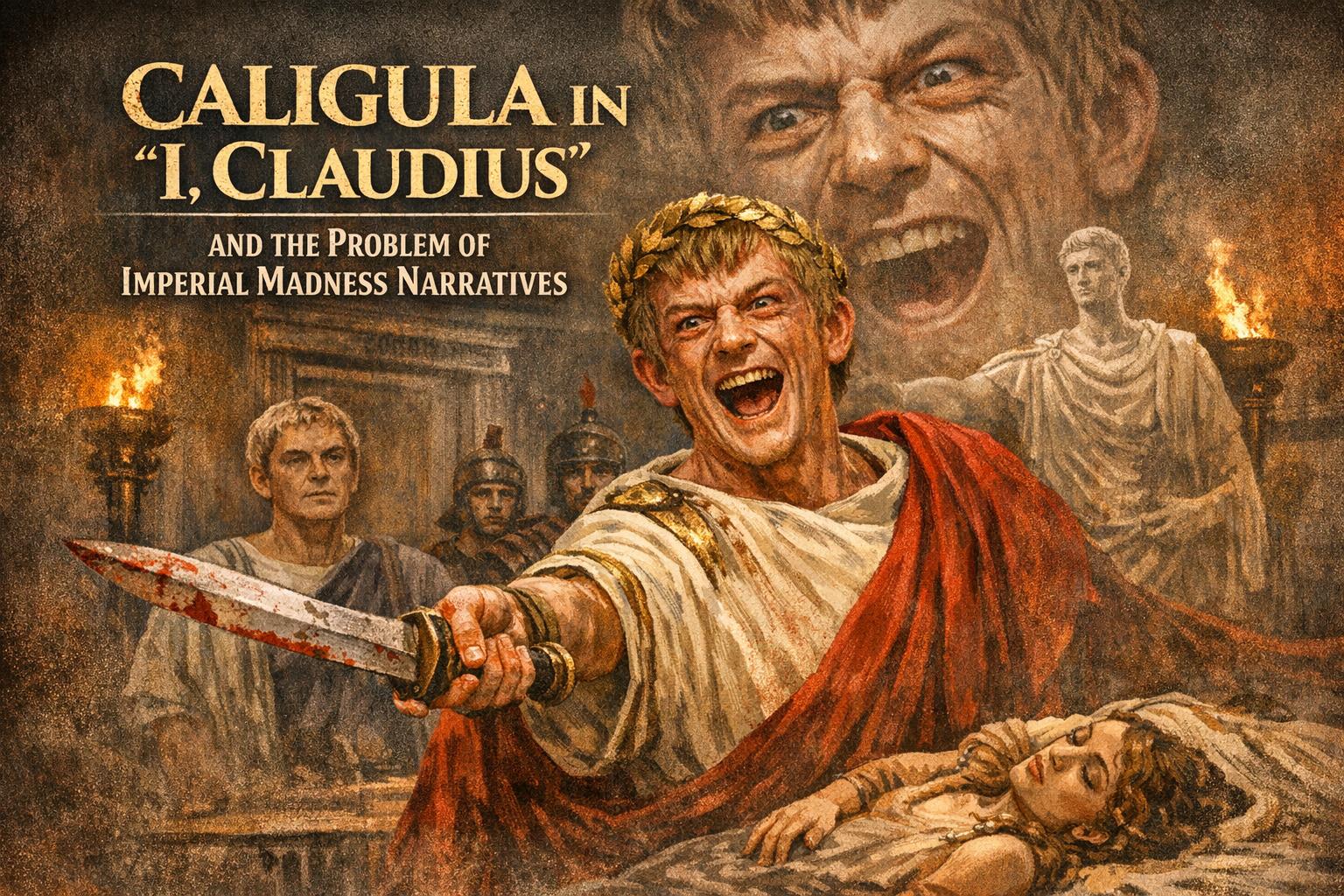
As the series progresses and Caligula assumes imperial power, his behavior shifts in manner and intensity. The portrayal emphasizes theatricality, inconsistency, and transgression of elite norms. Public spectacles, unconventional decrees, and episodes of cruelty are interwoven with moments of calculated political theater. The emperor’s actions often blur the line between deliberate provocation and loss of restraint. I, Claudius presents this ambiguity as central to understanding his rule.
The dramatic structure of the series positions Claudius as both participant and observer. Through Claudius’ perspective, Caligula’s conduct becomes a study in instability that destabilizes the imperial household and the wider state. The court responds with fear, compliance, and eventual conspiracy. Thus, Caligula’s reign is not presented in isolation but as a force that reshapes institutional behavior around him.
Historical Perspective
The series draws heavily on classical sources such as Suetonius, Cassius Dio, and Tacitus. These writers, operating under later regimes and often reflecting senatorial interests, depict Caligula as extravagant, arrogant, and erratic. Stories of appointing a horse to high office, engaging in elaborate building projects without financial restraint, and humiliating members of the elite have become central to the emperor’s reputation. However, modern historians frequently approach these accounts with caution.
Ancient historiography was shaped by political allegiance and rhetorical convention. Emperors who alienated the Senate were often described in moralizing and exaggerated terms. The literary style favored stark contrasts between virtuous and tyrannical rulers, reinforcing a narrative structure in which decline and corruption followed initial promise. Caligula’s transition from promising young princeps to destructive autocrat fits neatly into this pattern, raising questions about the interplay between fact and literary motif.
The television adaptation acknowledges these tensions indirectly by dramatizing the possibility that Caligula’s “madness” may have multiple causes. Some historians have speculated about physical illness, including encephalitis or epilepsy, following a severe sickness early in his reign. Others propose psychological stress resulting from childhood trauma and prolonged exposure to political violence. The series does not overtly endorse any single medical explanation, but it incorporates the motif of illness as a turning point, reflecting recurring themes in the historical record.
At the same time, the series amplifies the sensational aspects contained in classical texts. Caligula’s self-deification, demand for worship, and performative excess are central elements of his characterization. In doing so, the adaptation participates in the long tradition of portraying him as the embodiment of imperial excess. Yet the existence of this tradition itself invites scrutiny, as it may reveal as much about Roman political anxieties as about Caligula’s psychological state.
Portrayal of Madness
The depiction of madness in I, Claudius operates on several levels. On the surface, it is expressed through abrupt mood shifts, grandiose claims, and a disregard for convention. Caligula’s interactions with senators and courtiers often invert established hierarchies. He mocks formal procedures, delivers unpredictable judgments, and cultivates an atmosphere of uncertainty. Such conduct reinforces the perception that rational governance has given way to arbitrariness.
However, the narrative occasionally suggests calculation beneath the apparent disorder. Some of Caligula’s seemingly irrational acts function as deliberate tests of loyalty or as expressions of dominance. By destabilizing social expectations, he asserts control over interpretation itself. If no one can predict whether an action is serious or ironic, obedience becomes the safest response. In this way, theatrical madness can operate as a political instrument.
The ambiguity between genuine psychological instability and strategic unpredictability is central to the series’ interpretation. This dual possibility complicates the label of madness. Rather than presenting a straightforward descent into incoherence, the drama explores how extreme power conditions both perception and behavior. Actions that would otherwise provoke sanction are reframed as expressions of sovereign will. The emperor’s position allows him to redefine limits, at least temporarily.
The series also depicts how those around Caligula interpret and react to his behavior. Fear, opportunism, and moral compromise become widespread. Advisors and relatives adapt to his volatility by suppressing dissent or participating in questionable acts. Madness, in this framework, becomes relational; it spreads through institutions as they reorganize themselves around instability. The imperial court becomes a site where personal pathology and structural weakness intersect.
The Narrative of Imperial Madness
The broader concept of imperial madness extends beyond a single individual. In Roman political thought, the concentration of power in one person was always accompanied by tension. The principate attempted to preserve republican forms while consolidating authority in the emperor. As a result, accusations of tyranny or insanity carried significant political weight. To describe an emperor as mad was to suggest that the system enabling his dominance lacked adequate safeguards.
In I, Claudius, the narrative of madness highlights this systemic vulnerability. Caligula’s actions are not checked effectively by legal or institutional barriers. Senators fear reprisal, the Praetorian Guard calculates advantage, and the populace is largely removed from meaningful participation in governance. The absence of counterbalancing forces creates conditions in which personal instability can have large-scale consequences.
The theme of divine pretension further reinforces this narrative. Caligula’s self-identification with gods or his demand for worship illustrate the tension between Roman religious tradition and autocratic ambition. By crossing the boundary between mortal ruler and divine figure, he symbolically dismantles constraints that might otherwise limit his authority. The series uses these moments to underline how ideological shifts can accompany political excess.
At the same time, imperial madness functions as a literary device. Classical authors often structured imperial biographies around moral rise and fall. The figure of the mad emperor served as a cautionary example, warning audiences about the degradation of virtue in the presence of unchecked power. The television series inherits this tradition while reframing it for a modern audience familiar with psychological terminology and skeptical of absolute authority.
Performance and Characterization
The effectiveness of Caligula’s portrayal in I, Claudius owes much to performance choices and production context. The actor’s interpretation emphasizes physical expressiveness, vocal modulation, and abrupt tonal shifts. These elements visually and audibly convey instability, reinforcing the script’s thematic emphasis. At the same time, quieter scenes reveal calculation and awareness, preventing the character from collapsing into caricature.
The series’ stage-influenced production style, with its emphasis on dialogue and confined settings, concentrates attention on interpersonal dynamics. Caligula’s presence alters the atmosphere of each scene. Conversations become charged with uncertainty, and formal gatherings transform into arenas of risk. This theatrical framing enhances the impression that madness is performative as well as psychological.
Furthermore, the narrative structure juxtaposes Caligula’s reign with those of Augustus, Tiberius, and Claudius. This comparative framework situates his rule within a continuum of imperial conduct. The audience is invited to consider how different personalities navigate similar institutional arrangements. In this context, Caligula’s extremity underscores the fragility of norms that rely heavily on personal restraint rather than codified enforcement.
Madness and Political Legitimacy
One of the series’ underlying concerns is the relationship between mental stability and political legitimacy. Roman emperors derived authority from a combination of military support, senatorial endorsement, and public acceptance. When behavior appeared irrational or destructive, it threatened this delicate balance. Allegations of madness thus became tools for both critique and justification of regime change.
In the narrative arc of I, Claudius, Caligula’s increasingly erratic decisions alienate key constituencies. Financial strain from extravagant projects, humiliation of elites, and perceived sacrilege weaken his standing. Conspiracy becomes conceivable when stability seems unattainable. The eventual assassination is portrayed less as spontaneous outrage and more as calculated preservation of order by those who perceive a breakdown in governance.
The portrayal encourages reflection on how societies define acceptable leadership behavior. Without modern psychiatric frameworks, Romans relied on moral and philosophical categories to interpret conduct. Traits such as superbia (arrogance) or crudelitas (cruelty) carried ethical weight. By presenting Caligula as embodying these excesses, ancient authors and the series alike frame his removal as restoration rather than subversion of political norms.
Modern Interpretations and Continuing Relevance
Modern audiences encounter Caligula through multiple layers of interpretation: ancient texts, Graves’ novels, and the television adaptation. Each layer reshapes the previous one. Contemporary scholarship often emphasizes the need to disentangle propaganda from verifiable fact. Archaeological evidence, administrative records, and reexamination of literary tropes complicate the image of a ruler governed solely by irrational impulses.
Nevertheless, the enduring interest in Caligula’s alleged madness reflects broader intellectual concerns. Autocratic leadership continues to prompt debate about the psychological dimensions of power. The series resonates not because it offers a clinical portrait, but because it dramatizes structural risks inherent in concentrated authority. When checks on executive action are minimal, personal disposition can influence public life to an exceptional degree.
The adaptation also contributes to discussions about historical storytelling. By blending documented episodes with dramatized dialogue and inferred motivation, it illustrates the challenges of representing antiquity. Viewers are reminded that every portrayal is selective, shaped by narrative goals and contemporary assumptions. Caligula’s madness, whether literal or symbolic, becomes a lens through which to examine not only Roman history but also the practice of historical reconstruction.
Conclusion
The portrayal of Caligula in I, Claudius provides a sustained examination of imperial authority, personal instability, and historiographical tradition. Drawing from ancient sources while incorporating dramatic invention, the series presents a ruler whose behavior oscillates between calculated provocation and apparent derangement. This ambiguity mirrors scholarly debates about the reliability of classical accounts and the extent to which accusations of madness reflect political bias.
By situating Caligula within the broader narrative of the Julio-Claudian dynasty, the adaptation underscores the structural vulnerabilities of early imperial governance. His reign illustrates how concentrated power can magnify individual traits and destabilize institutions. The concept of imperial madness functions simultaneously as character study, political critique, and literary inheritance.
Ultimately, the series does not resolve the question of Caligula’s mental state. Instead, it emphasizes the consequences of leadership unrestrained by effective accountability. Through its layered portrayal, I, Claudius invites consideration of how history is shaped by perspective, how power interacts with personality, and how narratives of madness continue to inform interpretations of authority across time.