
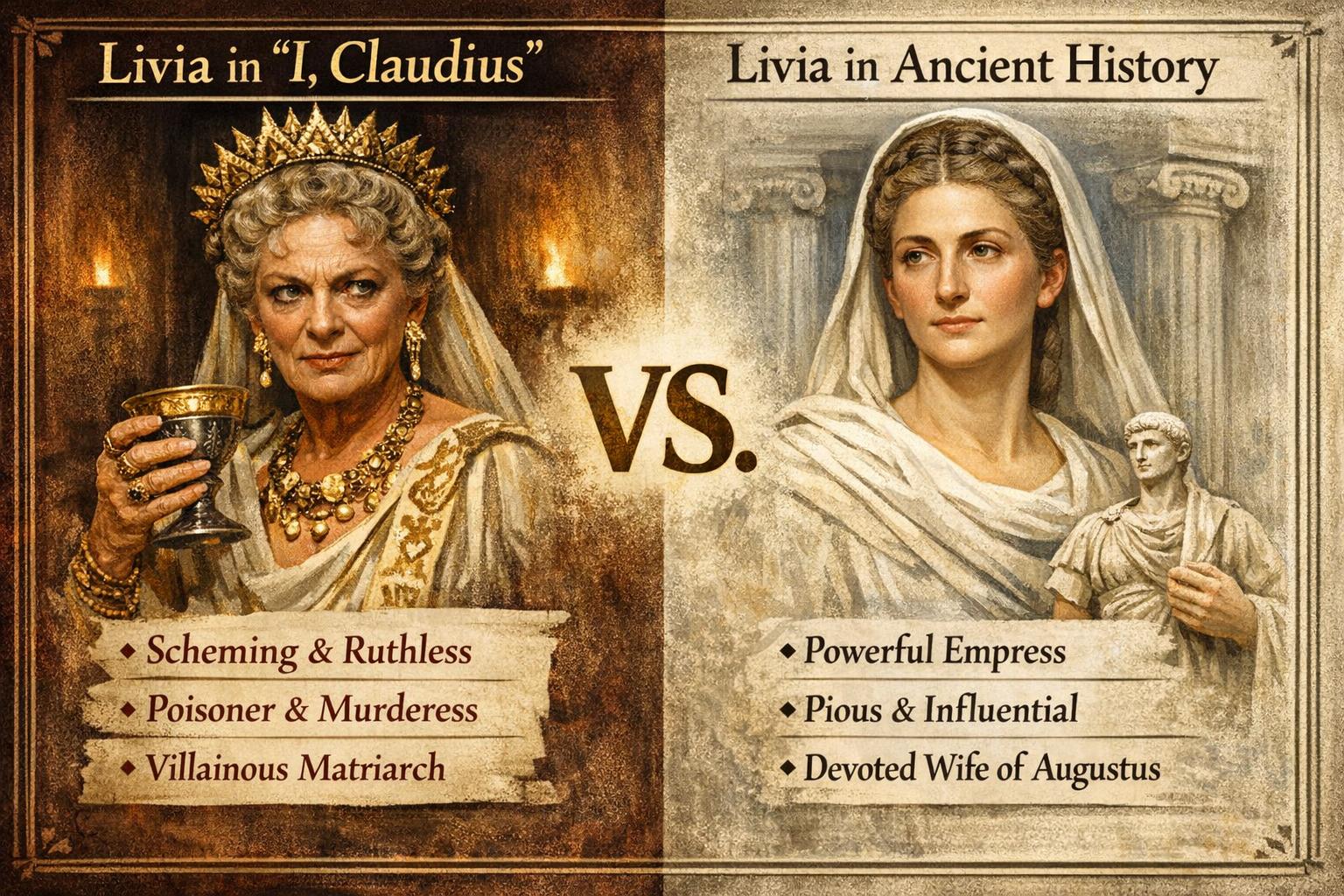
Livia Drusilla in “I, Claudius”
In the television adaptation of Robert Graves’ novels I, Claudius and Claudius the God, Livia Drusilla emerges as one of the central forces shaping the narrative of the early Roman Empire. The series presents her as a calculating and disciplined political strategist whose influence extends across decades. Rather than ruling openly, she operates within the domestic sphere and the imperial household, using her proximity to power as the wife of Augustus to guide succession and policy according to her long-term objectives. The portrayal places her at the center of the transformation of Rome from Republic to Empire, suggesting that her guidance, interventions, and conspiracies underpin the stability and continuity of the new regime.
The character is written as a figure of exceptional patience. She rarely seeks immediate rewards; instead, she invests in extended strategies that unfold gradually. Within the dramatic framework of the series, she carefully removes perceived threats to her son Tiberius and to the supremacy of her bloodline. Rivals fall through exile, disgrace, or suspicious deaths. Although direct evidence is seldom presented within the narrative, the pattern of advantage consistently favors her interests. This recurring alignment encourages viewers to interpret adverse events as the outcome of deliberate orchestration rather than coincidence.
The series consistently situates Livia as a participant in the political realm despite formal exclusion from public office. Roman law and custom denied women the authority to hold magistracies or command armies, yet the drama suggests that power can be exercised through influence, persuasion, and covert action. Livia’s domestic authority becomes a parallel structure to the official apparatus of the state. Decisions appear to flow through the emperor, but the dialogue repeatedly implies that his judgment has been shaped beforehand in private consultation.
In moral terms, the depiction is not presented as impulsive or chaotic. Livia does not pursue disruption for its own sake. She values order, discipline, and continuity, aligning herself with Augustus’ broader vision of a stable imperial system. Her interventions are rationalized as necessary corrections to prevent instability or moral weakness within the ruling family. She views competitors and unsuitable heirs not simply as personal obstacles but as risks to Rome’s fragile political order. This framing gives her actions a degree of internal logic, even when the consequences appear severe.
Influence and Relationships
Livia’s influence derives primarily from her network of relationships. Her marriage to Augustus provides the legal and social foundation for her authority. The series portrays Augustus as a ruler who, despite immense power, can be guided in subtle ways. Livia positions herself as the voice of practicality and foresight. In moments of uncertainty, he turns to her judgment. The dynamic between them is not depicted as overt domination; rather, it is characterized by quiet correction and suggestion. Through this method, she reinforces her role as indispensable counselor.
Her relationship with her son Tiberius is central to her ambitions. The drama shows her shaping his path with relentless determination, sometimes against his own inclinations. Tiberius is characterized as reserved and reluctant, yet Livia pushes him toward the imperial succession. She removes alternative heirs who threaten his position and strategically arranges marriages to consolidate alliances. While the emotional bond between mother and son is acknowledged, it is consistently subordinated to political calculation. Tiberius becomes both beneficiary and instrument of her long-term strategy.
Her interactions with her grandchildren and extended relatives further illustrate her approach to dynastic security. Members of the Julio-Claudian household are treated as pieces within a larger configuration. Marriages are negotiated for advantage. Public reputation is managed to sustain moral authority. When individuals behave in ways that threaten the family’s standing, the series suggests that corrective measures follow. These depictions reinforce the theme that succession in the early Empire is not simply biological inheritance but the outcome of continuous management.
The character’s exchanges with Claudius add another dimension to her portrayal. Claudius, underestimated and marginalized because of physical disabilities and perceived simplicity, survives in part by appearing harmless. In the dramatic narrative, Livia regards him as insignificant and therefore unthreatening. This miscalculation ultimately underscores the limits of her foresight. Although she attempts comprehensive control, the complexity of political life ensures that not every outcome aligns perfectly with her expectations. The portrayal thus avoids presenting her as omnipotent, instead depicting her as formidable yet constrained by circumstance and incomplete information.
Methods and Political Strategy
The series suggests that Livia’s power rests on information and timing. She is frequently shown receiving reports, evaluating character, and interpreting small signs of disloyalty or ambition. Knowledge becomes a currency through which she anticipates developments before they reach public awareness. By acting at decisive moments, she minimizes resistance and preserves plausible deniability.
Poison, rumor, and moral accusation appear as recurring instruments within the drama. Whether or not these acts occur directly at her instruction, the narrative structure often implies her involvement without requiring explicit confirmation. This ambiguity maintains tension and reflects the broader uncertainty of ancient historical sources. Her strategies are not flamboyant; they are quiet adjustments designed to produce cumulative results.
Another key aspect of her method is moral presentation. She cultivates the image of a traditional Roman matron, devoted to domestic virtue and family discipline. Public modesty contrasts with private calculation. The preservation of this image protects her from suspicion and legitimizes her authority in a society that valued female restraint. By embodying conventional ideals, she shields unconventional actions. The series emphasizes that reputation in Rome functions as a political resource as tangible as military power.
Livia in Ancient History
Outside the framework of fiction, Livia Drusilla occupies a prominent position in the historical record of the early Roman Empire. Born in 58 BC into the distinguished Claudian family, she experienced the turbulence of the late Republic firsthand. Her early life was shaped by civil conflict and shifting alliances. She married Tiberius Claudius Nero, with whom she had two sons, Tiberius and Drusus. After political realignment and divorce, she married Octavian, the future Augustus, in 38 BC. This union linked two influential lineages and formed a central partnership in the consolidation of imperial authority.
Ancient sources, including Tacitus, Suetonius, and Cassius Dio, acknowledge her prominence while differing in tone and interpretation. Some portray her as dignified and supportive, while others imply ambition and subtle interference. These accounts were written decades after her death and reflect the authors’ own political contexts. As a result, modern scholars approach them with caution, distinguishing between factual detail and rhetorical embellishment.
As Augustus’ wife, Livia received honors uncommon for Roman women. She was granted public recognition, statues, and the right to manage her own financial affairs independently. Augustus’ reforms promoting moral legislation and family values positioned elite women as exemplars of discipline and fertility. Livia’s conduct aligned with this image, reinforcing the regime’s ideological program. Her public persona supported the narrative of renewed Roman virtue following decades of civil war.
Historical Achievements and Status
Livia’s influence extended into several domains of Roman public life. In religion, she participated in ceremonial roles that underscored the sanctity of the imperial household. She was associated with traditional cults and later with the imperial cult that developed around Augustus. After Augustus’ death in AD 14, she was adopted into the Julian family and received the title Augusta, signifying her elevated and quasi-sacred status.
Architectural patronage formed another dimension of her public contribution. She was connected with building projects and restorations, including properties associated with the imperial residence on the Palatine Hill. Such initiatives reinforced the visibility of the dynasty within the urban landscape of Rome. Patronage was not merely aesthetic; it conveyed continuity, prosperity, and benefaction.
Her advisory role remains more difficult to quantify. Ancient historians refer to her counsel, noting that Augustus valued her judgment. However, specific decisions directly attributable to her are rarely documented in detail. The lack of administrative records from this period limits certainty. While later writers speculate about her influence on succession, contemporary evidence does not confirm the extent of her direct intervention. The contrast between sparse documentation and vivid anecdote has encouraged the development of dramatic interpretations.
The question of whether Livia engaged in systematic elimination of rivals remains unresolved. Tacitus reports rumors that she arranged or facilitated certain deaths, but he stops short of definitive accusation. Modern historians generally regard these claims as part of a broader pattern in which powerful women were associated with intrigue in literary tradition. Without forensic evidence or contemporaneous confirmation, such narratives remain speculative.
Transition to the Reign of Tiberius
Upon Augustus’ death, Tiberius succeeded as emperor. Livia’s position during this transition illustrates both her authority and its limits. As mother of the reigning emperor and bearer of the title Augusta, she retained considerable prestige. Inscriptions and coinage reflect her continued public recognition. However, ancient accounts suggest tension between mother and son. Tiberius may have considered her influence excessive or politically inconvenient.
The Senate at one point proposed additional honors for Livia, and debates over her formal role indicate the novelty of her status. No clear constitutional framework existed for the mother of an emperor. Her presence challenged traditional boundaries while reinforcing dynastic continuity. Tiberius reportedly resisted certain proposals, perhaps seeking to assert independent authority. This uneasy balance demonstrates that even significant informal power required careful negotiation within Rome’s political culture.
After her death in AD 29, Livia was eventually deified under the reign of Claudius. This posthumous honor affirmed her lasting importance within the dynasty. Deification also served political purposes, strengthening the legitimacy of later rulers by associating them with sanctified ancestors.
Legacy
Livia’s legacy combines verifiable historical prominence with layers of interpretation developed across centuries. She stands as the first Roman empress in practical terms, establishing precedents for imperial women who followed. Her life illustrates how elite women could shape political outcomes without holding formal office. Through marriage alliances, patronage, and symbolic representation, she contributed to the consolidation of a new political order.
The dramatized depiction in I, Claudius amplifies elements that are only partially visible in surviving sources. By presenting her as architect of succession and master of intrigue, the series transforms ambiguity into narrative certainty. This approach reflects broader themes in Roman historiography, where moral lessons and character studies often overshadow precise documentation. The popularity of the dramatization has significantly influenced modern perceptions, sometimes eclipsing the more measured assessments of academic scholarship.
Contemporary historians emphasize the structural constraints within which Livia operated. Roman society placed limits on female authority, yet elite women exercised agency through kinship networks and property rights. Livia’s success derived in part from her alignment with Augustus’ program and from her management of reputation. Her enduring image as either devoted matron or strategic manipulator illustrates the intersection between gender expectations and political commentary in both ancient and modern narratives.
The comparison between fiction and history does not reduce her significance; rather, it underscores the complexity of reconstructing individual agency in antiquity. The scarcity of unequivocal evidence invites interpretation. Dramatic portrayals supply coherence and motive where the historical record remains fragmentary. Through this interplay, Livia Drusilla remains a subject of ongoing examination, situated between documented authority and imaginative reconstruction.
Her position at the origin of the Julio-Claudian dynasty ensures her presence in discussions of imperial governance, succession, and gender roles. Whether viewed through the lens of television drama or critical scholarship, she represents a formative figure in the early Empire. The persistence of debate regarding her character and influence reflects the broader challenges of interpreting Roman political culture.